Introduction: Why Sintering Matters
In our daily life, advanced ceramics play a more and more important role. We see them in small electronic parts and in large industrial equipment. But ceramics are not hard by nature. A loose powder must become a dense ceramic block or sheet. The key step is "sintering."
The Core Conflict: Density vs. Grain Size
Simply put, sintering is a process. Ceramic particles join together, grain boundaries form, and pores are slowly removed. In this process, the industry always faces a core conflict. A higher temperature gives a stronger driving force, so the ceramic densifies more easily. But too high a temperature or too long a holding time makes grains grow too much. This harms the mechanical properties. To find a good balance between "higher density" and "smaller grain size," many sintering technologies have been developed. They keep pushing the performance limits of ceramics.
These technologies can be grouped into four routes, based on the manufacturing process and the part shape.
2.1 Route 1: Conventional Sintering for Basic Forming and Mass Production
The first route is the conventional route for basic forming and mass production. Pressureless sintering and reaction sintering are the representatives. Pressureless sintering relies on liquid surface tension at normal pressure to drive densification. The process is simple and the cost is low. It is very suitable for mass production of ceramic tubes or blocks with common shapes. Reaction sintering uses the heat from a chemical reaction to achieve densification. Its advantage is that there is almost no size shrinkage after sintering. It is very suitable for special-shaped products that need high dimensional accuracy.
2.2 Route 2: Complex Shapes and Near-Net Shaping
The second route focuses on complex shapes and near-net shaping. With the development of high-end manufacturing, many applications need custom parts with complex structures. High-energy laser sintering uses a high-energy laser beam to melt powder along a preset path. It can quickly print special-shaped structural parts. This greatly reduces later machining. Cold sintering takes a different path. It uses a transient liquid-phase solvent and pressure. At a very low temperature, it achieves densification through dissolution and precipitation of particles. This makes low-energy production of small custom parts possible.
2.3 Route 3: High-Performance and High-Densification Routes That Challenge Limits
The third route is the high-performance and high-densification route that challenges limits. In harsh fields such as aerospace, locating pins and precision parts need very high density and strength. These technologies usually use external pressure to drive densification. For example, hot isostatic pressing uses high-temperature and high-pressure gas. It makes the material isotropic and its density close to the theoretical value. Hot pressing uses mechanical pressure to help powder sinter at high temperature. The products have high density and excellent strength. These processes need expensive equipment. But they give ceramics top-level overall performance.
2.4 Route 4: Fast Heating and Special Energy Fields
The fourth route is the special route that pursues very fast heating and special energy fields. For some materials, traditional heating is not efficient enough. Microwave sintering uses the material itself to absorb microwave energy and turn it into internal energy. This gives uniform and fast heating. It saves energy and reduces temperature gradients. In addition, spark plasma sintering, flash sintering, and self-propagating high-temperature synthesis use internal electric discharge or the huge heat from chemical reactions. They can complete sintering in a very short time. They greatly suppress grain growth. This provides a shortcut to keep special microstructures.
How to Choose the Right Sintering Route
So how should one choose among so many sintering routes? The answer depends on the specific material and the part shape.
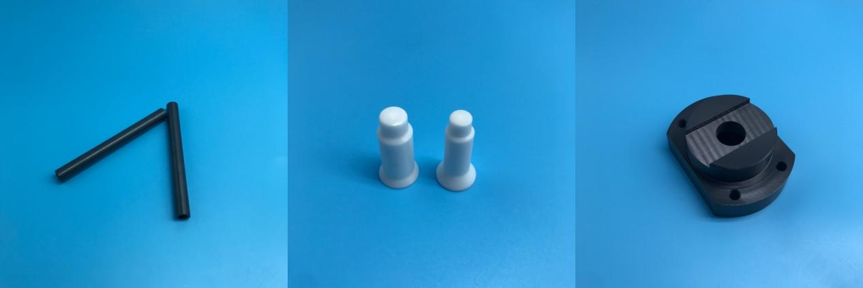
For example, alumina and zirconia ceramics are widely used. They are usually made as conventional parts in large batches. Aluminum nitride and silicon nitride ceramics have excellent thermal conductivity or high strength. They are often used as high-end electronic or structural parts. They need very high density. Silicon carbide and boron carbide ceramics often need very high temperature or special gas pressure to become fully dense. Boron nitride ceramic has a special layered structure. It is very hard to sinter. It often needs special field-assisted technology. The final product form also matters directly. Is it a thin ceramic sheet, a cylindrical ceramic rod, or a complex custom part? This decides whether to use pressureless mass production, laser printing, or hot isostatic pressing.
Conclusion: Rational Trade-Offs for Unlocking Ceramic Potential
In short, sintering technology is evolving to save time, reduce energy use, and improve material performance. No single technology is universally applicable. By considering the specific application scenario, comprehensively evaluating the material properties and the shape of the parts, and making rational choices based on multi-objective optimization, is the key to unlocking the unlimited potential of advanced ceramics.


 EN