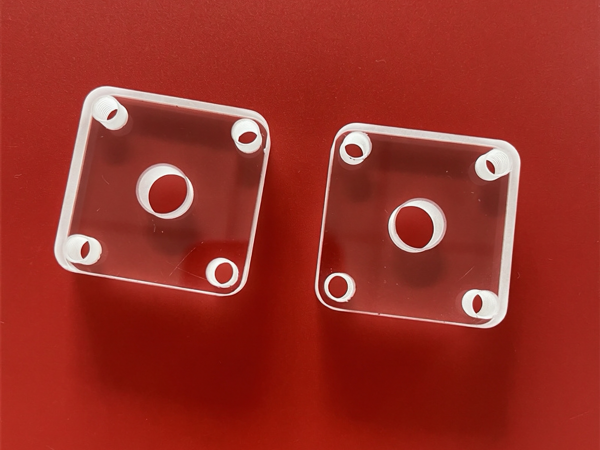
Have you ever encountered such a situation: a seemingly flawless piece of quartz glass, which has neither been dropped nor subjected to obvious external forces, suddenly cracked by itself? The underlying cause of this phenomenon is an invisible and intangible force - internal stress.
What is the "internal stress" of quartz glass?
Internal stress refers to the elastic strain energy generated when the atoms or molecules inside quartz glass are in an unbalanced state. To understand this, one needs to first understand the nature of quartz glass. It is composed of silicon dioxide (SiO₂), but unlike the regularly arranged quartz crystals in nature, its atomic network is in an unordered state - after the silicon atoms and oxygen atoms form tetrahedrons, the way they connect to each other lacks long-range periodicity. This disordered structure brings about high transparency, low thermal expansion coefficient and extremely strong chemical stability, but also makes stress more likely to be hidden within. When the microscopic particles inside pull and push each other, a kind of balanced yet tense internal force is formed. This force is usually invisible, but when released under specific conditions, it can cause the glass to shatter instantly. These stresses cause minute and uneven deformations within the material, which in turn affect the strength, optical uniformity and thermal stability of the entire piece of glass.
Where does stress come from? Five main sources
1.Thermal stress
This is the most common type. When quartz glass is heated or cooled, if there is a temperature difference between the surface and the interior, the rates of expansion or contraction will be different. For example, after rapid cooling after high-temperature processing - the surface hardens and contracts quickly, while the interior remains in a high-temperature expansion state - thus internal compressive stress is formed, and the surface forms tensile stress. This phenomenon varies in different forms of products: a thin quartz glass sheet, due to its small thickness and large area, is particularly sensitive to thermal stress, and a slight temperature difference can lead to optical distortion; while a thicker quartz glass rod is prone to residual thermal stress in the radial direction, and the stress difference between the center and the surface layer needs to be fully annealed to be eliminated; as for quartz glass tubes, the temperature difference stress between the inner and outer surfaces of the tube wall is significant, and uneven axial stress along the tube length direction is likely to cause bending or longitudinal cracking.
2.Mechanical stress
Processing stress: During mechanical processing such as cutting, grinding, and polishing, the pressure exerted by the tools causes the crystal lattice of the glass surface to undergo slight distortion, resulting in local plastic deformation. For instance, if the cooling is uneven when processing quartz glass sheets, micro-cracks are prone to occur at the edges.
Assembly stress: For instance, when using screws for fixation, if the clamping force is too strong, or if there are sharp corners, thick-thin variations or other such features in the design, the stress is likely to concentrate and become a weak point.
3.Phase Transformation Stress
When quartz glass is exposed to a high-temperature environment above 1100℃ for a long time, some areas may crystallize. Due to the different thermal expansion coefficients between the crystals and the glass, repeated heating and cooling will gradually accumulate this difference into stress, which may even lead to surface peeling or cracks. White quartz glass (including white quartz rods and white quartz plates) appears white due to the presence of a large number of tiny bubbles or silica grain boundaries that scatter light. It has good infrared reflection properties on its own, but the presence of bubbles also makes it a sensitive material for stress concentration. Therefore, more gentle processing methods should be adopted during its processing. In contrast, opaque quartz glass has a higher porosity and is mostly used as the lining or insulation components in high-temperature furnaces, but residual thermal stress is prone to accumulate at the edges of the pores, causing local peeling.
4.Chemical Stress
When the surface is corroded by acids and bases or undergoes ion exchange, the volume changes are not uniform, thereby generating stress at the surface. For instance, if the white oxides remaining on the surface of the quartz glass tube after heat processing are not thoroughly removed, the residual chemicals may cause hidden chemical stress, leading to cracking in the future.
5.Internal Defects and Impurities
During the melting process, residual bubbles, metal ions or microcracks may exist. Due to their different physical properties such as thermal expansion coefficient and elastic modulus from the surrounding glass, they can also serve as the starting point for stress concentration, accelerating the crack propagation.
How to eliminate or control internal stress?
The core method for dealing with internal stress in industry is annealing: heat the quartz glass to a certain temperature (usually above 1000℃), then cool it down slowly to allow the atoms sufficient time to rearrange into a low-stress state. The annealing furnace is almost a necessary equipment for every quartz glass manufacturing enterprise. For different forms of products, the annealing process needs to be adjusted specifically: the thicker the diameter of the quartz glass rod, the longer the annealing time required; for quartz glass sheets, an especially uniform temperature field is needed to prevent warping.
Furthermore, proper design can also reduce stress: avoid rapid cooling and heating, maintain uniform cooling during processing, leave expansion gaps during assembly, and carefully inspect the surface for any corrosion or scratches before use.
Conclusion
The spontaneous cracking of quartz glass has a clear scientific explanation - the release of internal stress under specific conditions. From the flatness of quartz glass sheets to the heat shock resistance of white quartz rods, from the verticality of quartz glass tubes to the anti-peeling ability of opaque quartz plates, understanding stress is the first step in understanding the stability of materials.


 EN
EN