 EN


What Are Typical Application Cases of Piezoelectric Transducer?
A piezoelectric transducer turns a mechanical event into an electrical signal, or turns an electrical drive into controlled mechanical motion. That two-way behavior explains why the same broad device family appears in measurement instruments, ultrasonic equipment, alarms, positioning assemblies, and process-monitoring systems. The useful question is not simply where a piezoelectric transducer can be used, but which operating mode, frequency range, geometry, and mounting condition suit a particular job.
For an application engineer, the starting point is to define the energy path. A piezoelectric transducer used as a sensor receives force, pressure, vibration, or acceleration and produces charge. A piezoelectric transducer used as an actuator or ultrasonic source receives an electrical signal and moves or launches a wave. The material may be similar, yet the surrounding mechanics and electronics are often very different.
Why one device family serves so many applications
At the core of a piezoelectric transducer is a material that responds to mechanical stress with electrical charge. Conversely, an alternating electrical field can make the material deform repeatedly. In a sensing application, this makes a piezoelectric transducer especially useful for changing, rather than steady, loads. In a driven application, the deformation can be coupled into a horn, plate, fluid, structure, or acoustic path.
Piezoelectric ceramics are common active materials because they can be formed into discs, rings, plates, tubes, and custom geometries. Still, a material label alone does not decide suitability. Frequency, impedance, electrode arrangement, preload, bonding layer, and the medium in contact with the part all influence the finished assembly. More accurately, the operating conditions should be confirmed before comparing ceramic options.
1. Dynamic force, impact, and vibration monitoring
One of the most familiar uses of a piezoelectric transducer is dynamic measurement. The device can detect short events such as impacts, machine vibration, rapid pressure changes, structural strain variation, and acceleration. These signals are valuable in equipment diagnostics, impact testing, vibration studies, and production-line monitoring because the event itself carries information about motion or changing load.
A piezoelectric transducer is not normally selected by sensitivity alone. The mounting surface, cable routing, charge-amplifier or voltage-input arrangement, expected frequency content, and calibration method deserve equal attention. A rigid mounting scheme may preserve high-frequency response better than a compliant one, while poor strain relief can introduce unwanted signal changes. If a measurement must be compared across instruments or over time, calibration and the complete signal chain need to be defined together.
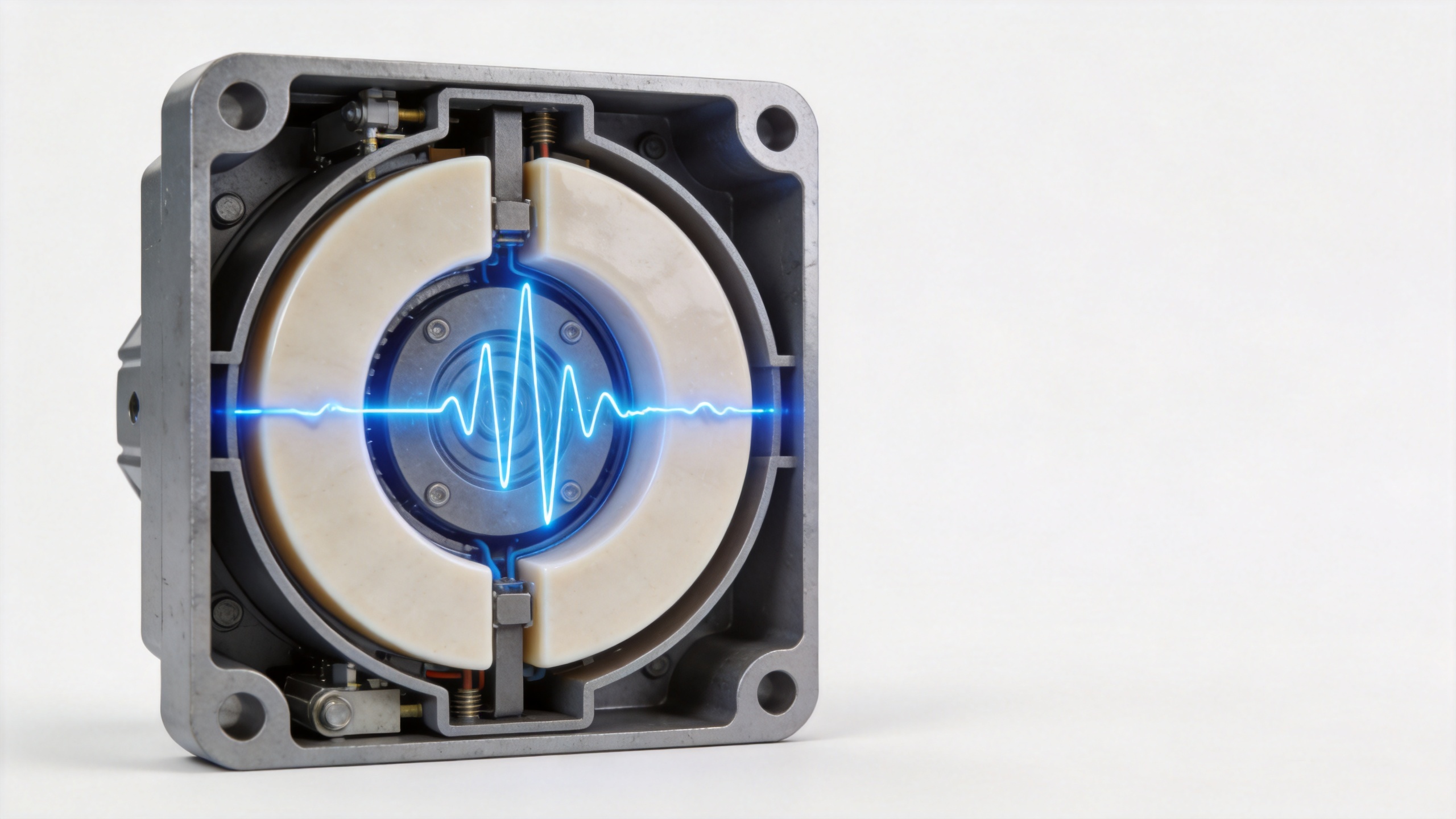
2. Ultrasonic cleaning, welding, and process equipment
In a driven system, a piezoelectric transducer converts an electrical AC signal into vibration. Coupled to a sonotrode, horn, tank wall, or other mechanical structure, that vibration is used in ultrasonic cleaning, plastic welding, emulsification, atomization, cutting, and some material-processing operations. The application is defined by the entire acoustic stack, not by the ceramic element in isolation.
For example, an ultrasonic-cleaning assembly needs the piezoelectric transducer, mounting arrangement, vessel or radiating surface, liquid load, and generator to work together. A change in liquid level, temperature, or fixture mass can alter the operating condition. In applications where emitted ultrasonic power must be verified, IEC 61161:2013 is one example of a standard that specifies a radiation-force-balance method for determining total acoustic power in liquids. That does not make the standard universal for every industrial device, but it shows why output verification belongs in a serious test plan.
3. Medical and laboratory ultrasound systems
Medical imaging probes, therapeutic ultrasound equipment, laboratory sonication tools, and some non-destructive evaluation setups use a piezoelectric transducer to send and receive acoustic energy. A pulse can be transmitted into a medium, then returned echoes can be converted back into signals for analysis. The intended use determines whether resolution, penetration, beam shape, thermal behavior, cleaning compatibility, or electrical matching is the dominant constraint.
Here, a piezoelectric transducer should be treated as part of an engineered system with material, matching layers, backing, housing, and electronics. It would be unsafe to infer medical suitability from a general-purpose component. Requirements for validation, output measurement, biocompatibility, cleaning, and regulatory review depend on the finished device and market, so they must be confirmed case by case.
4. Sonar, ranging, and level sensing
Another typical piezoelectric transducer application is sending a sound pulse and interpreting the returning echo. This principle supports distance sensing, liquid-level measurement, obstacle detection, depth sounding, and sonar. In air, liquid, or a solid structure, performance depends heavily on the acoustic path. A transducer designed for immersion is not automatically appropriate for air ranging, because impedance matching, sealing, beam behavior, and damping requirements change with the medium.
For a custom request, it helps to state the medium, target distance, angle, expected temperature, required response time, and whether the assembly transmits, receives, or performs both functions. Those details are more actionable than a broad request for a piezoelectric transducer alone.
5. Buzzers, alarms, and audible indicators
Piezoelectric buzzers and audible indicators are compact examples of a piezoelectric transducer used as an actuator. An electrical drive makes a disc or diaphragm vibrate, creating sound. They are used in appliances, control panels, warning devices, timers, and compact electronic products. The decision points include operating voltage, target sound frequency, mounting cavity, environmental exposure, and the required acoustic level at the installation point.
A ceramic substrate or enclosure can influence how vibration is supported and transmitted, but it should not be confused with the active piezo element. The same distinction matters when a device sits near a thick film circuit board: the board may provide electrical interconnection or packaging support, while the piezo assembly carries the conversion function. Keeping those roles separate makes an RFQ and a failure review much clearer.
6. Precision positioning and micro-actuation
Some piezoelectric transducer designs deliver very small, controlled motion rather than audible or ultrasonic output. These are used in optical alignment, precision valves, micro-dosing mechanisms, scanning equipment, focus adjustment, and laboratory positioning stages. Their advantage is responsive motion over a limited travel range. Their limitation is that travel, load, hysteresis, temperature effects, and driver behavior must be considered as a system.
When the target is precision movement, ask whether the piezoelectric transducer will work in open-loop or closed-loop control, what load it sees, and how it is clamped. A design that performs well without load may behave differently after it is bonded into a housing. This is why a drawing, mounting concept, and acceptance method should be discussed early.
7. Vibration energy harvesting and switch inputs
A piezoelectric transducer can also capture small amounts of energy from repeated vibration or bending, or act as a trigger when a surface is tapped or flexed. These applications include self-powered demonstration devices, low-power sensing concepts, impact switches, musical pickups, and touch-responsive interfaces. Output is highly dependent on the mechanical excitation, so an energy-harvesting claim needs a defined vibration profile rather than a generic promise.
How to match the application to the specification
Across all these cases, the most productive discussion begins with the application rather than a single material name. For a piezoelectric transducer, confirm the following:
- Is the device sensing mechanical input, producing motion, or doing both?
- What frequency range, duty cycle, and electrical drive or signal-conditioning method are required?
- What medium contacts the assembly: air, liquid, a solid structure, or a sealed housing?
- What dimensions, resonance target, mounting force, cable connection, and environmental limits apply?
- How will performance be tested: signal level, frequency response, acoustic output, displacement, or another measurable criterion?
For ceramic assemblies, the supporting electronics may include a ceramic substrate, thick film resistor networks, or a thick film circuit board, but each item should be specified according to its own electrical and mechanical role. Treating every ceramic item as interchangeable is a common source of unclear requirements.
Final takeaway
Typical applications of a piezoelectric transducer range from vibration sensing and ultrasonic processing to medical ultrasound, sonar, buzzers, precision movement, and low-power trigger systems. The common mechanism is simple; the application boundary is not. Start with the energy direction and operating medium, then translate the use case into frequency, geometry, mounting, electrical interface, and verification requirements. For a custom piezoelectric transducer discussion, a drawing or dimensional sketch, target frequency, working environment, and test expectation will make feasibility review far more useful.

