 EN


What surface finishing options are available for silicon nitride ceramic components
For an engineer specifying a silicon nitride ceramic part, surface finish is not a decoration added at the end of production. It can affect fit, contact stress, friction, sealing behavior, cleanability, and the way a component is inspected. The useful question is therefore not “how smooth can it be?” but “what surface condition does this function require?” A finish that suits a bearing contact may be impractical or unnecessary on an external, non-contact face.
Silicon nitride is a hard, brittle engineering ceramic, so finishing is normally planned with the part geometry, the sintering route, and the critical surfaces already in view. For a silicon nitride ceramic plate, a tube, or a shaped precision component, the production route should distinguish functional faces from surfaces that only need dimensional clearance or safe handling.
Start with the job of each silicon nitride ceramic surface
Before naming a finish, define where the surface sits in the assembly. Is it a sliding or rolling contact, a sealing land, an alignment face, an interior flow path, a bonded area, or an exposed non-contact surface? This first step keeps a silicon nitride ceramic specification from becoming an expensive blanket requirement.
- Contact and motion: control texture, waviness, edge condition, and form together.
- Sealing and mating: specify the relevant land, flatness or roundness requirements, and the mating material.
- Flow or contamination-sensitive passages: identify the internal length that must be finished and the allowable edge break.
- Handling and assembly: call out edges, corners, locating faces, and dimensions that influence fit.
- Appearance: define the acceptable visual state separately from a functional roughness requirement.
That level of definition is especially important for a silicon nitride tube. An outside diameter, bore, and end face may each need a different operation. Asking for one finish across the whole component can make inspection difficult without adding value.
Common finishing options for silicon nitride ceramic parts
As-fired or sintered surface
An as-fired surface is the condition left after densification, with only necessary cleanup. It may suit non-contact areas, protected internal features, or designs where a subsequent operation would add little functional benefit. A silicon nitride ceramic part in this condition still needs an agreed visual and dimensional acceptance standard; “as-fired” alone does not define texture, local marks, or edge condition.
Diamond grinding
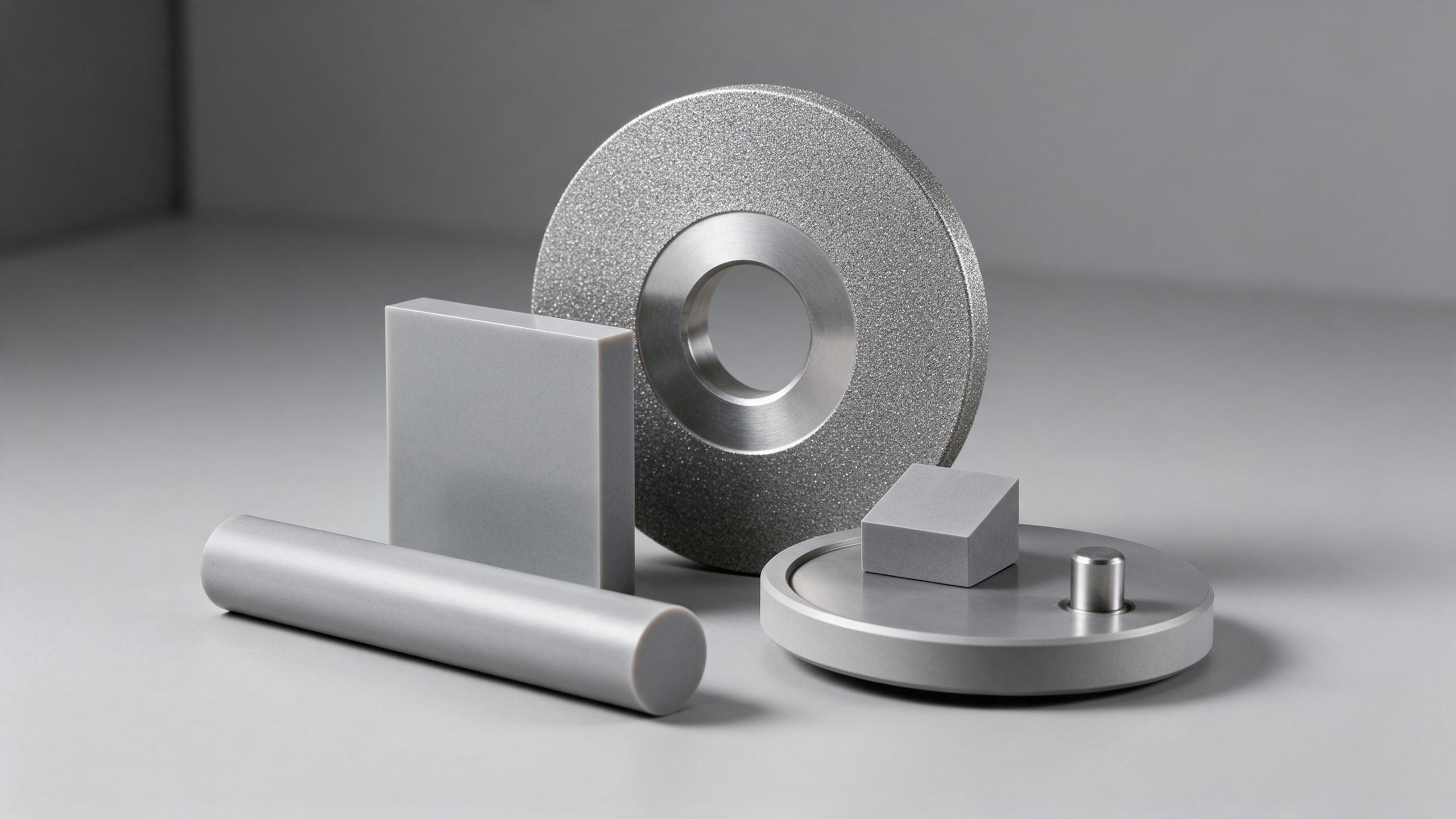
Diamond grinding is commonly used when a silicon nitride ceramic component needs controlled size, flatness, cylindrical form, or a more consistent working surface. It can be applied selectively to faces, outside diameters, bores, slots, and shoulders. The result depends on wheel selection, feed, coolant practice, geometry, and the amount of stock available after sintering. On thin sections or long features, the drawing should make clear which datum and which form characteristic matter most.
Grinding is often a sensible baseline for a silicon nitride plate used as a locating or support surface. Yet a ground finish is not automatically the correct answer for a sliding seal or a highly sensitive contact pair. Where the application is demanding, roughness, form, and micro-edge quality should be evaluated as a set rather than as isolated drawing notes.
Lapping
Lapping is used when a silicon nitride ceramic surface needs tighter flatness or a refined mating condition after grinding. It can be relevant for sealing lands, precision faces, and components that must mate consistently with another engineered surface. Lapping is usually selected for identified functional areas rather than the entire part because it adds process time and requires a clear inspection method.
For example, a silicon nitride ceramic plate may need a lapped face where it mates against another precision component while its reverse side remains ground. The drawing should distinguish the lapped zone, any permitted edge relief, and the measurement basis for flatness and surface texture.
Polishing or superfinishing
Polishing and superfinishing can reduce fine surface asperities on a silicon nitride ceramic surface intended for highly controlled contact. Potential applications include selected rolling, sliding, sealing, or optical-adjacent mechanical contact boundarys, but the requirement must reflect the actual contact mechanics and mating material. A visually bright finish is not, by itself, proof of the required texture or absence of local defects.
When polishing is considered, ask whether the requirement is average roughness, peak-related behavior, waviness, edge condition, or a combination. It is also worth confirming whether the entire contact boundary needs the same finish. Limiting the polished area can protect cost and preserve appropriate texture elsewhere.
Honing and internal-diameter finishing
For a silicon nitride tube or a component with a functional bore, honing or another internal finishing method may be evaluated after grinding. The purpose can be to improve bore texture, straightness, or the condition of a local contact path. Accessibility, wall thickness, bore length, and end geometry influence feasibility, so a nominal bore size alone is not enough information for a reliable process choice.
Edge breaking, chamfering, and radius control
Edge conditioning is one of the most important and frequently overlooked finishing operations for silicon nitride ceramic components. A small controlled chamfer or radius can make handling and assembly more predictable, reduce sensitivity to local chipping, and protect a critical mating edge. Conversely, an unspecified “deburr” instruction can be ambiguous because the permissible edge break may be very small on a sealing land or tight-fitting bore.
Specify the location, range, and functional reason for each edge condition. This is more useful than applying a generic note to every acute edge on the component.
Can blasting or texturing be used?
Blasting or controlled texturing may be considered for non-critical surfaces when a matte appearance, improved handling, or a preparation state for a later process is required. It should not be assumed suitable for a sealing face, precision diameter, or fragile edge. On a silicon nitride ceramic component, any texture-changing step should be assessed for dimensional change, local damage risk, and the resulting inspection method.
If a bonded contact boundary is involved, define the joining method and the surface condition needed by that method. A textured surface may help one process while creating a poor fit for another. The surface requirement should remain tied to the complete assembly, not a general preference for a rougher or smoother part.
How to write a finish specification that a supplier can use
A practical silicon nitride ceramic RFQ identifies the material grade, drawing revision, critical surfaces, dimensions and tolerances, surface texture where functionally needed, form controls, edge requirements, and inspection expectations. For custom work, include the mating material, load or motion description, operating medium, temperature cycle, and any cleanliness constraint. These inputs help a manufacturer decide whether grinding, lapping, polishing, internal finishing, or a mixed route is appropriate.
| Functional need | Potential finishing route | Information to confirm |
|---|---|---|
| Reference or locating face | Selective diamond grinding | Datum, flatness, parallelism, contact area |
| Precision sealing land | Grinding followed by lapping if required | Mating surface, leakage criterion, texture and form controls |
| Controlled sliding or rolling contact | Grinding, lapping, or superfinishing depending on the system | Counterface, lubricant or medium, load, speed, edge condition |
| Functional bore in a silicon nitride tube | Internal grinding or honing assessment | Bore length, wall thickness, straightness, end geometry |
| Non-contact exterior | As-fired, cleanup, or limited texture treatment | Visual acceptance, handling needs, dimensional clearance |
Inspection should match the functional requirement
Surface roughness alone cannot describe every critical silicon nitride ceramic surface. A good inspection plan can combine texture measurement with dimensional checks, flatness, roundness, concentricity, visual review, and agreed edge criteria. For a GPS silicon nitride requirement, clarify whether “GPS” refers to a dimensional and geometrical specification framework, an internal customer convention, or a component designation before it is used as a finish instruction.
It is also helpful to agree how measurements will be taken. A narrow face, a deep bore, and a small radius may require different access and sampling rules. Establishing the measurement location and acceptance basis early avoids a situation where the part is technically made but cannot be assessed against an unclear surface note.
Choose the finish only after defining the contact boundary
The available options for silicon nitride ceramic components range from as-fired surfaces and selective diamond grinding to lapping, polishing, internal finishing, controlled texturing, and purposeful edge conditioning. The suitable route depends on the component’s role in the assembly. When requesting a custom silicon nitride ceramic part, provide a drawing plus the functional details behind each critical surface. That allows the finish plan to focus effort where it affects fit, motion, sealing, or service behavior.

