In aerospace electronic equipment, the substrate is not the most conspicuous component, yet it often determines whether the entire system can operate stably. Signal transmission, device support, chip heat dissipation—many of these functions depend on it. For this reason, such materials have extremely high requirements for reliability, insulation, heat resistance, and surface quality.
high purity alumina ceramic substrates are one of the earlier and more mature types in this category. Their cost is relatively controllable, their processing route is mature, their insulation and thermal shock resistance are good, and they bond easily with metal films. Therefore, they have long been widely used in spaceborne electronic payloads.
But when they are to be used on spacecraft, things are not so simple. Once a spacecraft is in orbit, it cannot be repaired, and any small defect may be amplified. If the substrate is not pure enough, electrical performance will be affected; if mechanical strength is insufficient, it may crack or peel during assembly or testing; if the surface condition is not ideal, subsequent circuit films may not adhere firmly, and burrs or loose particles may even appear. These problems seem scattered, but in fact they all point to the same result: insufficient reliability.
For this reason, although high purity alumina substrates are widely used, doing them well is not simply a matter of sintering powder into a sheet.
Where Are the Key Manufacturing Difficulties Concentrated?
Once one truly enters the manufacturing stage, what determines whether a substrate can be used is often not a single parameter, but the coordination of a whole series of process conditions.
From slurry state to green sheet thickness, and then to subsequent binder burnout and sintering, every step affects the final substrate's performance. Whether the thickness is uniform, whether the surface is flat, and whether roughness can be controlled—these engineering indicators appear to be results, but in fact they all depend on whether these earlier steps have been kept stable.
Among these factors, the solvent system, casting tape thickness, and binder burnout and sintering parameters are especially critical. They are interrelated, and if any one of them is poorly controlled, it will leave traces on the final substrate.
1. Slurry System: Why Solvent Selection Is Critical
Whether casting can proceed smoothly is often already determined at the slurry preparation stage. And solvent is precisely one of the most difficult links to avoid.
It does not merely dissolve various additives together; it also must allow the powder particles to disperse uniformly and keep the slurry in a flow state suitable for casting. If the solvent is chosen incorrectly, it is very difficult to remedy later.
Different solvents have different adaptability to the environment, and their effects on slurry solid content, green sheet surface condition, and film-forming results also differ. Even if the dispersant, binder, and plasticizer remain unchanged, adjusting only the solvent may produce completely different casting results.
Using only one solvent often makes it difficult to simultaneously satisfy dispersion, volatilization, and film formation. If volatilization is too fast, the slurry dries before it has spread out; if volatilization is too slow, the drying stage is prolonged. In actual experiments, many problems arise here. Later, using two or more solvents in combination gradually became a more feasible choice.
2.Green Sheet Thickness: Where the Final Dimensions Begin to Be Determined
Dimensional stability is one of the indicators most prone to problems in this type of substrate, and also one of the hardest to remedy afterward.
The reason is that ceramic substrates are not finished after a single forming step. The green sheet stage only builds a "prototype"; what truly determines the dimensions is also the subsequent sintering shrinkage. If the allowance left earlier is inappropriate, deviation may appear after firing, and it is very difficult to fully correct it through subsequent processing.
Therefore, a more feasible approach in process design is to move dimensional control earlier. During green sheet preparation, predictions and compensation for subsequent shrinkage are made through slurry state and forming conditions. Then, at the sintering stage, fine adjustments are made in combination with the temperature schedule so that the final dimensions fall within the target range as much as possible.
The prerequisite for doing this is to understand the relationship between the slurry, the green sheet, and the fired result. Only by mastering this corresponding relationship can dimensional control cease to be a matter of luck and become a link that can be designed in advance.
3. Appearance and Flatness: Problems Often Lie Where They Cannot Be Seen
After the substrate is fired, surface condition is the most intuitive inspection standard. If flatness is insufficient or there are appearance defects, subsequent circuit fabrication will be difficult to carry out smoothly.
These problems appear to occur at the finished product stage, but in reality they gradually accumulate in the preceding processes. Below, we examine several links that are more prone to problems.
3.1 Where Do Surface Defects Come From?
During lamination and pressing of green sheets, surface condition can easily deteriorate. Pressure, support method, and green sheet orientation all affect the final result.
The edges of the tape are usually the areas where defects are most concentrated. Rather than repairing them later, it is better to avoid this part during lamination. By using a wider tape and then trimming off both sides after isostatic pressing, the quality of the central region is easier to ensure.
The support method is equally important. If green sheets are placed directly on ordinary carriers, they are easily affected by surface condition. Switching to carriers with higher flatness and keeping each green sheet in a consistent orientation can reduce the generation of microscopic defects. Actual results show that this approach has a fairly obvious effect.
3.2 How to Reduce Deformation During Batch Processing
Binder burnout is intended to solve the problem of organic residue, but in actual operation it must also deal with two other conflicts: furnace space is limited, and green bodies are prone to deformation during the process.
If processed piece by piece, efficiency is too low; if simply stacked, warping and cracking easily occur because of uneven heating and gas release. After repeated comparisons, the combination of lamination plus no cover plate gradually showed advantages, making use of space while reducing deformation risk.
On this basis, the number of laminated layers was also optimized. It was ultimately controlled to within 5 layers, balancing processing efficiency and finished product condition.
3.3 How to Avoid Contamination at the High Temperature Stage
At the sintering stage, temperatures are very high, and any impurity may affect the substrate surface. To avoid contamination while ensuring flatness, the choice of cover plates and backing plates cannot be arbitrary.
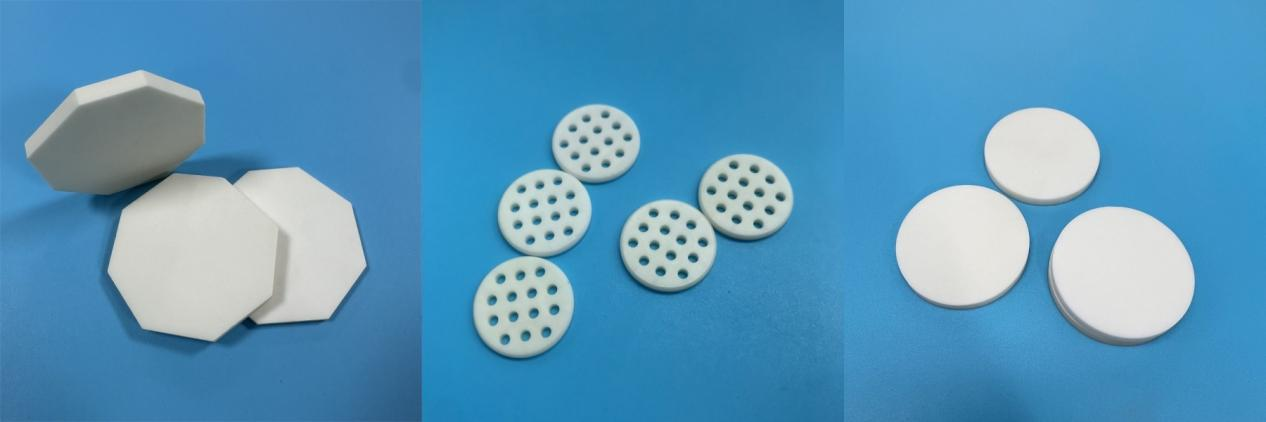
In actual practice, the cover plate uses porous high purity alumina ceramic, and the backing plate uses dense high purity alumina ceramic. Both must be ultrasonically cleaned before use. When multiple pieces are stacked, porous cover plates are used for separation, which can increase furnace utilization and also facilitate peeling after sintering, resulting in better substrate flatness.
After the sintering method is stabilized, further adjustment of the temperature schedule can yield high purity alumina substrates with stable performance and better consistency.
Conclusion
From powder to finished product, a substrate must go through multiple steps such as slurry preparation, forming, lamination, binder burnout, and sintering. Each step is not complicated when viewed individually, but what truly determines whether the finished product can be used is often whether these steps can coordinate stably with one another.
Purity, strength, surface condition, and dimensional accuracy are interrelated, and small problems in earlier steps are often amplified in later ones. So-called aerospace grade is not merely outstanding performance in one indicator, but a whole manufacturing route that is sufficiently controllable and repeatable. The difficulty has never been "whether it can be made," but "whether it can be made stably."


 EN