In high-end manufacturing, choosing a material is often not about picking the "best" one, but the "most suitable" one. Some applications require a material that is simultaneously lightweight, hard, high-temperature resistant, thermal-shock resistant, insulating, and corrosion resistant—few materials can satisfy all of these at once, and silicon nitride is one of them.
It is not a new discovery. As early as the last century, silicon nitride had already been developed, and its performance has long been considered promising. But only recently has it begun to be seriously discussed in more fields.
The reason does not lie in the material itself, but in manufacturing. The truly difficult part of silicon nitride has never been "whether it works," but "whether it can be made into the desired shape."
Silicon nitride is actually not young. As early as the last century, it had already been developed and was regarded as a high-end ceramic material with great potential. Based on its performance, it should have been able to excel in many demanding scenarios.
But in reality, its range of applications has never truly expanded. Not because it is not strong enough, but because it is too difficult to make into complex parts. The material itself is excellent, but manufacturing methods have long failed to keep up.
1. Why Traditional Manufacturing Cannot Make Complex Shapes
The conventional approach to silicon nitride is not complicated: first press the powder into a certain shape, then sinter at high temperature, and finally grind it slowly to size with diamond tools.
This process is suitable for simple parts, but once the shape becomes complex, problems arise.
The first reason complex structures are difficult to make lies in the forming step. Traditional methods mostly rely on molds, and molds are naturally better suited to parts with regular shapes and simple structures. Once a part contains crossed channels, irregular cavities, or thin-walled grids, forming becomes very difficult.
The second reason appears in the sintering stage. Silicon nitride undergoes significant shrinkage at high temperatures, and different parts of a complex component shrink inconsistently, greatly increasing the risk of deformation and cracking.
The third reason comes from subsequent processing. Silicon nitride is very hard, and after sintering it can often only be slowly ground with diamond tools. The more complex the part, the longer the processing time, and the harder it is to control costs.
When these steps are combined, complex silicon nitride parts have long faced problems of high cost, long lead times, and low yields. Many designs are eliminated during early material selection.
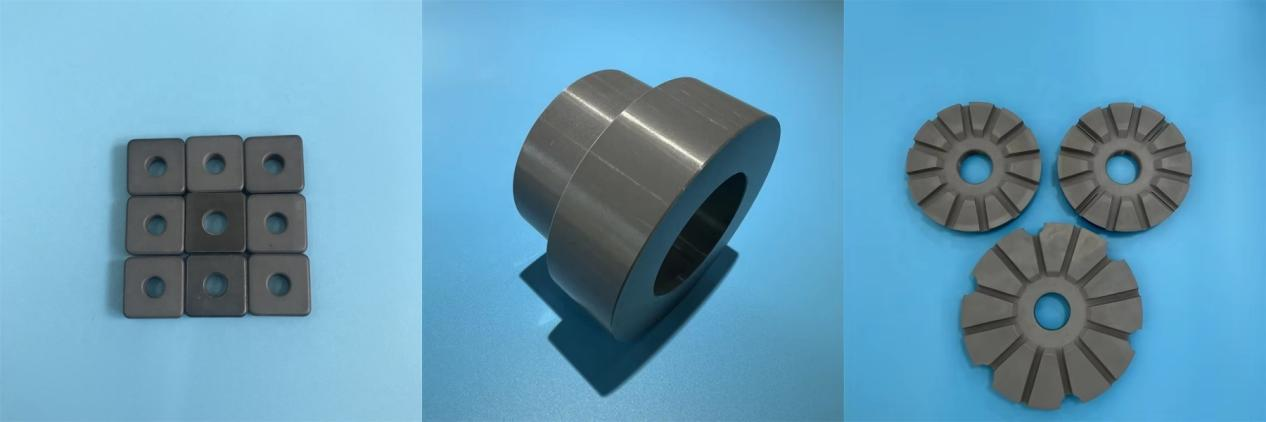
2. A New Path: Solving Shape and Density Separately
Powder extrusion printing, or PEP, takes a different approach.
Its process can be simply understood as: first mix silicon nitride powder with a binder to make granules suitable for printing, then extrude them into a green body, followed by debinding, and finally high-temperature sintering into a finished product.
The truly key change is splitting "forming" and "densification" into two steps.
In the printing stage, the material has not yet truly become ceramic; it is only in an extrudable state after mixing powder and binder. This stage does not pursue final performance—it is only responsible for stably building up the geometric shape. Because the material is deposited layer by layer, internal structures that previously required molds can now be formed directly, greatly increasing design freedom.
What truly determines material performance is the subsequent sintering. After debinding is complete, only a powder skeleton remains inside the part, and after high-temperature liquid-phase sintering, it gradually becomes dense. In other words, the shape is determined in the previous stage, while shrinkage and densification are solved in the later stage, so the two no longer constrain each other.
Another important point: PEP does not create an entirely unfamiliar process. It still belongs to the powder metallurgy route, and the debinding and sintering steps can connect with silicon nitride's existing mature processes. What truly changes is only the forming method—from relying on molds to layer-by-layer printing.
3. Why Demand Is Beginning to Concentrate
The renewed attention to silicon nitride is not because a single industry suddenly shifted direction, but because several types of high-end applications are simultaneously posing similar material-selection challenges.
Some components must work long-term in environments with strong corrosion, high insulation requirements, and severe temperature changes, such as certain key parts in etching equipment. Some components require both thermal conductivity and insulation, while also matching the thermal expansion of chips, such as heat-dissipation substrates for power modules. Still other components need to bear loads at high temperatures while reducing weight as much as possible, such as certain high-temperature structural parts on aircraft engines and spacecraft. These needs are scattered across different fields, but the material properties they point to are highly consistent: heat resistance, corrosion resistance, insulation, thermal-shock resistance, and also sufficient lightness and hardness.
In the past, such demands were often met with the help of metals or other ceramic materials. However, as structures became increasingly complex and performance requirements became more demanding, traditional material solutions began to struggle. The performance combination of silicon nitride precisely met the needs, and what truly made it go from being "optional" to "available" was the change in manufacturing methods.
PEP can complete complex structures in the green body stage and then obtain nearly dense ceramic parts after sintering, making many parts that once remained at the design stage possible to realize. Demand has always existed; only after manufacturing capability caught up was the material's value truly released.
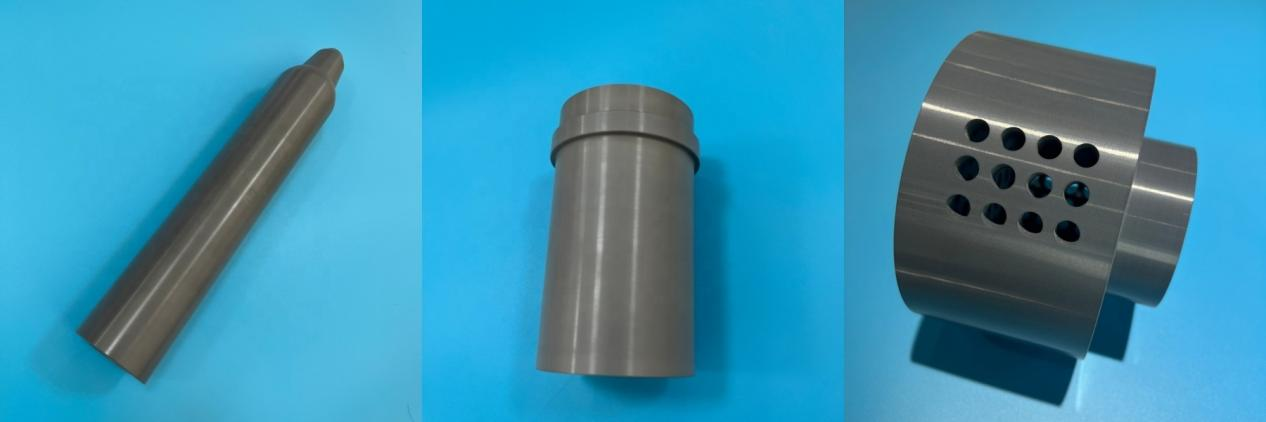
4. What Is Truly Difficult Is Not Just Printing
PEP appears to be simply extruding material and stacking it layer by layer, but the difficulty of silicon nitride does not lie in the printing action itself.
Whether the powder can be extruded stably, whether the binder can be smoothly removed, how to formulate sintering aids, and how to control the furnace atmosphere and temperature—these issues must be solved together. If any link is not handled well, the part may develop cracks, deformation, or fail to reach the required density.
Therefore, PEP is not something that can be completed independently by a single piece of equipment or a single material. It requires the cooperation of the entire chain: materials must be compatible with printing and sintering, equipment must adapt to the flow characteristics of ceramic slurry, debinding and sintering curves must be repeatedly verified, and post-processing must also connect smoothly.
For users, what is truly needed is not simply buying a machine or a batch of powder, but a manufacturing process that has already been proven. From model to finished product, only when every step in between can be stably connected can complex silicon nitride parts possibly move from design drawings to actual products.
Looking back, the reason silicon nitride has not expanded on a large scale is not that it is not excellent enough, but that in the past there was a lack of a method capable of stably producing complex structures.
When the manufacturing stage is no longer a bottleneck, the value of silicon nitride truly has room to be realized. Demand has always existed; it was simply blocked outside the door by process limitations in the past. Now, as forming methods gradually mature, this material is finally beginning to move toward broader applications.


 EN