In high-end manufacturing, ceramic nozzles combine high hardness, wear resistance, corrosion resistance, and insulation, making them suitable for extreme conditions such as high temperature and pressure, strong corrosion, and high-speed erosion. However, their hardness and brittleness, poor toughness, and near-zero plasticity make them prone to chipping, cracking, and dimensional deviation when machining micro-holes, deep holes, and special-shaped inner holes. Meanwhile, fluid injection, atomization cooling, and medium delivery in semiconductors, precision electronics, and fine chemicals cannot do without them. Therefore, high yield, high precision, and high efficiency are key to industrialization.
The difficulties in ceramic nozzle inner-hole machining mainly stem from the conflict between material and working conditions, concentrated in three aspects:
1.1 Limiting Factors for Microchannel Machining
Ceramic nozzle inner holes require strict control of aperture, roundness, roughness, and taper. High-end products often have apertures of 0.1–2 mm, precision semiconductor models can be below 0.1 mm, and depth-to-diameter ratios reach 10:1 to 30:1. Narrow channels make chip removal difficult; residual debris scratches the hole wall, blocks the channel, and causes dimensional deviation. Poor heat dissipation also causes thermal stress concentration, micro-cracks, and tool wear, amplifying machining errors.
1.2 Cracking Risk Induced by Machining Load
Structural ceramics such as zirconia ceramic, alumina ceramic, and silicon nitride ceramic have high hardness and compressive strength but weak resistance to crack propagation. Once machining force exceeds the threshold, micro-cracks expand rapidly. Ceramic elastic deformation is similar to metal, but plastic deformation is difficult, and brittle fracture occurs once stress exceeds the limit. When cutting force, impact load, and thermal stress are unevenly distributed, micro-cracks form, leading to chipping, debris shedding, and hole-wall peeling.
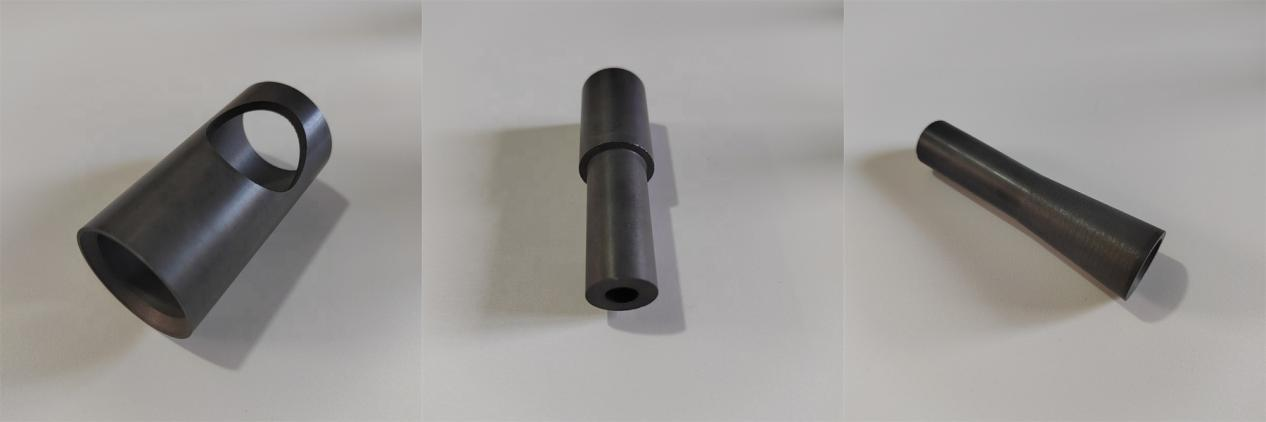
1.3 Forming Difficulties of Special-shaped Flow Channels
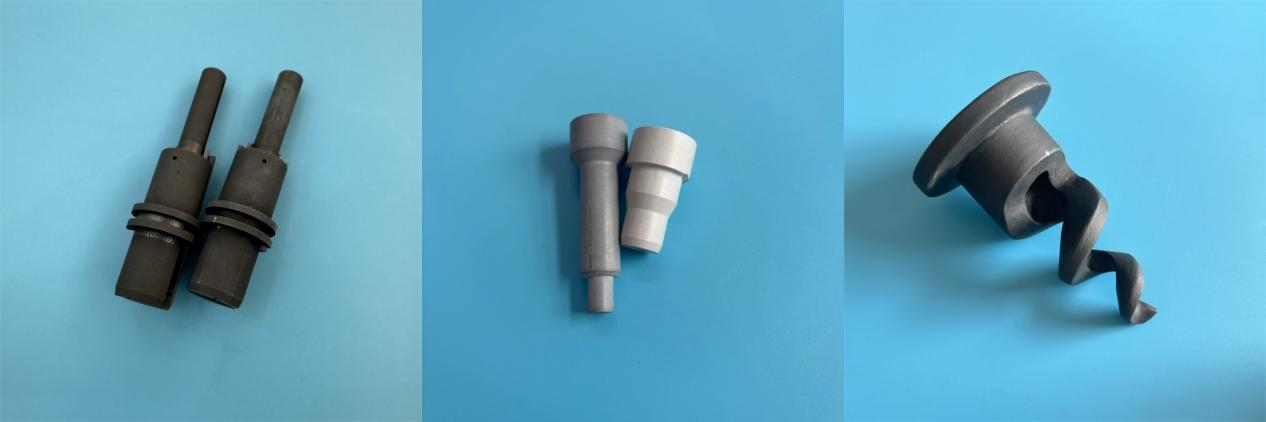
Special nozzles for aerospace and chemical applications often use tapered holes, inclined holes, graded apertures, or spiral flow channels. Complex contours in alumina ceramic nozzles are difficult to form with high precision by conventional methods. Tool vibration, clamping offset, and stress release cause aperture fluctuation, uneven taper, and hole misalignment, making batch consistency difficult to guarantee.
The mainstream processing technology for the inner hole of ceramic nozzles
In the face of these multiple processing difficulties, the industry has developed various molding methods. The processing plan will be selected based on the diameter specification, precision index, hole shape and production scale of the ceramic nozzle. It includes mechanical fine grinding and cutting, ultrasonic processing, laser micro-processing, and electrical discharge machining, etc. The implementation methods of different processes are different, and each has its own strengths and weaknesses in performance. The applicable processing scenarios and product specifications also have obvious differences.
2.1 Ultrasonic Excitation Assisted Microhole Forming
A vibration unit drives the tool in high-frequency reciprocation, while abrasive suspension circulates and impacts the workpiece, gradually eroding and forming micro-holes. Cutting load is low, chip removal is easy, and heat impact is small, reducing chipping and micro-cracks. It suits 0.1–2 mm micro-holes and irregular cross-section channels. However, material removal is slow, and tool wear is significant, affecting micro-hole contour accuracy.
2.2 Diamond Tool CNC Precision Grinding Process
This process is mature, stable, and versatile, producing good hole-wall quality. It relies on high-precision CNC machine tools and diamond abrasives to remove material at high speed, correcting dimensional deviation and surface defects. Six-axis linkage equipment can machine through holes, tapered holes, and inclined holes above 0.5 mm in alumina and zirconia ceramics. However, abrasive consumption is high, and it cannot machine 0.1 mm micro-holes or deep holes with very large depth-to-diameter ratios, with limited capability for special-shaped flow channels.
2.3 Discharge-type Stress-free Microhole Machining
This process uses pulsed discharge local electrical erosion to remove material without cutting force, machining high-hardness ceramics and reducing crack risk, suitable for deep and fine holes. In deep-hole mass production, it controls hole direction well, solving the deep-hole difficulty of mechanical machining. However, discharge heat alters the hole-wall surface, leaving deposits and micro-cracks, reducing smoothness. Dimensional accuracy is inferior to laser, making it more suitable for deep-hole nozzles with large depth and moderate precision requirements.
2.4 High Energy Pulsed Laser Microhole Forming
Ultrafast laser machining is non-contact, avoiding external force cracking. High-energy short pulses break molecular bonds and remove material, with flexible hole shape and taper adjustment, stably machining micro-holes above 0.05 mm. Femtosecond lasers concentrate energy on the surface with minimal heat diffusion, removing material via chemical bond breaking, leaving clean walls without molten residue, suitable for high-standard semiconductor micro-hole nozzles. Picosecond lasers have longer pulses and slight controllable heat accumulation, with lower contour accuracy but more stable continuous production and higher energy efficiency, balancing quality and speed.
Summary
Ceramic materials suit harsh conditions, but hardness and brittleness make batch precision machining difficult. Each inner-hole process has strengths and weaknesses, adapting to different apertures and forming requirements. With high-end manufacturing upgrading, a single process cannot meet diverse needs, and composite machining will become the future direction.


 EN