The semiconductor industry serves as the cornerstone of modern electronics industry, and its manufacturing process is highly dependent on various high-purity quartz products. From etching to diffusion, from cleaning to coating, different process stages correspond to different functions and requirements for quartz components. Today, we will systematically review the five most common types of quartz products in semiconductor manufacturing, and introduce their specific composition, application scenarios, and key technical requirements one by one.
Quartz machining components for precision etching and deposition
These products mainly include quartz glass rings, quartz discs, and other precision components. They are manufactured from high-purity, high temperature resistant quartz glass materials and are key consumables in etching and deposition equipment. Due to the high hardness and brittleness of quartz materials, microcracks or stress concentration are easily generated during the processing, thus requiring extremely strict standards for dimensional tolerance, surface cleanliness, and appearance consistency. Many critical parts cannot be reworked due to process requirements and must be formed in one go, which poses extremely high challenges to the precision of manufacturing equipment and operational techniques. The reason for such strict requirements is that in the high-temperature and corrosive environment of plasma etching or chemical vapor deposition, any minor defect on the surface of quartz parts may become a contamination source or a stress fracture point, directly affecting the uniformity of wafer processing and the yield of the final product.
Quartz carriers for wafer loading and transfer
These products mainly include quartz carriers and carriers suitable for different specifications of silicon wafers such as 4-inch, 6-inch, 8-inch, and 12-inch. Their main function is to directly load and fix the silicon wafers during high-temperature processes such as diffusion, oxidation, and annealing, as well as during wet cleaning procedures, ensuring that the wafers maintain precise positions and spacings during the process. Since the quartz carriers directly contact the silicon wafers and are mostly used in automated wafer transfer systems, their dimensional tolerances such as tooth shape accuracy, flatness, and parallelism are extremely high. At the same time, the surface cleanliness is also crucial - any tiny particle contamination could scratch the silicon wafers or introduce impurities, leading to a decline in device performance. Moreover, in repeated high-temperature cycles and acid-base cleaning environments, the quartz carriers need to have good thermal stability and corrosion resistance to ensure the dimensional stability and service life during long-term use.
Quartz fixtures for process assistance and positioning
These products mainly include quartz loading plates, quartz bases, and quartz covers, which are auxiliary components. They are widely used in various semiconductor thermal treatment, deposition, or etching processes, for supporting, positioning, or sealing wafers and process chambers. Although they do not directly participate in the core reactions, they are crucial for ensuring the stable operation of the process. Depending on the specific application scenarios, the precision requirements of quartz fixtures vary significantly - for example, the bases used for precise alignment have extremely high requirements for flatness and hole diameter tolerances, while the covers that perform sealing functions focus more on dimensional compatibility and thermal expansion consistency. Additionally, since they are exposed to high temperatures and corrosive atmospheres for a long time, quartz fixtures must be made of high-purity quartz materials and undergo strict cleaning treatment to avoid releasing contaminants during the process, which could affect the purity of the wafer surface.
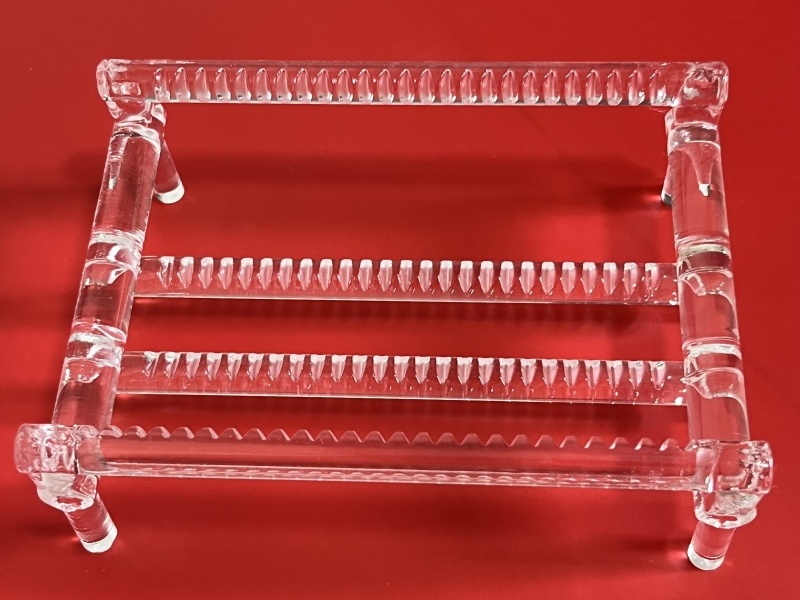
Quartz tanks and supports for wet cleaning process
These products mainly include quartz cleaning tanks and quartz supports, etc. They are specifically used in semiconductor wet cleaning processes to hold wafers or support trays, allowing them to undergo cleaning, etching, or desoldering treatments in chemical solutions such as acids, bases, or organic solvents. Due to the strong corrosive nature of the chemicals and the high-temperature liquids involved in the wet process, quartz cleaning tanks must have excellent chemical corrosion resistance and thermal stability to prevent deformation of the tank or contamination of the solution. At the same time, the structural design of the quartz supports needs to ensure smooth fluid flow and avoid liquid stagnation, ensuring uniform cleaning of the wafer surface. Although the requirements for mechanical processing accuracy of these products are relatively low, their appearance quality (such as no bubbles, no scratches) and surface cleanliness are extremely crucial - any minor surface defect could become a residue point for the chemical solution, leading to cross-contamination and directly affecting the cleaning effect of the wafer and the yield of subsequent processes.
Quartz tubes for high-temperature heat treatment processes
These products mainly include quartz reaction tubes, quartz furnace tubes, quartz jet tubes, as well as inner tubes, outer tubes, etc. They are mainly used in high-temperature heat treatment processes such as semiconductor diffusion, oxidation, chemical vapor deposition, and annealing, serving as the core components of the process chamber, carrying the gas for reactions or the wafer-carrying environment. Due to being exposed to temperatures above 1000℃ and corrosive atmospheres for a long time, quartz tubes must be made of high-purity, low-hydroxyl content quartz materials to ensure their thermal stability and durability, preventing deformation or the release of impurities that could contaminate the process environment. Moreover, the dimensional accuracy, uniformity of wall thickness, and sealing compatibility of quartz furnace tubes directly affect the gas flow distribution and temperature field uniformity within the chamber, thereby determining the uniformity of the film layer on the wafer surface. Therefore, these products have extremely strict requirements for assembly dimensions, cleanliness, and sealing - any minor scratches or contaminants could, under high temperatures, evolve into stress concentration points, affecting the lifespan of the tube body or even causing rupture, resulting in process interruptions and economic losses.
Summary: Quartz Products-A Key Support in the Semiconductor Manufacturing Chain
The above are the five common types of quartz products in semiconductor manufacturing. From precision machine parts to high-temperature furnace tubes, each type plays an indispensable role in every stage of chip production. Different products focus on different aspects such as material purity, processing accuracy, and cleanliness, but the common goal is to ensure the stability of the wafer processing process and product yield. We hope this article can help you quickly establish a comprehensive understanding of semiconductor quartz products.


 EN
EN