 EN


How alumina ceramic grades match different working condition demands
An alumina ceramic is often selected because it combines electrical insulation, wear resistance, heat tolerance, and chemical stability. Yet “alumina” is not one fixed answer. The grade, microstructure, part geometry, surface condition, and mounting method all shape how an alumina part behaves in service. For industrial buyers, the useful starting point is not a purity percentage alone; it is a clear description of the working condition.
In technical discussions, alumina is also called Al2O3 ceramic. Grades are commonly differentiated by alumina content, additives, grain characteristics, density, and the processing route used for the finished part. Those differences matter when a component must carry a load, cycle through temperature changes, guide abrasive media, insulate electrical hardware, or contact a process fluid.
Begin with the working condition, not the grade name
A grade designation gives a preliminary comparison point, but it cannot replace a service-condition review. Before choosing an alumina ceramic, define what the component will experience:
- Mechanical loading: steady compression, bending, impact risk, vibration, or point loading at a clamp or fastener.
- Temperature profile: peak temperature, heating and cooling rate, thermal cycling, and temperature gradients through the part.
- Media exposure: dry abrasion, slurry, high-temperature material, gas, water, cleaning chemicals, or electrical contamination.
- Electrical duty: required insulation, frequency, voltage, dielectric-loss considerations, and heat dissipation path.
- Geometry and assembly: wall thickness, holes, corners, threads, tolerances, mating materials, and preload.
That checklist shifts the grade conversation from “Which alumina is stronger?” to “Which alumina ceramic products can be specified and installed with an appropriate safety margin for this duty?”
How common alumina grade ranges support different demands
Lower-to-mid purity grades for balanced industrial duty
Many industrial alumina formulations are chosen where wear resistance, insulation, and reasonable cost need to be balanced. They can be practical for fixtures, insulators, guides, seals, and general wear components when the environment is understood. A lower purity grade is not automatically unsuitable; it may be a sensible choice where ultra-high electrical, thermal, or chemical requirements are not driving the design.
Ask for the supplier’s data for the actual fired material rather than relying on a generic grade label. Density, open porosity, grain condition, and test specimen orientation can influence the reported values. This is particularly important when an alumina part includes thin sections, long unsupported spans, or machined details.
High-purity alumina for demanding electrical and thermal environments
High purity alumina is often considered when applications place greater emphasis on electrical insulation, dielectric behavior, thermal performance, material cleanliness, or resistance to a defined process environment. It may be relevant to electronic fixtures, vacuum-related hardware, semiconductor-adjacent tooling, and high-temperature insulating components. The suitable grade still depends on the entire assembly: a material with suitable bulk properties can be undermined by an acute edge, an uneven mounting surface, or a large local temperature difference.
For electrical applications, describe the voltage, frequency, creepage and clearance requirements, surrounding atmosphere, and expected heat path. For thermal applications, clarify whether the problem is steady heat exposure or repeated thermal cycling. These are different demands and may lead to different grade, geometry, and joining recommendations.
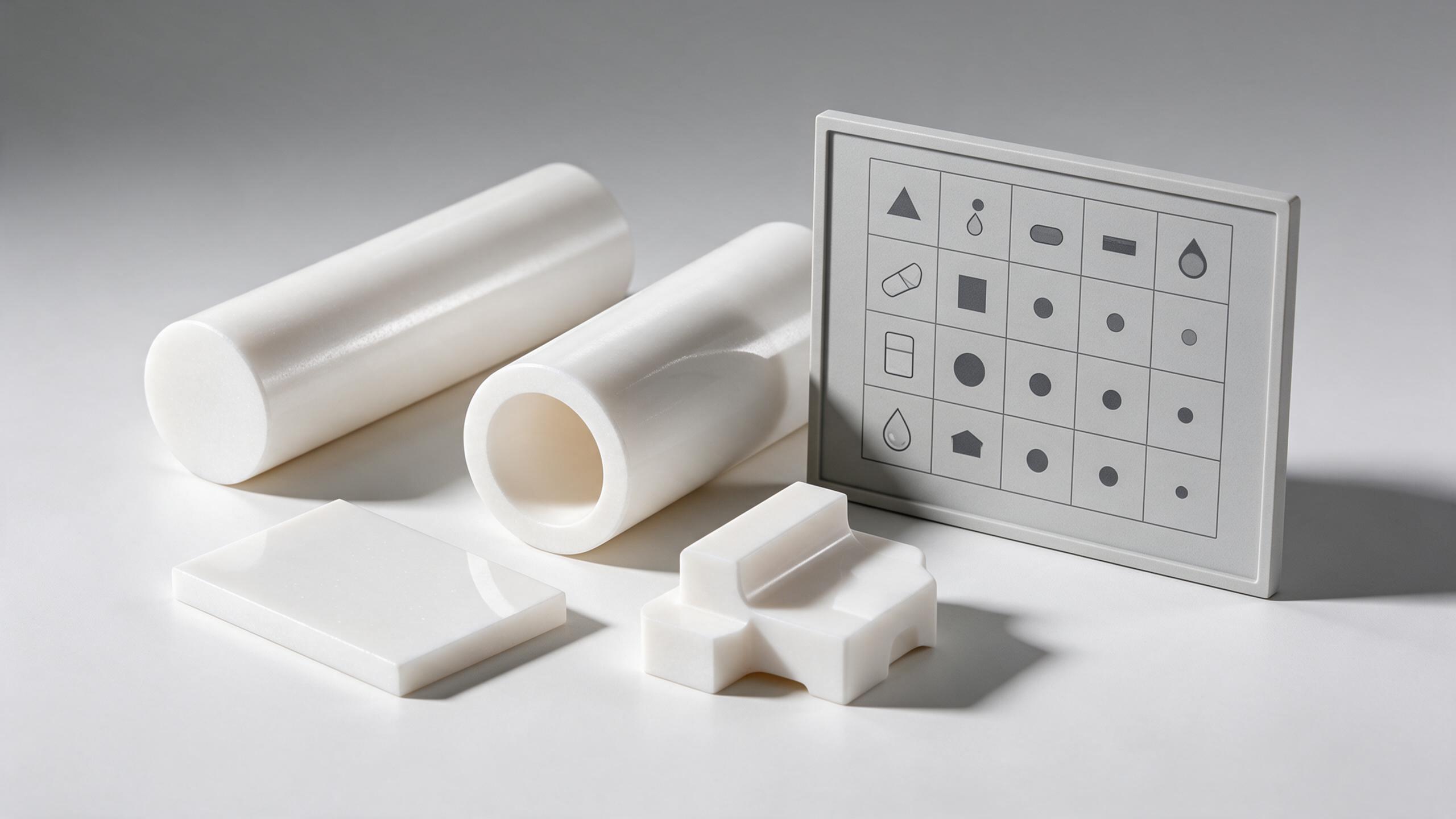
Purity is only one part of alumina ceramic selection
Higher alumina content is easy to read as an across-the-board upgrade, but that interpretation is incomplete. In practice, an engineering choice has to account for brittleness and flaw sensitivity as well as hardness and insulation. Ceramic components do not yield in the same way as metals. A concentrated load, tight interference fit, unsupported overhang, or corner chip can become more important than the nominal grade.
When bending strength is a critical requirement, request the test method, specimen geometry, surface condition, and lot-specific data where available. ASTM C1161 is commonly used for room-temperature flexural-strength testing of advanced ceramics. It provides useful context for comparing test results, but a published test value should not be treated as the allowable stress for every finished component or operating temperature.
Match grade decisions to four recurring application patterns
Abrasive contact and wear
For a guide, nozzle, liner, or sliding contact part, identify the abrasive type, particle size, contact pressure, speed, and whether impact occurs. The grade is one factor; surface finish, counterface material, edge radius, and alignment also affect wear. An alumina ceramic can be a strong candidate for a controlled wear environment, while shock-heavy service may require a broader material comparison.
High temperature and thermal cycling
For furnace fixtures, insulating supports, or hot-zone components, report maximum temperature together with ramp rate, cycle count, support points, and adjacent materials. Thermal expansion mismatch and mounting restraint can create stresses even when the bulk temperature is within the material’s expected range. A grade review should therefore include installation design, not only a temperature number.
Electrical insulation and heat management
For substrates, isolators, and electrical hardware, separate insulation requirements from heat-removal requirements. An al2o3 ceramic formulation can support these functions, but the relevant decision inputs include thickness, metallization or contact design, power level, contamination risk, and thermal contact conditions. Confirm the test conditions behind any property value used for design.
Chemical or process-media exposure
When a part contacts a liquid, gas, slurry, or cleaning agent, provide the exact media, concentration, temperature, pressure, exposure time, and cleaning sequence. Broad statements about chemical resistance are not enough for a final selection. A representative exposure review or application-specific evaluation may be warranted for critical service.
Specify the alumina part, not just the material
A successful RFQ for an alumina part includes the grade target and the details that govern manufacturability and service risk. Provide a drawing with dimensions and tolerances, identify flatness or surface-finish needs, mark contact and load zones, describe the working medium and temperature cycle, and state the acceptance checks that matter. If the component replaces an existing part, include photos and the original mounting arrangement where possible.
Lianyungang Highborn Technology can organize a custom ceramic discussion around drawings, dimensions, media, temperature, and assembly conditions. This helps engineering and purchasing teams compare an alumina ceramic option against the actual duty rather than a generic material description.
Make the final choice a controlled comparison
Treat the grade as one item in a documented comparison: define the duty, screen candidate alumina ceramic formulations, review geometry and mounting, then confirm the relevant test evidence or sample evaluation. This approach helps avoid an expensive mismatch between a material label and a real operating condition. For critical applications, involve the component supplier early and keep performance conclusions tied to the stated conditions.

