 EN


What industrial sectors benefit most from silicon nitride ceramic components
When a conventional metal component reaches its limits, the question is rarely “which material is strongest?” A more useful question is which failure mode is driving cost, downtime, or qualification risk. This ceramic is often considered where heat, rolling contact, wear, electrical isolation, or low moving mass all matter at once. For engineering and purchasing teams, the value comes from matching the component form to the operating environment—not from treating the material as a universal substitute.
As a materials-selection viewpoint, this article ranks sectors by the clarity of that match. It also separates material potential from part-level performance. It may be relevant in a bearing ball, an igniter, a tool, a guide, or a custom structural part, but geometry, surface condition, assembly loads, and validation requirements still determine whether it belongs in the final design.
Why silicon nitride ceramic fits demanding component work
This advanced engineering ceramic is commonly evaluated for high hardness, wear resistance, relatively low density, thermal-shock tolerance, and electrical insulation. Its microstructure can give it useful fracture-toughness behavior compared with many other technical ceramics, yet it remains a brittle material rather than a drop-in metal. Stress concentrations, edge design, mounting method, and contact conditions need careful review.
The material becomes most compelling when several requirements overlap. A part exposed to temperature cycling may need dimensional stability and resistance to thermal gradients. A rolling element may need low mass, high stiffness, and electrical isolation. A production tool may need wear resistance without adding unnecessary inertia. In those cases, specifying this ceramic component can be more logical than optimizing for only one property.
1. Bearings, motion systems, and precision machinery
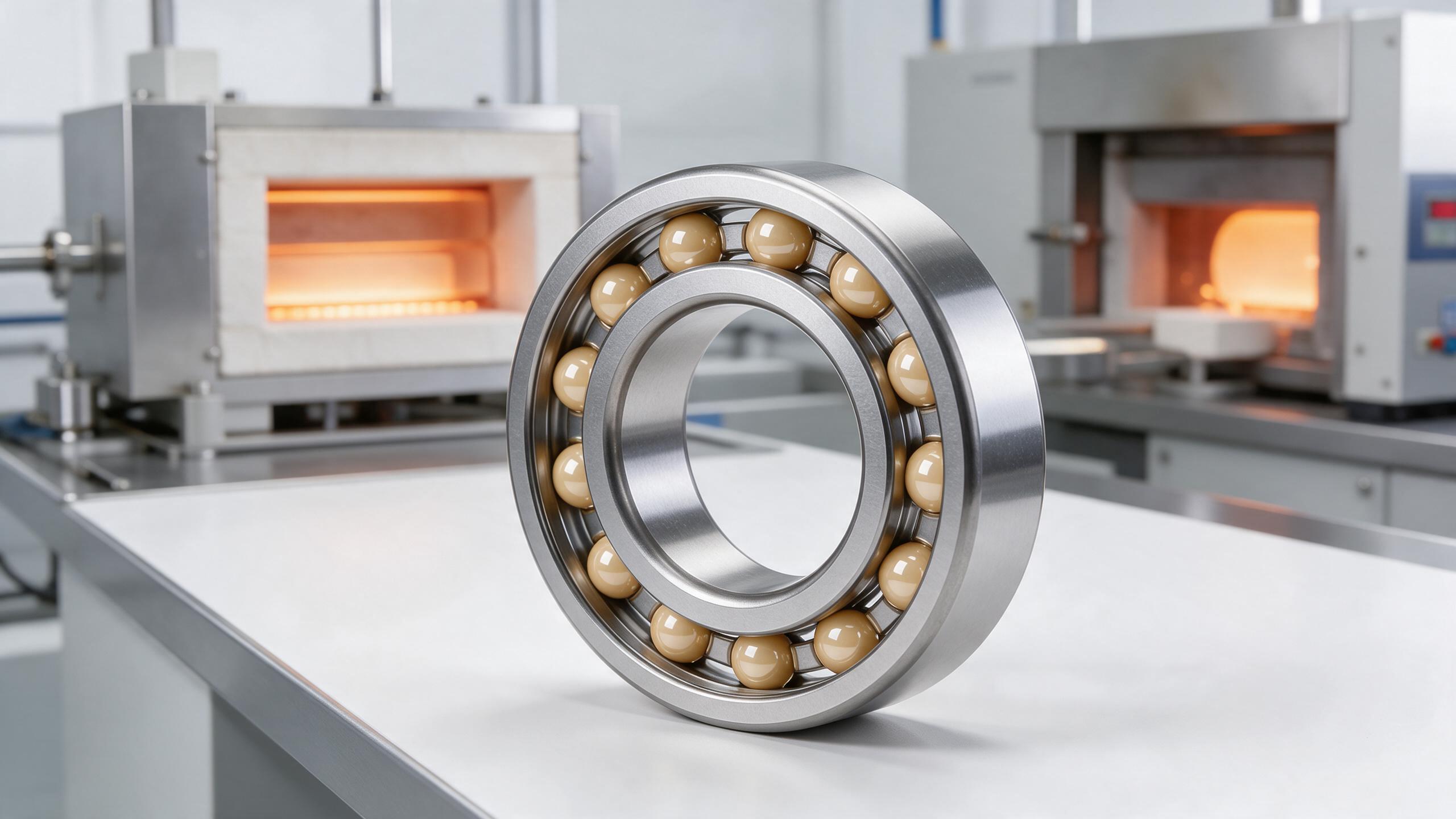
Rolling-contact applications are among the clearest industrial uses for this material. A silicon nitride ball is used in hybrid bearing designs where steel rings are paired with ceramic rolling elements. The combination can be relevant in high-speed spindles, machine-tool assemblies, pumps, motors, and dedicated motion systems.
The sector benefit is practical: a ceramic rolling element can reduce moving mass and electrically isolate the rolling path from current-related damage in applications where that issue is part of the design risk. Published bearing references also identify uses around turbines, aircraft instrumentation, gearboxes, and other high-duty equipment. Those examples do not mean every bearing should change material. Lubrication, cage design, raceway finish, preload, contamination, and speed must still be validated together.
Who benefits most: machine builders and maintenance teams dealing with high rotational speed, electrical current concerns, or a need to review rolling-contact reliability in a specific duty cycle.
2. Aerospace, turbines, and energy equipment
Aerospace and energy equipment benefit where a silicon nitride ceramic can address the combined effects of heat, inertia, and rotating motion. Component categories may include bearing rolling elements, turbine-adjacent hardware, hot-air valves, and carefully designed structural parts. In a historical turbocharger study, a silicon-nitride rotor design was investigated because a lower inertia moment could change transient response; that design-specific result should not be generalized to every rotor or engine program.
For gas turbines, microturbines, and auxiliary power equipment, the sector case is strongest when engineers can state the local temperature, thermal gradient, vibration, load path, and inspection method. The material does not remove the need for proof testing or system-level analysis. It gives designers another material option when a metal part creates a constraint in the operating envelope.
3. Industrial heating, combustion, and thermal processing
Industrial burners, furnaces, boilers, kilns, and process-heating equipment are a natural setting for the silicon nitride igniter. In hot-surface ignition systems, the material is valued for rapid heating behavior and operation in elevated-temperature environments. A silicon nitride igniter can therefore be relevant to OEMs and service organizations supporting gas-fired or oil-fired equipment.
The procurement conversation should go beyond the word “igniter.” Teams should confirm voltage, connector and mounting geometry, heated length, thermal cycling profile, atmosphere, control sequence, and required electrical testing. This is especially important for replacement programs: a similar-looking silicon nitride part may not have the same fitment or thermal profile as the original.
4. Automotive, transport, and heavy-duty powertrain systems
Automotive and heavy-duty transport applications benefit selectively from a silicon nitride ceramic, particularly in high-temperature rotating assemblies, precision bearings, and ignition-related components. Turbocharger development is often cited because lower-density ceramic rotors can be explored where rotational inertia is important. Bearing applications can also be relevant in electric drive systems or auxiliaries when electrical isolation and speed are design considerations.
The sector is not a broad replacement market for every steel or aluminum component. It is a targeted engineering opportunity. A silicon nitride ceramic should be evaluated only after the duty cycle, shock exposure, joining method, service environment, and cost of qualification are understood. This keeps a materials comparison connected to actual vehicle or equipment requirements.
5. Metalworking, forming, and wear-intensive production
Metalworking and industrial production can benefit from a silicon nitride ceramic in wear-sensitive parts such as guides, forming elements, cutting-related components, and fixtures exposed to heat or abrasive contact. The attraction is not simply hardness. Wear behavior depends on the counterface, contact pressure, lubrication or coolant, impact frequency, and surface finish.
For continuous processes, a custom silicon nitride part may be worth reviewing when a conventional component requires frequent changeovers or introduces contamination concerns. The engineering team should provide drawings, critical radii, contact materials, loading direction, temperature range, and acceptance criteria before a manufacturing path is chosen.
6. Electronics, semiconductor equipment, and insulation-critical systems
Electronics and semiconductor equipment are another important sector, although the component geometry varies widely. A silicon nitride ceramic may be considered for insulating structural elements, wear components, precision guides, or parts near heat-generating and electrically sensitive assemblies. The benefit is strongest when electrical isolation must coexist with mechanical precision and thermal stability.
Here, “ceramic” alone is not a sufficient specification. Buyers should identify dielectric needs, heat path, cleanliness requirements, dimensional tolerances, vacuum or process atmosphere, and mounting stresses. A well-defined specification helps distinguish a suitable silicon nitride ceramic design from a part that needs a different ceramic or a composite solution.
A practical sector-selection checklist
The sectors that benefit most are the ones with a clear combination of heat, wear, rolling contact, insulation, or weight-sensitive motion. Before requesting a quote for a silicon nitride ceramic, prepare the following information:
- Component drawing, critical dimensions, tolerances, edges, holes, and mounting surfaces.
- Operating temperature, heating or cooling rate, and number of thermal cycles.
- Static, impact, vibration, and contact loads, including the counterface material.
- Speed, lubrication, electrical conditions, and contamination limits where relevant.
- Prototype quantity, production quantity, inspection needs, and acceptance criteria.
This checklist lets engineering and procurement teams compare a silicon nitride ceramic against other material options on the conditions that matter. For custom ceramic components, a manufacturer can then review feasibility from the drawing, dimensions, and service environment rather than making unsupported assumptions.
Conclusion: focus on the failure mode, then the sector
Bearings and precision machinery, aerospace and energy equipment, thermal processing, transport powertrain systems, wear-intensive manufacturing, and insulation-critical electronics all have credible reasons to evaluate a silicon nitride ceramic. The common thread is not industry label; it is the presence of demanding operating conditions that must be balanced together. Start with the failure mode, document the real environment, and use that information to determine whether a silicon nitride component is technically and commercially appropriate.

