 EN


What advantages does flow quartz cuvette offer for continuous fluid analysis
A flow cell turns a stationary optical measurement into a controlled, moving-sample measurement. Instead of removing a vessel, filling it, placing it in an instrument, and starting again, liquid travels through a defined optical chamber while the instrument observes it. That arrangement can be useful in process monitoring, reaction tracking, chromatography-related work, and laboratory setups that need a sequence of readings rather than one isolated result.
The advantage is not simply that a flow cell is made from quartz. It is the combination of an optical path, a fluid channel, and a connection layout that can be matched to the liquid, wavelength range, flow behavior, and maintenance routine. A well-specified flow cell can make sampling more consistent; an unsuitable one can still introduce bubbles, contamination, pressure concerns, or misleading optical behavior.
Why continuous flow changes the measurement workflow
With a conventional cuvette, every measurement may involve manual transfer and repositioning. A flow cell keeps the sample path in place, so a pump or upstream process can refresh the liquid in the optical window. This can reduce handling steps between time points and supports observation of a changing stream, provided the flow is stable and the instrument is configured for the intended method.
For kinetic work, the practical benefit of a flow cell is continuity. The operator can follow a reaction or concentration trend as fresh liquid passes through the same measurement zone. That does not make the result automatically representative: residence time, mixing upstream of the cell, tubing volume, and detector response still need to be considered. It does give the method a repeatable physical location for the observation.
Quartz glass supports many UV-Vis measurement needs
Material choice is one of the reasons engineers specify a flow cell. Quartz glass and fused-silica grades are commonly considered where the analytical wavelength extends into the ultraviolet as well as the visible region. Ordinary flow glass cuvette options may be appropriate for some visible-light methods, but their suitability at shorter wavelengths should be checked rather than assumed.
A flow cell should therefore be selected by the actual optical requirement: wavelength range, path length, wall thickness, surface quality, and the optical grade requested. Product ranges found in the market may list broad transmission windows, yet those figures are not interchangeable across every quartz glass grade or cell geometry. The instrument method and supplier documentation should be evaluated together.
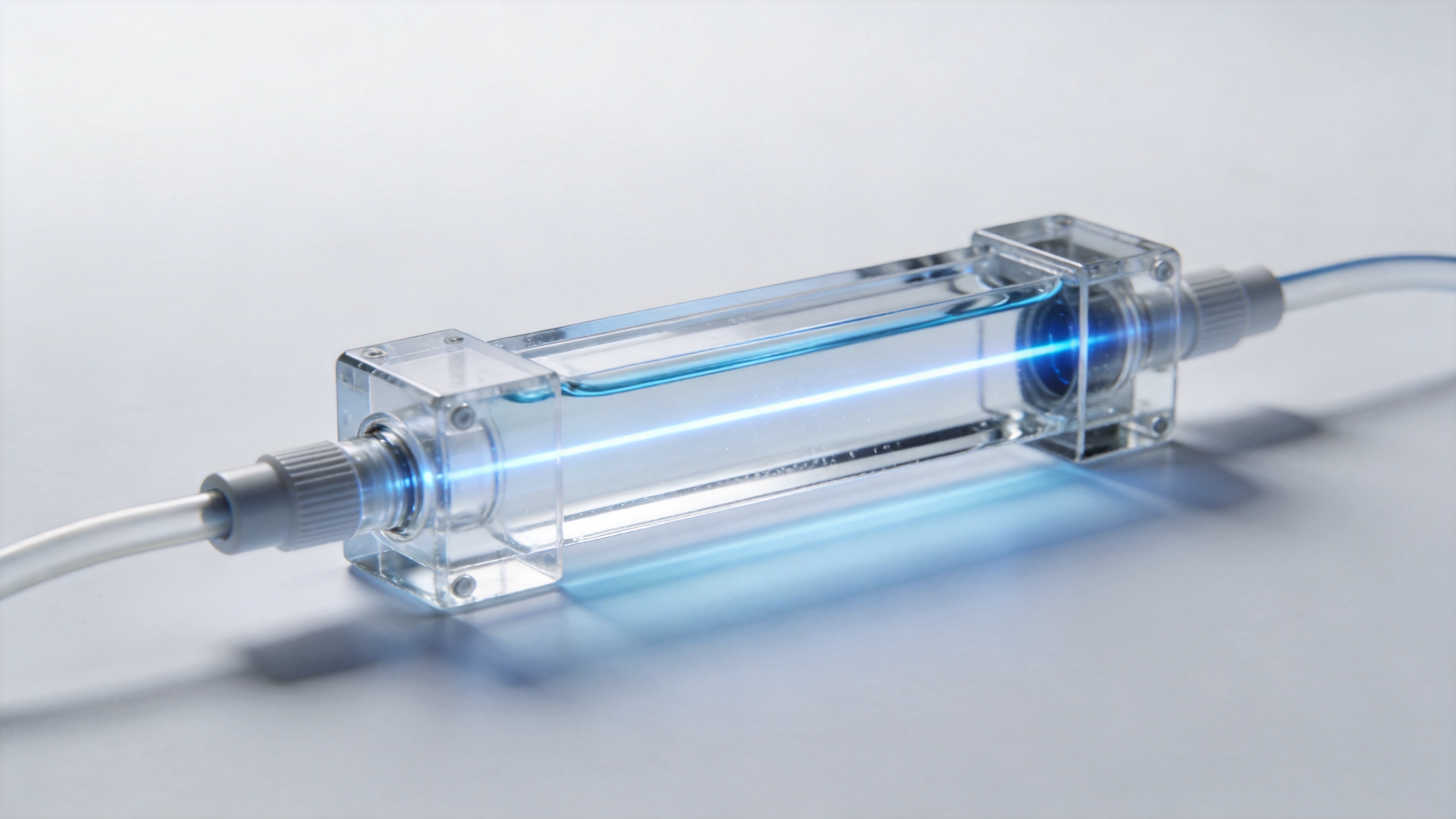
Key advantages of a flow quartz cuvette
1. A defined optical path during sample replacement
In a flow cell, the sample moves while the optical geometry remains fixed. Maintaining one controlled path length can help a team compare a series of readings under the same cell geometry. The benefit depends on consistent filling and a channel that does not trap residues or gas.
2. Better fit for time-resolved and inline workflows
A flow cell can be integrated with compatible pumps, valves, or sampling lines, allowing sequential measurements without repeatedly opening the optical compartment. This can be helpful when a process or reaction changes faster than a manual workflow can comfortably follow. It is still important to set a suitable acquisition interval and allow the line to reach the intended sample condition.
3. Broad optical selection possibilities
The quartz material in a flow quartz cuvette gives designers an option for UV-Vis methods where a standard glass cell may not meet the wavelength requirement. The benefit is conditional, not universal: select the appropriate grade and confirm its transmission data for the target wavelength, especially when the method operates near a material or instrument limit.
4. Controlled sample volume and exposure
A flow quartz cell can be designed around a small or larger internal volume, depending on the method. Lower volume may reduce sample consumption and shorten the time between a change upstream and a reading; a larger channel may be easier to manage in another setup. Neither choice is inherently superior. The useful question is whether the internal volume, flow rate, and desired response time agree.
5. A maintainable measurement zone
When cleaning access, flushing procedure, and compatible seals are specified, a flow quartz cuvette gives a process a known zone to inspect and maintain. This is important because deposits, fingerprints on external windows, and dried residues can alter transmitted light. Ask how the channel will be flushed, whether the windows can be inspected, and which cleaning media are compatible with the complete assembly.
What can limit the advantage?
A flow quartz cuvette does not remove common optical risks. Air bubbles scatter light and can make a reading unstable. Particles, precipitates, and poorly mixed samples can change the apparent signal independently of concentration. Dead volume in fittings can delay the arrival of a new sample. A flow quartz cell needs a sensible orientation, degassed or appropriately conditioned liquid when the method requires it, and plumbing that avoids unintended restrictions.
Mechanical conditions matter as well. Confirm expected pressure, temperature, port type, tubing size, seal material, and mounting arrangement before treating a flow quartz cuvette as an inline component. Quartz glass offers useful optical properties, but the complete cell also includes bonded areas, fittings, and seals whose limits may govern the assembly.
How to compare a flow quartz cell with a flow glass cuvette
| Selection question | Why it matters |
|---|---|
| Which wavelengths will the method use? | It helps determine whether quartz glass is needed instead of a flow glass cuvette. |
| What path length is required? | Path length affects absorbance range and must fit the instrument method. |
| What liquid will contact the channel? | Fluid chemistry informs compatibility checks for quartz, seals, fittings, and cleaning media. |
| What are the flow rate and pressure conditions? | These affect channel design, connection choice, and bubble-management planning. |
| How will the cell be cleaned and inspected? | A practical cleaning plan helps protect repeatability over repeated runs. |
The comparison should not end at “quartz versus glass.” A flow quartz cuvette may be the more suitable option for a UV-focused method, while a different material or design could be sufficient for a visible-only application. The right decision is based on the full operating window, not the name of the material alone.
A practical specification checklist
Before requesting a flow quartz cuvette, prepare the details that shape both optical and fluidic performance:
- analytical wavelength range and instrument type;
- required optical path length and acceptable optical-window dimensions;
- sample composition, pH range, solvent, particles, and cleaning approach;
- nominal and maximum flow rate, pressure, and temperature;
- inlet/outlet connection, tubing dimensions, orientation, and available mounting space;
- internal-volume target and allowable carryover or response delay;
- inspection, packaging, and acceptance requirements for precision optical parts.
This list makes a technical discussion about a flow quartz cuvette more productive than a request based on an image alone. For a custom application, a drawing and the operating conditions are often more informative than a generic model description.
Conclusion
The principal advantage of a flow quartz cuvette is that it combines a stable optical measurement path with continuous fluid handling. That can support sequential, time-resolved, and inline-style analysis while giving UV-Vis methods access to suitable quartz glass options. Its value comes from correct integration: choose the optical grade and path length for the method, then confirm fluid compatibility, bubble control, pressure limits, and cleaning access for the complete cell. Those checks help determine whether a flow quartz cuvette is a sound fit for the measurement rather than merely an attractive component description.

