 EN


What Advantages Does a Quartz Container Have for Laboratory Testing?
A quartz container can be a practical choice when a laboratory test needs optical access, stable geometry through temperature changes, or a clean silica-based contact surface. The material alone is not the decision. The useful question is whether the proposed quartz container matches the wavelength, sample chemistry, temperature cycle, wall thickness, cleaning method, and fixture used in the test.
From a material-selection perspective, it is easy to reduce the choice to a label such as quartz glass. A more reliable approach is to identify what the container must do during the measurement. For optical work, the relevant items are transmission range, path length, window finish, and contamination control. For heated work, the relevant items are temperature profile, thermal gradient, mounting, and handling. Those conditions determine whether a quartz container offers a meaningful advantage.
Why laboratories use a quartz container
The main advantages of a quartz container come from the behavior of silica-based glass rather than from a generic claim that it suits every experiment. Properly specified quartz glass can be useful in UV-visible optical cells, sample holders, reaction vessels, and high-temperature process fixtures. It is also available in formed, machined, fused, and polished geometries, so the optical or mechanical connection can be tailored to the test setup.
For many laboratories, the decision has three parts: the light path, the thermal duty, and the chemical-contact duty. A quartz container is often considered when one or more of those parts exceed what ordinary glassware is intended to handle. It remains important to validate the finished component rather than assuming that a material name defines the finished vessel's performance.
1. Optical access for UV and visible measurements
A key advantage of a quartz container is its relevance to optical testing. Fused silica and selected quartz grades can transmit light into ultraviolet wavelengths that are inaccessible or less suitable for many common glasses. This matters in UV-visible spectroscopy, fluorescence work, photochemical studies, and instrument cells where the sample must be observed through a defined optical path.
That advantage is conditional. A quartz container for optical testing should be specified by wavelength range, wall thickness, path length, window flatness, surface finish, and grade. A vessel that is visually clear is not automatically suitable for a particular UV measurement. Bubbles, inclusions, scratches, surface contamination, and geometry can affect baseline stability or scattered light. For a high-sensitivity method, confirm the transmission requirement with the instrument and validate the assembled cell with blanks and relevant controls.
The term fused silica is often used when purity and optical behavior are central to the requirement. Depending on how a supplier uses material names, quartz glass and fused silica may refer to related but differently produced silica materials. The specification should state the required performance rather than rely only on the name.
2. Low expansion helps with controlled temperature changes
A quartz container is also valued for low thermal expansion. When a test involves heating, cooling, or repeated cycling, lower expansion can help reduce stresses caused by changing dimensions. That is one reason quartz components appear in furnace-adjacent apparatus, thermal-process observation parts, and laboratory vessels that must retain a stable form through a defined temperature program.
Low expansion does not mean that a quartz container cannot crack. Thermal-shock resistance depends on the wall thickness, shape, edge condition, local heating rate, thermal gradient, scratches, residual stress, and how the piece is held. A thin, evenly heated vessel may behave very differently from a thick container clamped at one point. Ask for the intended temperature range, ramp rate, hold time, and fixture details before treating thermal stability as a selection benefit.
A quartz coil tube, for example, is normally evaluated as a formed flow or heating path rather than as a simple storage vessel. Its bend radius, wall thickness, support points, medium, and heating pattern matter. The same material advantage can therefore lead to different specifications for a coil, a cell, or a quartz container.
3. A silica-based surface for many controlled chemical applications
In suitable conditions, a quartz container can provide a chemically stable contact surface for laboratory samples and processes. Quartz glass is widely associated with good resistance to many common media, and its smooth surface can support cleaning and visual inspection. These properties can be useful where a test needs a transparent vessel and where the proposed chemistry has been checked for compatibility.
The limitation is just as important as the benefit. Hydrofluoric acid attacks silica. Strong alkaline exposure, elevated temperature, long contact time, and certain cleaning practices can also change the compatibility assessment. Therefore, do not select a quartz container based only on an acid-resistance statement. Record reagent identity, concentration, temperature, exposure duration, agitation, and cleaning cycle. If contamination or extractables matter, establish an application-specific cleaning and verification procedure.
4. Useful geometry for samples, optical cells, and thermal fixtures
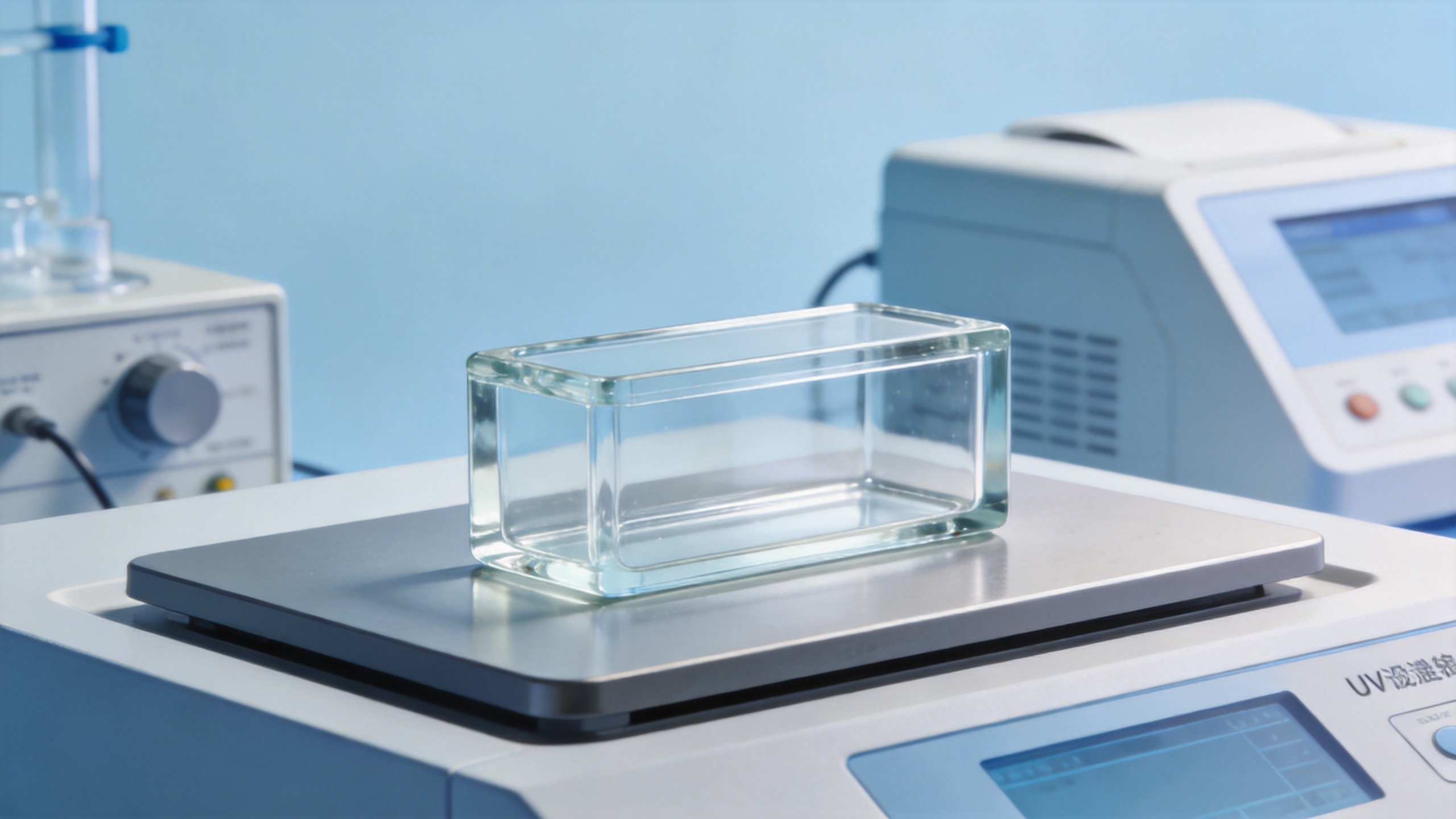
Quartz can be made into more than one laboratory format. A quartz container may be a square optical cell, a dish, a beaker-like vessel, a covered chamber, or a custom sample holder. The geometry can support a known path length, a fixed sample volume, a polished observation window, or a controlled opening for access and venting.
A quartz boat has a different job. It is commonly considered for holding material during heating or controlled processing, where surface condition, dimensions, loading pattern, and thermal profile should be reviewed. Calling every silica part a quartz container can hide these differences. The component should be defined by its test function first and its material second.
How to specify a quartz container for a laboratory test
Before requesting a quartz container, prepare a short requirement list. It reduces ambiguity for both the laboratory and the fabricator.
- State whether the quartz container is used for optical measurement, heating, reaction, sample storage, or a combination.
- Provide the wavelength range, required path length, window locations, and surface-finish requirement if light passes through it.
- List the medium, concentration, temperature, exposure time, cleaning agents, and contamination limits.
- Define dimensions, wall thickness, tolerances, lid or port arrangement, and how the part will be mounted.
- Describe the temperature program, ramp rate, thermal cycle count, and whether the vessel will be locally heated or clamped.
- Identify acceptance checks, such as visual inspection, dimensional checks, leak checks, or instrument baseline tests.
When quartz is not automatically the right answer
A quartz container is not a universal replacement for borosilicate, metal, polymer, or ceramic laboratory hardware. A visible-light test at moderate temperature may not require quartz. An application involving HF is unsuitable for a silica-based vessel. A mechanically demanding setup may need a different design, protective handling, or another material. The value of quartz glass is strongest when its optical, thermal, or purity-related characteristics directly answer a documented test requirement.
In practice, the most useful advantage is not simply that a quartz container is made of quartz. It is that the material can be specified around a real test condition: a UV path, a controlled thermal cycle, a clean observation surface, or a shaped holder. Confirm those conditions early, then verify the finished component in the intended method.
Frequently asked questions
Is a quartz container suitable for UV testing?
A quartz container can be suitable for UV testing when the selected material grade, thickness, window quality, and instrument wavelength range are appropriate. Confirm the optical requirement rather than assuming all quartz glass is interchangeable.
Can a quartz container be used with all acids?
No. A quartz container should not be assumed compatible with hydrofluoric acid, and other chemical conditions require review of concentration, temperature, exposure time, and cleaning method.
What information should be supplied for a custom quartz container?
Provide the test purpose, sample medium, temperature program, dimensions, tolerances, optical-path requirements, surface-finish needs, mounting method, and acceptance checks. This information helps turn a general material request into a usable laboratory component.

