 EN


How fluorometer quartz cell supports accurate fluorescence testing
A fluorescence result is only as dependable as the optical path that carries the excitation light to the sample and the emitted light to the detector. A fluorometer quartz cell is the sample holder that helps define that path. It does not make a measurement accurate by itself; instrument setup, sample preparation, calibration, and data handling still matter. However, choosing a suitable cell and using it consistently can reduce avoidable optical variation during fluorescence testing.
From a device-user perspective, the practical questions are straightforward: Is the material suitable for the wavelengths in use? Are the clear faces aligned with the fluorometer’s optical geometry? Is the cell clean, undamaged, and filled without bubbles? Answering those questions turns a generic cuvette into a controlled part of the measurement method.
Why quartz glass matters in fluorescence work
Many fluorescence methods use ultraviolet or near-ultraviolet excitation. In those cases, ordinary glass or some plastics may not transmit the required excitation range as well as quartz glass. Synthetic quartz is commonly selected because it can support UV and visible optical work; the exact usable range still depends on the grade of material and the instrument method. Before selecting a fluorometer quartz cell, compare the intended excitation and emission wavelengths with the cell specification rather than relying on the material name alone.
The role of quartz glass is not limited to transmission. A uniform, clean optical material gives the instrument a more consistent boundary between its optics and the sample. Scratches, residue, fingerprints, or a cloudy surface can scatter or block light. For low-signal measurements, a small change at a clear window may become noticeable in the reported intensity. That is why cleaning and handling are part of the method, not merely lab housekeeping.
Four clear faces support the fluorescence geometry
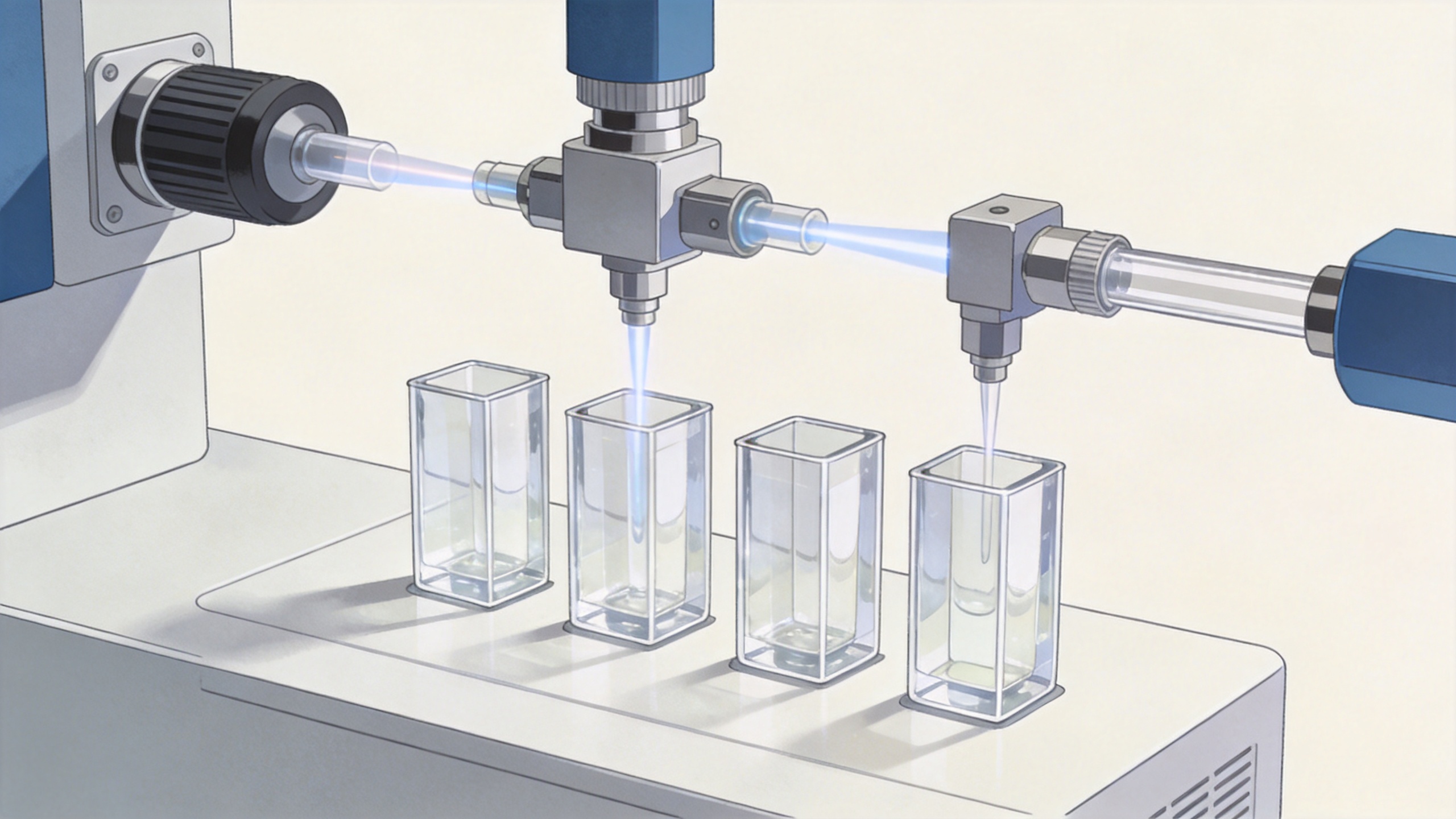
Absorbance work often sends light straight through two opposite faces of a cuvette. Fluorescence instruments commonly excite the sample from one direction and collect emitted light at approximately 90 degrees. A fluorescence-oriented fluorometer quartz cell therefore often has several polished, transparent faces so both the incoming beam and the observation path can pass through clean optical surfaces.
This geometry helps limit the amount of directly transmitted excitation light that reaches the detector. It also means that cell orientation matters. If a four-sided cuvette is rotated between standards and samples, a face with a different scratch pattern, label position, or residue level may enter the optical path. Establishing one orientation mark and using it for blanks, standards, and unknowns is a simple repeatability control.
A common mistake is to treat every clear container as interchangeable. A two-window cuvette may be appropriate for a transmission method but may not provide the windows required by a fluorometer’s collection geometry. Confirm the number and location of clear faces, the path length, the external dimensions, and the working volume before changing the cell format.
What the cell can and cannot control
A fluorometer quartz cell contributes to measurement consistency by holding a known sample volume in a defined position. It cannot correct for a poor blank, a concentration outside the method’s linear region, an unstable light source, or a sample that absorbs too much excitation light. The cell is one controlled input within a larger measurement system.
For a routine assay, make the blank and standards use the same fluorometer quartz cell type as the unknowns. Keep fill height sufficiently consistent for the instrument’s illuminated region. Wipe the outer faces with a lint-free material and inspect the liquid for bubbles, especially near the excitation or observation windows. If the method is sensitive to temperature, let the sample and cell reach the specified condition before comparing readings.
When a flow quartz cuvette or flow quartz cell is useful
A static cuvette is convenient when individual samples are prepared and measured one at a time. A flow quartz cuvette can be useful when a liquid stream must pass through the observation zone, such as during a connected process, chromatographic setup, or continuous sampling arrangement. The core optical questions remain the same: wavelength suitability, window quality, light-path geometry, and clean surfaces.
A flow quartz cell adds fluid-handling questions. Tubing interfaces, internal volume, flow stability, trapped air, carryover, and cleaning compatibility can influence what reaches the optical region. Bubbles are particularly important because a moving gas-liquid boundary can scatter light and make the fluorescence signal fluctuate. Before treating a flow result as a sample change, first check whether the flow quartz cell is fully wetted, free of bubbles, and operating at a stable flow condition.
Choose a flow quartz cuvette only after confirming that its optical geometry and connection details fit the instrument and fluid path. A flow-through body is not automatically a substitute for a standard cell. If a method was validated with a static cuvette, changing to a flow configuration calls for a method-specific comparison of blank response, signal stability, and cleaning procedure.
A practical selection and handling checklist
- Match wavelengths: Verify that the quartz glass grade and cell construction suit the planned excitation and emission range.
- Match geometry: Check how many clear faces the fluorometer needs and where it collects emission.
- Match dimensions: Confirm path length, external size, fill volume, cap style, and holder compatibility.
- Control cleanliness: Use an appropriate cleaning procedure, then inspect every optical face before use.
- Control orientation: Use the same marked orientation for blank, calibration standards, and samples.
- Control liquid condition: Avoid bubbles and particles in the observed zone; for a flow quartz cell, verify stable wetting and flow.
- Document the setup: Record the fluorometer quartz cell type, path length, handling procedure, and any cell change in the method record.
Turn a material choice into a testing control
The useful question is not simply whether quartz is suitable. Ask which wavelengths, cell geometry, sample volume, cleaning method, and fluid conditions the fluorescence method requires. A fluorometer quartz cell supports accurate fluorescence testing when those requirements are translated into a repeatable optical setup. For custom optical quartz components, the relevant discussion should begin with the instrument layout, drawing or dimensions, wavelength range, liquid contact conditions, and acceptance checks. You can explore the manufacturer’s broader quartz glass component information before preparing those technical details.
Use a suitable fluorometer quartz cell, keep its optical windows clean and consistently oriented, and validate any move from a static cuvette to a flow quartz cuvette within the actual method. This approach keeps the cell in its proper role: a controlled optical component that supports reliable fluorescence data.

