 EN


What surface characteristics make textile ceramic fit fiber contact work
In a winding, drawing, twisting, or weaving path, an industrial ceramic component does more than redirect yarn. Its contact surface influences drag, filament disturbance, lint retention, and the consistency of the path over time. That is why a textile ceramic should be specified as a fiber-contact surface system, not merely as a hard replacement part. From an application-engineering perspective, an industrial ceramic selection starts with the yarn, speed, wrap angle, lubrication, and mounting condition.
A textile ceramic may take the form of a guide, roller, eyelet, disc, or specially shaped insert. The material family matters, but material name alone does not establish suitability. Surface finish, edge condition, form accuracy, and resistance to groove formation determine whether the part can carry fiber smoothly in the intended process. The right industrial ceramic specification therefore connects a functional need to an inspectable requirement.
Why the contact surface matters
Fiber contact is a tribological condition: the yarn moves across a solid surface, often under tension and sometimes with finish oil, sizing residue, moisture, dust, or abrasive contaminants. A smooth industrial ceramic surface can help keep local friction more consistent than a rough, chipped, or grooved surface. More precisely, smoothness alone is not the whole answer. The finish must also be uniform around the actual yarn track, including transitions into and out of a hole, groove, or roller.
For a ceramic guide, a small scratch or raised particle can act as a snag point. An abrupt transition can concentrate contact pressure. A worn channel can change the path and increase rubbing in a narrow zone. These issues may show up as fuzz, broken filaments, unstable tension, or a need for more frequent inspection. They do not automatically prove that the ceramic material is wrong; yarn condition, alignment, and cleaning practice also need review.
Five surface characteristics to specify
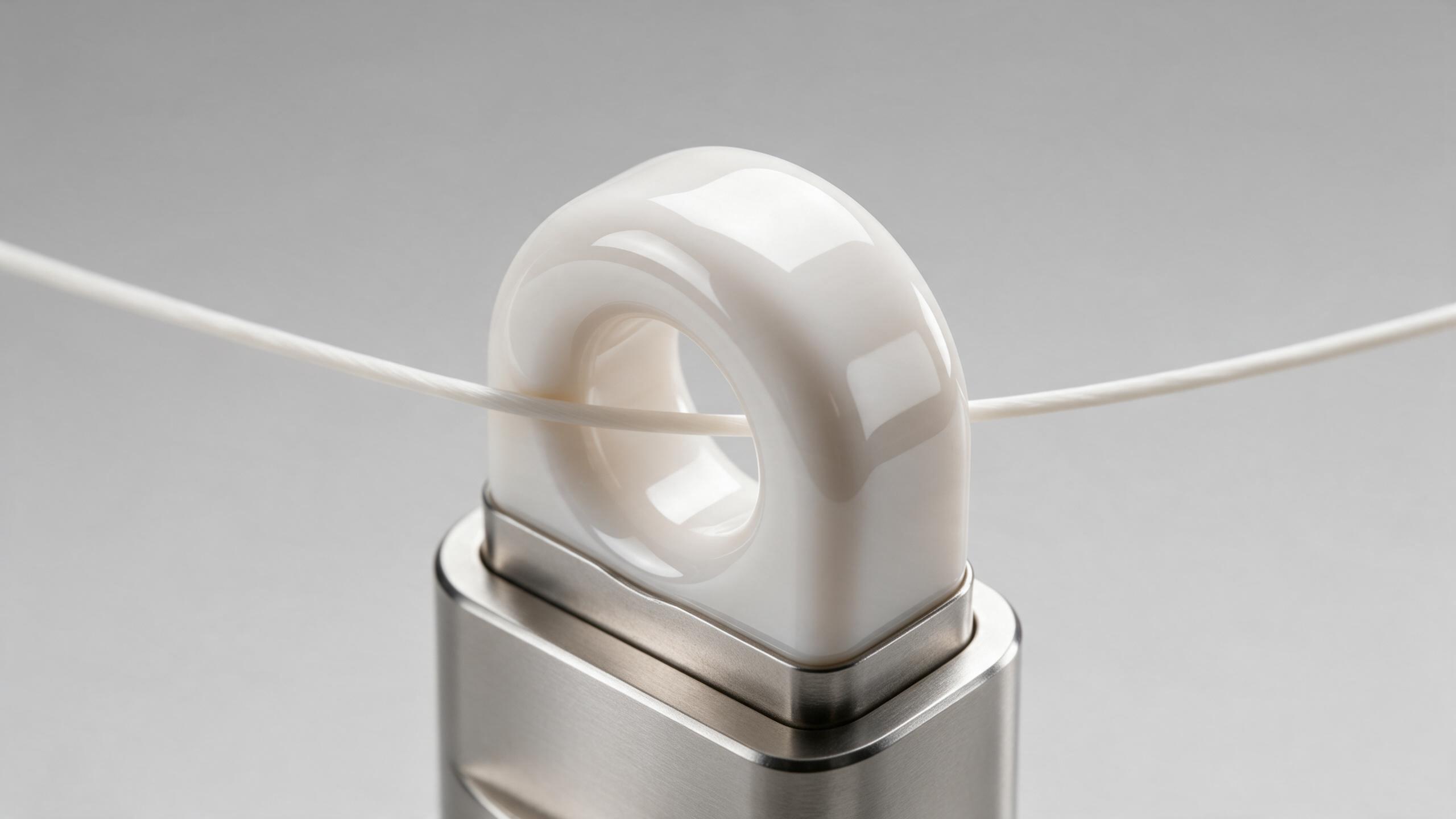
1. Low, uniform roughness on the yarn track
The visible face of an industrial ceramic part is not necessarily the functional face. Define the yarn-contact track and require a polished, continuous finish across that track. The aim is to avoid isolated asperities, polishing marks that run across the yarn path, pores exposed at the surface, and inconsistent zones near geometry changes. Instead of asking for a vague “smooth finish,” a buyer can ask how roughness will be measured, where measurements will be taken, and how the supplier distinguishes the contact track from non-contact surfaces.
2. Rounded entry, exit, and edge transitions
Fiber should meet a ceramic eyelet or slot through a controlled radius rather than an unblended edge. The usable radius depends on yarn type, tension, speed, and wrap angle, so one radius value should not be copied from another machine. The important point is continuity: entry, bearing surface, and exit should form a path without a unblended lip. An industrial ceramic component with a polished bore but poorly blended entrance can still be unsuitable for sensitive filaments.
3. Form accuracy that preserves the intended path
Roundness, concentricity, groove profile, and runout become surface-performance issues when they change contact distribution. In a textile ceramic roller, uneven geometry can shift pressure from a broad band to a narrow line. For a stationary ceramic guide, an off-center hole or distorted groove can alter the wrap angle and routing. The industrial ceramic drawing should identify the datum scheme, the yarn path, and any dimensions that control alignment with neighboring parts.
4. Wear resistance without hidden groove damage
Wear resistance is valuable because a stable contact surface can retain its shape longer, but it should not be treated as a lifetime promise. Inspect the used path for grooves, flats, cracks, chips, and changes in polish. A groove is especially important because it can capture lint or finish residue and change friction as yarn enters and leaves it. When evaluating an industrial ceramic part, ask whether the expected contact zone is accessible for visual inspection or magnified examination after installation.
5. Cleanliness and compatibility with process residue
Surface condition and yarn lubrication work together. Residue can mask a developing groove, while debris embedded in a deposit may create a rough local contact point. The industrial ceramic should be considered with the planned cleaning method and the actual yarn finish, not in isolation. Confirm that the cleaning method will not leave abrasive particles, attack nearby mounts, or require disassembly that damages the component. If chemical exposure is relevant, it belongs in the application review before material and finish are finalized.
How to compare a textile ceramic, guide, roller, or eyelet
Start with the contact mode. A fixed textile ceramic eyelet needs attention to bore polish and entrance radii. A ceramic guide with a groove needs the groove profile, flank transitions, and mounting alignment checked. A rotating textile ceramic roller adds runout, bearing arrangement, and surface consistency around the circumference. In all cases, the industrial ceramic is part of a system whose fiber behavior also depends on upstream tension control and downstream take-up.
| Requirement | Why it matters in fiber contact | What to confirm |
|---|---|---|
| Polished contact track | Helps limit snagging and variable drag | Track location, finish method, inspection approach |
| Blended radii | Reduces abrupt contact at entries and exits | Profile drawing, edge-break or radius requirement |
| Stable geometry | Keeps the intended yarn path and pressure distribution | Critical dimensions, runout, concentricity, mounting datum |
| Wear inspection plan | Finds grooves and chips before they affect the path | Access, inspection interval, replacement trigger |
| Cleaning compatibility | Limits residue-related roughness and contamination | Yarn finish, cleaning media, handling method |
Turn the application into a workable specification
A practical RFQ for an industrial ceramic fiber-contact part should identify the fiber or yarn type, denier or count where relevant, line speed, tension range, wrap angle, contact length, lubrication or finish, temperature, contaminants, drawing or sample, mounting dimensions, and the acceptance method. This is more useful than requesting an industrial ceramic part simply because it is “wear resistant.” The acceptance discussion should also separate appearance requirements from functional surface requirements.
For custom work, a supplier can use the drawing, dimensions, and operating conditions to discuss manufacturing and inspection options. Lianyungang Highborn Technology Co., Ltd. can organize custom ceramic discussions around these inputs rather than assuming that two visually similar guides have the same fiber-contact duty. If a sample is being evaluated before volume production, keep the sample acceptance criteria separate from the final production inspection plan.
A short inspection checklist before installation
- Confirm that the specified yarn-contact path is polished and free of visible chips, cracks, burrs, or residue.
- Check entry and exit transitions on every ceramic eyelet, groove, and guide opening.
- Verify orientation, mounting datum, and alignment with the adjacent yarn path.
- For each textile ceramic roller, confirm that rotation and geometry do not introduce path variation.
- Document how the industrial ceramic surface will be cleaned and how groove wear will be reviewed in service.
Choose the surface for the operating condition
The most suitable industrial ceramic fiber-contact surface is not defined by hardness alone. It combines a uniform polished track, controlled radii, stable geometry, inspectable wear behavior, and a cleaning approach compatible with the yarn process. For demanding textile ceramic applications, compare the part against the real yarn path and confirm the details on the drawing before ordering. That turns a general material choice into a component specification that engineering, purchasing, and quality teams can evaluate together.

