 EN


Why aluminum nitride ceramics stand out for high thermal conductivity scenarios
When a design must draw heat from a compact electronic assembly while preserving electrical isolation, aluminum nitride ceramics deserve a close look. They are not a universal replacement for every insulating ceramic, but they address a demanding combination of requirements: a short thermal path, electrical separation, controlled expansion, and a geometry that can be integrated into an assembly.
As a practical starting point, engineers should evaluate aluminum nitride ceramics as part of a complete heat path rather than as a conductivity number on a data sheet. The chip, contact-layer material, metallization, mounting pressure, ceramic thickness, and heat sink all influence the temperature reached in service. This article explains where AlN adds value and what should be confirmed before a specification is released.
The property combination that changes the design conversation
Many materials either conduct heat well or electrically isolate adjacent elements. Aluminum nitride ceramics are notable because they can support both objectives in the same component. That makes them relevant where an electrically insulating layer cannot become the thermal bottleneck, such as a power module, LED assembly, RF package, or semiconductor-process fixture.
Commercial material data illustrate the distinction. One supplier lists AlN grades at 170, 200, and 230 W/m·K at 25°C, while the actual value for a finished part will depend on composition, density, additives, and process control. Those examples should not be used as a blanket specification; they show why aluminum nitride ceramics are investigated when alumina-class conductivity is no longer sufficient for the heat-load budget.
Electrical insulation is just as important. A conductive heat spreader may require separate dielectric layers, which add contact layers and thermal resistance. With aluminum nitride ceramics, the insulating body can also be a heat-conduction route. The result can simplify the stack-up, but it does not remove the need to verify dielectric requirements, creepage distances, metallization design, and contact quality.
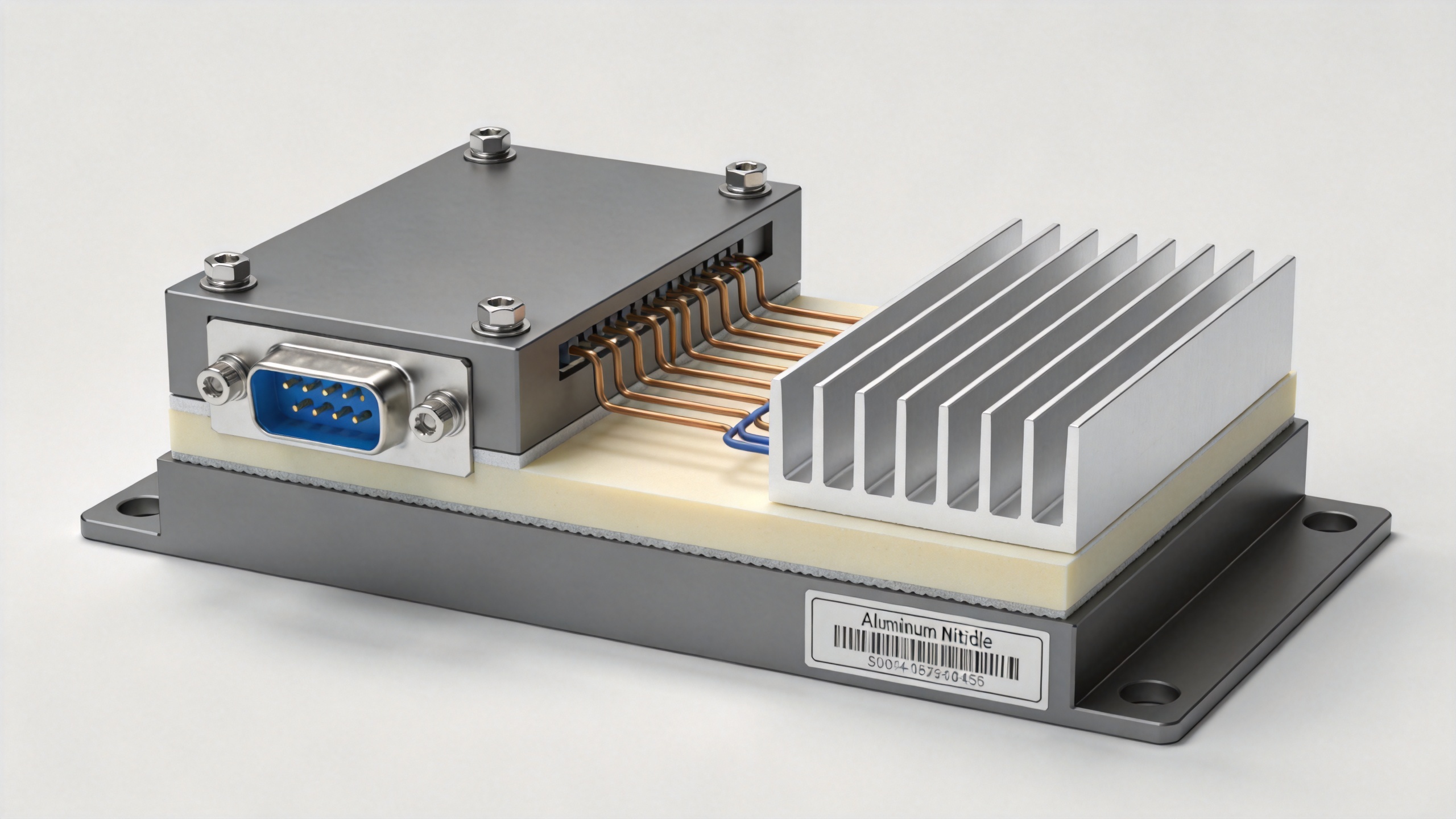
Why thermal conductivity alone is not enough
A useful comparison begins with the direction of heat flow. Through-thickness conduction matters for a substrate under a device, while in-plane spreading may matter for a larger support. Part thickness, contact area, and the quality of each contact layer determine the resistance in that path. For this reason, selecting aluminum nitride ceramics solely by a headline conductivity value can lead to an incomplete design decision.
Thermal expansion belongs in the same review. A published example value for AlN is approximately 4.5 × 10⁻⁶/K from 25°C to 400°C. That can be helpful when comparing a ceramic layer with neighboring electronic materials, but the relevant question is the strain in the actual temperature cycle and assembly. A thin aln substrate may behave differently in a bonded stack than a thick, unsupported plate.
Mechanical loading must also be considered. Ceramics are strong in compression but can be sensitive to localized loading, edge damage, hole geometry, and mounting stress. If aluminum nitride ceramics are being considered for a fixture or support, ask how the part will be clamped, what flatness is required, and whether repeated thermal cycling changes the support conditions.
Choose the form factor around the thermal path
AlN substrates for electrically isolated heat transfer
An aln substrate is usually assessed where the component needs a relatively thin insulating base beneath an electronic circuit or device. Define thickness, planarity, surface condition, metallization compatibility, thermal direction, and the temperature range before comparing grades. In this role, aluminum nitride ceramics can help designers separate heat-management and insulation questions without treating them as unrelated parts of the assembly.
AlN plates for larger contact areas or fixtures
An aln plate may be appropriate when a wider contact surface, a spacer, or a thermal isolation-and-transfer element is needed. Plate thickness is not merely a mechanical choice: it adds thermal resistance in a through-thickness path. Discuss finished dimensions, holes, slots, edge condition, and the mating surfaces early. An aluminum nitride plate should be specified with its function in the assembly, not only with length and width.
AlN rods for application-specific insulating components
An aln rod can suit application-specific insulating supports or components where heat needs to move along a defined geometry. Here, machining features, contact area, axial loading, and surface condition may dominate the final outcome. The same material family does not make a rod interchangeable with a substrate; aluminum nitride ceramics need form-specific drawings and acceptance criteria.
What can change real-world performance
Grade-to-grade variation is one reason to request the data for the proposed material rather than rely on a generic description of aluminum nitride ceramics. Thermal conductivity can be affected by raw-material purity, oxygen content, sintering aids, porosity, crystal quality, and the manufacturing route. Metallization, coatings, and finish also need review because the component is used as a system, not as a coupon.
Environmental handling is another review item. AlN is often discussed with a moisture-sensitivity caveat, especially for prolonged exposure at bare surfaces, cut edges, grooves, or slots. The appropriate response is not to assume failure in every humid application. Instead, define the environment, storage conditions, exposed features, cleaning method, and any protective design choices. That is a more useful way to assess aluminum nitride ceramics for a specific assembly.
Supplier communication should also distinguish sample validation from volume acceptance. A prototype may show that an aln plate fits the heat path, while a production specification must also define dimensions, flatness, surface finish, inspection method, packaging, and lot documentation. These details protect both engineering intent and purchasing clarity.
A practical selection checklist
- Heat load: What power, thermal path, target temperature, and contact-layer materials define the problem?
- Electrical boundary: What insulation, voltage, spacing, and dielectric verification are required?
- Geometry: Is the component an aln substrate, an aln plate, an aln rod, or another machined form?
- Thermomechanical fit: What temperature range, cycle count, mounting method, and expansion mismatch apply?
- Environment: Are humidity, cleaning chemicals, exposed edges, or contamination controls relevant?
- Acceptance: Which dimensions, flatness, finish, material data, and packaging conditions must be checked?
When AlN is the sensible direction
Aluminum nitride ceramics stand out when high heat transfer and electrical insulation are simultaneous design constraints rather than separate problems. Their value is often greatest in applications where a more conventional insulating ceramic would create too much thermal resistance, yet a metal solution would complicate electrical separation. The decision still depends on the finished geometry, contact layers, environment, and evidence supplied for the proposed grade.
For an RFQ or design review, provide the operating temperature, heat source location, required electrical isolation, drawing, thickness range, surface requirements, and expected environment. With those inputs, a supplier can discuss whether an aluminum nitride plate, substrate, or custom form aligns with the application and which performance items require project-specific confirmation.

