 EN


What sealing problems can silicone rubber solve for industrial equipment?
A leak at an enclosure, pump cover, inspection door, or instrument housing is not necessarily a “bad gasket” problem. In my material-selection work, I start by separating the leak path from the seal material. A silicone elastomer is often considered when an industrial seal must stay flexible through hot, cold, weather-exposed, or electrically sensitive service. It can be a useful option, but it is not a universal answer for every fluid, motion pattern, or gland design.
This guide explains the sealing problems a silicone seal can address, where the material needs a closer review, and what information to provide before requesting a custom molded elastomer part. The aim is to help engineering and purchasing teams turn a vague leak complaint into a specification that can be checked.
Start with the sealing problem, not the material name
A static joint seals when the elastomer fills small surface irregularities while retaining enough contact force as pressure, temperature, and time change. A dynamic joint has an additional challenge: friction, extrusion risk, and wear can change the contact condition during operation. The material can support sealing where flexibility at the operating temperature is the main concern, yet a seal that is chemically unsuitable or incorrectly compressed can still leak.
For that reason, diagnose the evidence first: is the leak localized at a split line, around fasteners, at a moving shaft, after thermal cycling, or only after cleaning? Also record the medium, pressure direction, temperature history, joint material, surface condition, and whether the assembly was opened recently. That short list is usually more valuable than a material name alone.
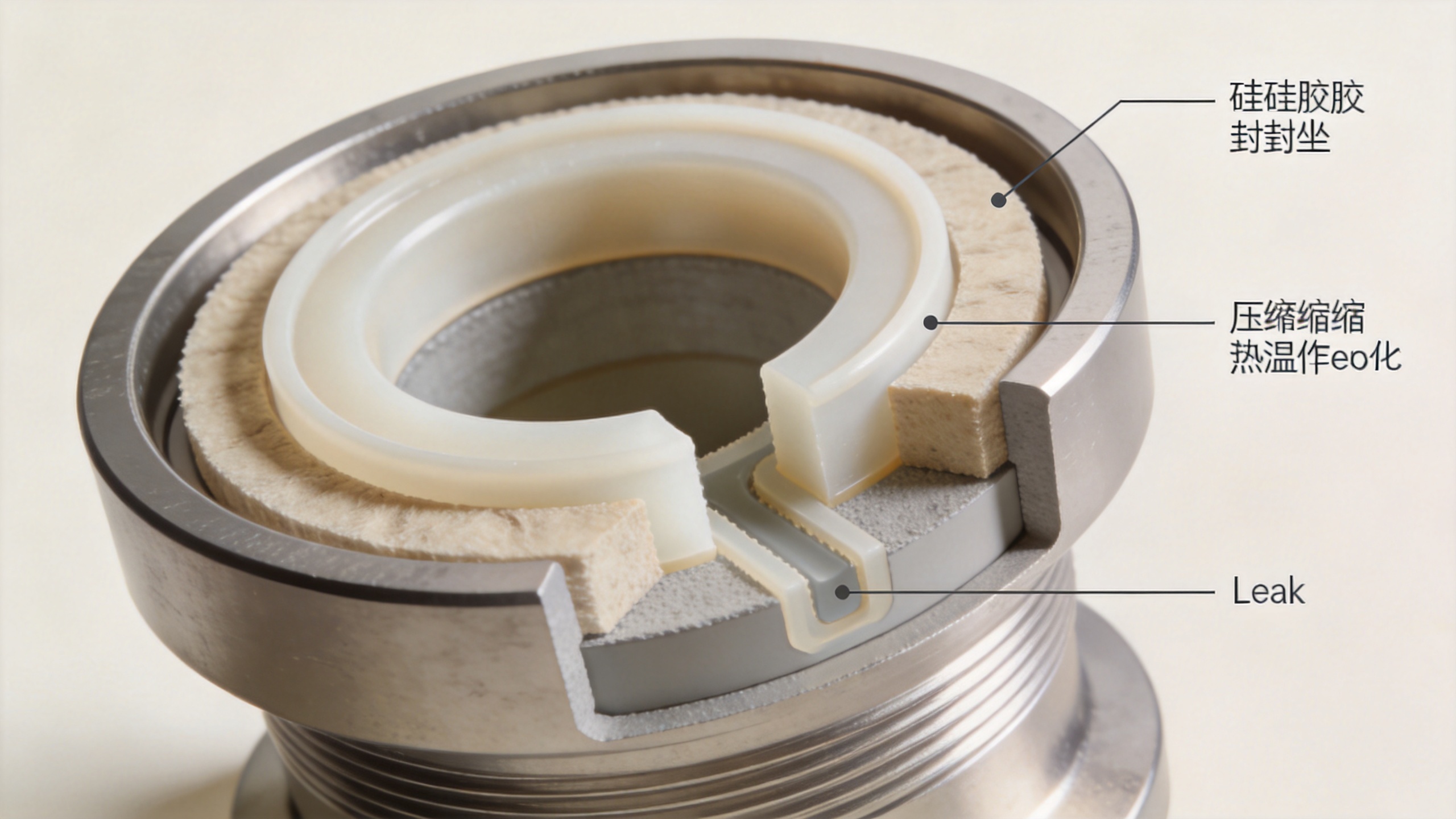
Sealing problems a silicone elastomer can help solve
1. Loss of flexibility during cold starts or temperature swings
Cold equipment starts can expose an elastomer that has become too stiff to follow a flange, cover, or housing surface. Silicone Rubber is commonly evaluated for broad temperature flexibility. A retrieved handbook excerpt describes silicone elastomers as having good heat resistance up to about 232°C and cold flexibility down to about -59°C, but those figures are not a design rating for every compound or assembly. Duration, compression, motion, and the actual formulation matter.
In practical terms, the seal may help when a conventional material loses conformability during a cold start or when repeated hot-to-cold cycles cause a seal to move from minor surface irregularities. The review should include both the lowest and highest stabilized temperature, plus the rate of temperature change and any differential expansion between the seal and the metal gland.
2. Heat aging concerns in static covers and housings
Heat can harden some elastomer systems, reduce recovery, or change the force they apply to a joint. Silicone Rubber may be a reasonable candidate for static seals around ovens, heated enclosures, lighting equipment, thermal-process covers, and instrument housings when the medium is compatible. The useful question is not simply “How hot is it?” Ask how long the joint stays hot, whether it cycles, whether pressure pulses occur, and whether the seal is compressed within the recommended range for its profile.
The molded component should therefore be specified with its cross-section, finished dimensions, hardness range, compression target, and tolerance stack. Excessive squeeze can raise assembly force and accelerate permanent deformation; too little squeeze can leave a leak path when the joint expands or vibrates.
3. Weather, ozone, and outdoor enclosure exposure
Outdoor electrical cabinets, access panels, sensor housings, and machine guards need a seal that can keep conforming after sun, rain, and changing ambient temperature. This material is often considered for static environmental barriers because it retains flexibility in a wide temperature window and is commonly associated with weather and ozone resistance. For an enclosure gasket, the mating surfaces, drainage route, fastening pattern, and compression stops are just as important as the compound.
This is especially relevant when water ingress appears at corners or around interrupted channels. The material cannot compensate for a mismatched joint, a abrupt burr, a poorly supported corner, or uneven fastener load. A continuous gasket path and controlled compression are needed to make the material choice useful.
4. Electrical insulation and environmental separation
Where a gasket also sits near electrical hardware, the material can be evaluated as an insulating elastomeric barrier. Examples include covers for controls, connectors, sensors, and industrial lighting assemblies. Here, a shaped elastomer can combine dust or splash separation with an elastomeric contact boundary, but the application team should still define ingress targets, condensation exposure, temperature, and the required electrical clearances.
5. Cleanable equipment joints that need a tailored profile
Flat gaskets, molded frames, cord seals, and shaped boots may be used where a standard O-ring cannot follow the joint geometry. A custom profile can be considered when the seal needs holes, corners, ribs, local compression features, or a particular assembly method. This is a geometry problem as much as a material problem. A drawing should identify the datum surfaces, tolerances, mating material, and any sections that may twist or stretch during fitting.
When a silicone rubber seal needs a different material review
This elastomer family is not automatically the right selection for hydrocarbon oils, fuels, concentrated process chemicals, abrasive slurry, or high-speed dynamic sealing. In those cases, chemical compatibility, pressure, frictional heat, and extrusion clearance can outweigh the benefit of temperature flexibility. A leak may call for another elastomer family, a backup element, a changed groove, a surface-finish correction, or another seal type.
Be cautious with broad supplier claims. Two compounds sold under the same general material name can behave differently because of formulation, hardness, curing system, fillers, and processing. Ask the supplier for compound-specific compatibility and compression information tied to the medium and temperature cycle. If the duty is critical, use representative testing rather than relying on a generic chart.
A practical troubleshooting sequence
- Locate the leak path. Mark where fluid, dust, or moisture first appears; do not assume the nearest gasket is the source.
- Separate static from dynamic duty. A stationary cover and a reciprocating rod require different decisions.
- List the full service envelope. Include medium, concentration, pressure, vacuum, peak and continuous temperature, cycling, cleaning, and external weathering.
- Check the joint. Measure groove dimensions, surface damage, corner transitions, fastener sequence, and actual compression.
- Define the molded seal. Provide a drawing, cross-section, hardness target, color if relevant, quantity, and acceptance checks.
- Validate under representative conditions. A short bench fit does not replace a thermal, media, or pressure-cycle evaluation where failure consequences are significant.
What to send when requesting a silicone rubber seal
A useful supplier request includes a photo of the installed joint, a dimensioned drawing or sample, the mating materials, the leak symptom, expected service life, medium, pressure, temperature range, and whether the part is static or moving. Add assembly details such as lubrication, clamp load, curing or cleaning exposure, and any inspection criteria. This turns the discussion from “send a silicone gasket” into an engineering review of the real joint.
For industrial equipment, this material can solve meaningful sealing problems related to temperature flexibility, environmental exposure, insulating boundaries, and complex static geometries. Its contribution is strongest when material behavior, gland design, and installation are treated as one system. If the evidence points to oil swelling, abrasive wear, pressure extrusion, or insufficient compression, resolve that specific mechanism before changing materials.
Frequently asked questions
Can Silicone Rubber stop every industrial leak?
No. A silicone seal can address particular temperature-flexibility and environmental-barrier problems, but it cannot correct incompatible media, damaged surfaces, poor gland geometry, or an unsuitable dynamic duty.
What information matters most for a custom silicone rubber part?
Provide the profile or drawing, joint dimensions, medium, pressure, temperature range, motion, mating materials, assembly method, and the failure symptom. These details allow a supplier to review the molded component in its real service context.
How should I compare silicone rubber manufacturers?
Compare how clearly suppliers request operating conditions, drawing data, tolerance requirements, and acceptance criteria. For this type of seal, a condition-specific technical discussion is more useful than a generic material claim.

