 EN


What are the main applications of refractory ceramics in industrial fields
Industrial heating systems rarely fail because temperature is the only issue. Atmosphere, load, thermal cycling, abrasion, hot process media, and installation details all act together. For that reason, refractory ceramics are specified as working materials, not merely generic heat-resistant parts. In materials-selection discussions, the useful first question is not “Which ceramic tolerates the highest heat?” but “What does this component need to do in this zone?”
Refractory ceramics are used wherever a process needs a stable barrier, support, wear surface, or functional component under severe thermal conditions. They appear in steelmaking vessels, glass-melting equipment, cement and lime kilns, ceramic firing systems, chemical-process hardware, and heat-treatment lines. The correct choice depends on the actual duty cycle, not the industry label alone.
Why industrial processes use refractory ceramics
Refractory ceramics can be formulated for combinations of hot strength, resistance to chemical attack, low thermal expansion, abrasion resistance, and controlled heat flow. One installation may require a dense lining that limits interaction with a process atmosphere; another may need a support that stays dimensionally stable while products are repeatedly heated and cooled. A high temperature ceramic component may therefore be a lining, a burner block, a kiln shelf, a tube, a roller, a setter, or a wear part.
This distinction matters because one furnace can contain several thermal and chemical zones. A material appropriate near a loading door may not be appropriate in a zone exposed to dust, flame, slag, glass, or rapid temperature changes. Refractory ceramics should be matched to the local environment and to the way the part is fixed in the equipment.
1. Furnace and heat-treatment linings
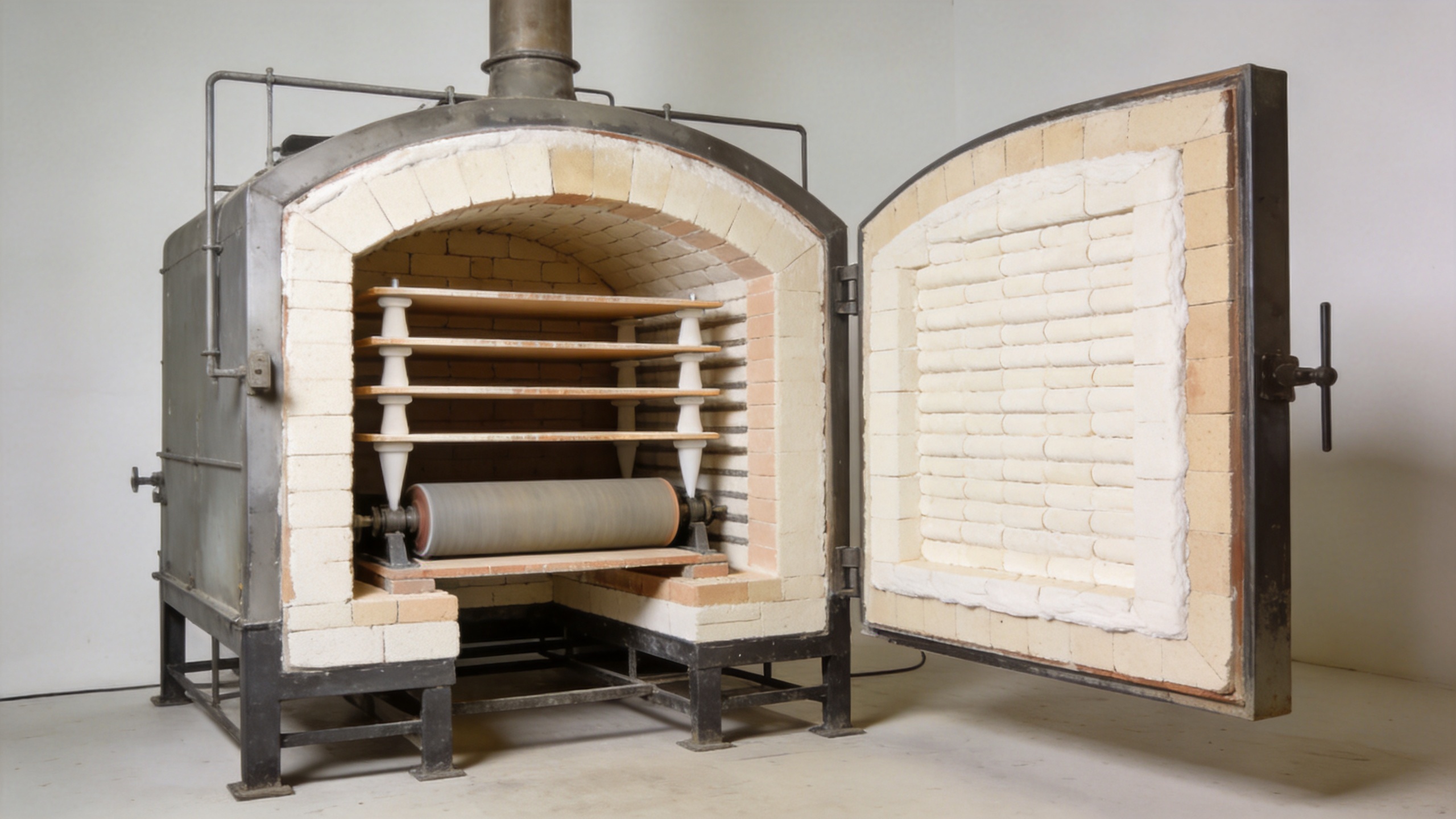
The most familiar application of refractory ceramics is the lining of industrial furnaces, ovens, incineration systems, and heat-treatment chambers. Linings protect steel shells and help define the process environment around the load. Depending on the temperature profile and atmosphere, the lining may need to resist oxidation, gas flow, particulate impact, or intermittent heating.
In practice, engineers map the furnace by zone: hearth, wall, roof, burner area, door area, and transfer section. Refractory ceramics are then specified with attention to operating temperature, peak excursions, heat-up rate, cool-down rate, chemical exposure, and backup insulation. A lining design also needs expansion joints and installation details that allow the system to move without concentrating stress in brittle sections.
2. Steel, foundry, and non-ferrous metal processing
Metal processing uses refractory ceramics in ladle areas, tundish systems, furnace linings, runner components, crucible-related hardware, and protective fixtures. These duties can combine heat with contact from liquid metal, slag, dross, or fluxes. In a foundry, the relevant question is usually not simply whether a material is refractory; it is whether its chemistry and structure are compatible with the specific melt and the duration of exposure.
Refractory silicon carbide is often evaluated for components where wear, thermal transfer, or demanding thermal service is part of the duty. Its use still requires grade-specific assessment because bonding phase, porosity, geometry, and atmosphere change the result. For refractory ceramics near liquid metal, the design review should include wetting behavior, cleaning practice, thermal cycling, and mechanical handling rather than relying on a material name alone.
3. Glass melting and glass-forming equipment
Glass furnaces place refractory ceramics in contact with high heat, batch dust, combustion products, and—at some locations—liquid glass. Typical applications include furnace linings, crowns, ports, burner blocks, forehearth structures, and supporting pieces. Each location has its own mix of temperature, vapor chemistry, load, and thermal gradient.
A zone-by-zone review avoids broad claims about a single “glass-furnace ceramic.” Refractory ceramics selected for a crown or port may face different requirements from components used around a forehearth or a forming area. Documentation of glass composition, furnace atmosphere, heating schedule, and maintenance method gives a supplier a more reliable basis for discussing material options.
4. Cement, lime, and mineral-processing kilns
In cement, lime, and mineral processing, refractory ceramics protect kiln shells, calcining equipment, coolers, ducts, and associated high-heat zones. The service environment can involve abrasive feed, dust, alkali-bearing deposits, thermal cycling, and mechanical vibration. The material decision must therefore connect process chemistry with lining geometry and anchoring practice.
Some refractory ceramics are chosen primarily for chemical compatibility; others are selected where thermal movement or abrasion is the dominant concern. A useful RFQ identifies the process material, peak and normal temperatures, flame or gas conditions, affected zone, existing failure pattern, and dimensions of the replacement area. Those details are more actionable than a request for a generic high temperature ceramic.
5. Ceramic kilns and kiln furniture
Firing operations use refractory ceramics not only as kiln linings but also as kiln furniture: shelves, posts, setters, bats, rollers, and support structures. Here, the component must carry a load while remaining stable through repeated firing cycles. Flatness, section thickness, loading arrangement, and heating rate can be as important as the nominal service temperature.
A cordierite ceramic is commonly considered where low thermal expansion can help manage rapid heating and cooling. A mullite ceramic is often considered where high-temperature strength and structural stability are important. In practice, refractory ceramics for kiln furniture should be reviewed alongside firing profile, load distribution, atmosphere, and the expected number of cycles; no material label substitutes for this operating information.
6. Radiant tubes, rollers, burners, and heat-transfer parts
Many continuous thermal processes need refractory ceramics as functional hardware rather than as linings. Examples include radiant tubes, burner tiles, recuperator-related parts, furnace rollers, thermocouple protection tubes, and heat-exchange elements. These parts may experience a steep temperature gradient across the wall, localized flame exposure, or bending loads during operation.
Refractory silicon carbide is relevant to some of these applications because silicon carbide grades can combine useful heat-transfer behavior with resistance to wear or harsh service. Yet design variables remain decisive: unsupported length, wall thickness, mounting method, atmosphere, and start-stop frequency should be checked before selecting refractory ceramics. A part that works in a stable atmosphere may require a different design in a cycling or oxidizing environment.
7. Chemical, energy, and environmental process equipment
Refractory ceramics also support chemical reactors, thermal oxidizers, waste-treatment equipment, catalyst-process systems, and high-temperature filtration or protection assemblies. These processes differ, but each requires heat management alongside corrosive gases, deposits, erosion, or cleaning methods. Dense components, porous bodies, insulation layers, and wear pieces each serve different purposes.
For these projects, a procurement team should provide the medium, gas composition where known, temperature range, pressure or flow condition, particle content, cleaning procedure, part drawing, and acceptance criteria. This turns a broad request for refractory ceramics into an engineering discussion with defined boundaries.
A practical selection checklist
Before choosing refractory ceramics, collect the following information:
- normal and maximum temperature, plus heating and cooling rates;
- atmosphere, process gas, hot process media, dust, slag, or chemical deposits;
- mechanical load, abrasion, impact, vibration, and installation constraints;
- part geometry, thickness, thermal gradient, and allowed deformation;
- expected maintenance practice, inspection interval, and failure observations.
For example, when a kiln support cracks after a rapid shutdown, check temperature gradient, fixture restraint, and load placement before changing from a cordierite ceramic to a mullite ceramic. The material may be part of the answer, but the installation can be part of the cause.
Conclusion
The main industrial applications of refractory ceramics include furnace linings, metal-processing hardware, glass-furnace structures, cement and mineral kilns, kiln furniture, heat-transfer components, and chemical-process equipment. Across these uses, refractory ceramics perform different jobs: containing heat, carrying loads, resisting wear, coping with thermal cycling, or separating equipment from a demanding process environment. Start with the operating conditions, then compare material families and component designs against those conditions. That approach makes the choice of a high temperature ceramic, refractory silicon carbide, mullite ceramic, or cordierite ceramic more specific and more useful.

