 EN


Why ceramic wire guide reduces yarn breakage during high speed weaving
In a high-speed weaving line, a yarn break rarely begins as one dramatic event. More often, it starts with a small source of drag: a worn contact point, a sharp transition, an eyelet that is no longer smooth, or a guide position that makes tension rise and fall too quickly. A ceramic wire guide can help control those contact conditions because it gives yarn a hard, stable, and polishable running surface. That benefit is real, but it is not automatic. The yarn type, line speed, wrap angle, tension setting, guide geometry, and installation all matter.
From a materials-selection perspective, the useful question is not simply “is ceramic better than metal?” It is whether the guide surface and path are appropriate for the yarn moving through them. A well-specified ceramic yarn guide can lower abrasion, keep the route more consistent, and reduce the chance that a small defect turns into a break at production speed.
How a ceramic wire guide changes the yarn path
A guide does more than point yarn in a new direction. It controls where the yarn touches, how sharply it bends, and how much friction is added at that location. In weaving, a ceramic wire guide may be an eyelet, pigtail, open guide, traverse element, or another shaped contact component. Its job is to lead the yarn with as little unintended damage as practical while still maintaining the required path.
Textile machinery references commonly describe thread guides as components used to guide, redirect, twist, and help control yarn tension. At higher speeds, that basic function becomes more demanding: the same local roughness or misalignment is encountered more frequently, and transient tension peaks can become more consequential.
A ceramic yarn guide is especially valuable when it holds a smooth running path over time. Instead of letting a contact point become progressively rougher as it wears, a suitable textile ceramic can retain a more consistent surface for longer under the intended conditions. That consistency helps the process team separate a true guide issue from tension, yarn-quality, or machine-setting issues.
Why ceramic surfaces can reduce abrasion-related breaks
Yarn breaks often have a friction component. Every time a yarn slides over a guide, it experiences contact pressure and movement. If the surface contains scratches, chips, embedded contamination, or an unfavorable edge, individual filaments can be scuffed or snagged. The damage may remain invisible at first, then show up as fuzz, lint accumulation, uneven tension, or repeated breaks at the same location.
Many textile ceramics use alumina ceramic materials because they can offer useful hardness and wear resistance. In a properly designed part, a polished alumina ceramic contact surface can resist the gradual grooving that may change a guide’s behavior. This is a material-and-finish advantage, not a promise that every alumina grade fits every fiber or process.
Surface finish matters just as much as material. A hard but poorly finished guide can still abrade yarn. Conversely, a carefully polished ceramic eyelet with an appropriate bore transition can let yarn pass more smoothly than a damaged component made from another material. For that reason, inspections should focus on the actual yarn-contact zone rather than judging the guide only by its overall appearance.
The breakage mechanisms to look for at high speed
When breakage rises after a speed increase, examine the guide path before assuming the yarn is at fault. These mechanisms are common candidates:
- Micro-abrasion: roughness, debris, or a worn groove gradually weakens filaments.
- Local tension spikes: a tight wrap angle, off-center entry, or sharp transition makes tension fluctuate as yarn travels.
- Heat at the contact point: higher sliding speed can make an already unfavorable friction condition more significant.
- Snagging: a chipped edge, cracked eyelet, or incorrect clearance catches hairs or filaments.
- Path instability: vibration or poor mounting allows the yarn to strike an edge instead of following a controlled curve.
A textile ceramic guide will not correct every one of these causes by itself. It can, however, remove one recurring source of path deterioration: an unsuitable or unstable contact surface. That is why the guide should be evaluated together with the yarn entry angle, exit angle, tension device, and nearby rollers.
Why geometry matters as much as ceramic material
It is tempting to specify “textile ceramic” as though that alone defines performance. It does not. The bore diameter, radius, groove profile, guide opening, mounting orientation, and yarn wrap angle directly affect how the yarn moves. A guide that is too small, too sharp, or incorrectly aligned can create excess contact pressure even if its material is excellent.
For a ceramic wire guide replacement, start with the original path rather than only the outside dimensions. Confirm the yarn or thread type, the speed range, the desired direction change, the existing guide location, and how the component seats in the machine. A guide can look like a direct fit while still changing the yarn path enough to alter running tension.
This is particularly important for a ceramic eyelet. Check the entry and exit transitions under magnification, not just the nominal hole diameter. A smooth, continuous transition is usually more relevant to yarn handling than a material label alone. If the guide is a custom part, share a drawing or a sample together with the operating conditions so material, profile, and tolerance can be discussed together.
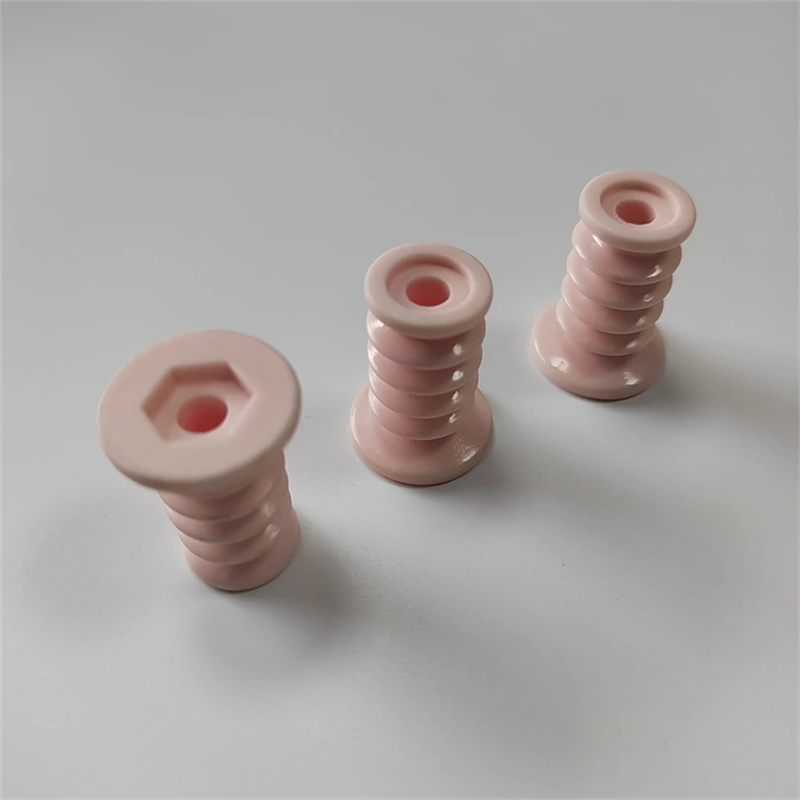
A practical inspection routine for ceramic yarn guide locations
Use a consistent inspection routine when a break cluster appears. First, stop treating the guide as a generic spare part. Record exactly where the break occurs and whether the yarn fails before, at, or after the guide. That observation helps determine whether the guide is the source of damage or simply the point where an existing weakness becomes visible.
- Clean the yarn-contact surface and remove lint or finish buildup.
- Inspect the contact area with adequate lighting and magnification for chips, grooves, cracks, or deposits.
- Check whether yarn enters and exits centrally rather than rubbing one side of the guide.
- Compare tension before and after the guide while the machine is operating under controlled conditions.
- Confirm that the holder is rigid and that vibration is not pushing the yarn against an edge.
- Review recent changes in yarn lot, speed, sizing, lubrication, humidity, or downstream tension settings.
This routine prevents a common maintenance mistake: replacing a guide without checking the reason it wore or why the path became misaligned. A new ceramic yarn guide may temporarily improve the symptom, but the same tension or mounting problem can shorten the life of the replacement.
Choosing between a standard and custom ceramic wire guide
A standard guide can be appropriate when the machine uses a known geometry and the operating window has not changed. A custom ceramic wire guide becomes more relevant when the yarn construction, route, speed, or mounting constraints differ from the original arrangement. In either case, the purchasing discussion should cover the yarn material, running speed, direction change, contact profile, installation dimensions, and the inspection criteria used at acceptance.
For alumina ceramic guides, it is sensible to ask about the intended application rather than demand a generic claim about wear life. The right choice depends on the grade, finish, geometry, mating hardware, and operating environment. That approach is more useful than a blanket statement that every textile ceramic will reduce breaks.
When a ceramic guide is not the root cause
If inspection shows a clean, smooth, correctly aligned ceramic wire guide, look beyond it. Yarn quality variation, excessive loom tension, package unwinding behavior, sizing changes, poor humidity control, damaged rollers, and unstable downstream take-up can all produce similar symptoms. A guide is a high-value checkpoint because it is a concentrated contact point, but it should be part of a wider diagnosis.
In practice, the most useful approach is to treat the yarn path as a system. A suitable ceramic yarn guide contributes a durable, smooth contact interface; the rest of the system must still deliver stable tension and correct alignment. That is the combination most likely to reduce abrasion-related breaks during high-speed weaving.
Key takeaway
A ceramic wire guide can reduce yarn breakage when it provides a smooth, wear-resistant, correctly shaped contact path for the actual weaving conditions. Check the material, polish, bore or groove geometry, alignment, mounting, and tension behavior together. If breaks persist, use the guide inspection as the beginning of a yarn-path diagnosis rather than the final answer.

