 EN


Why structural ceramics serve heavy load and high temperature mechanical parts
When a mechanical part must keep its shape while it sees abrasion, sustained load, heat, or a corrosive process environment, structural ceramics deserve a closer look. They are not a universal replacement for metal. Their value comes from a particular combination of stiffness, hardness, heat stability, and resistance to many wear mechanisms. The catch is equally important: structural ceramics are brittle, so the load path, geometry, assembly method, and thermal cycle must be considered as one engineering problem.
From a material-selection perspective, the useful question is not “Which ceramic is strongest?” It is “Which structural ceramics grade can carry this component’s actual compressive, bending, contact, and thermal stresses with an acceptable margin?” That question leads to better choices for bushings, seals, guides, fixtures, furnace hardware, insulation supports, and other ceramic parts.
What makes structural ceramics suitable for demanding mechanical duty?
Structural ceramics are engineered to function as load-bearing members rather than only as electrical insulators, decorative pieces, or chemical containers. In service, they often provide high hardness, strong resistance to abrasive wear, dimensional stability, and useful performance at temperatures where many polymers soften and many metals need more protection.
The atomic bonding that gives structural ceramics their stiffness also limits plastic deformation. That is an advantage when a part needs to resist indentation or preserve a precise contact surface. It is a disadvantage when a design creates a sharp stress concentration or unexpected impact. A ceramic component generally will not yield to redistribute an overload in the way a ductile metal may. Instead, a flaw can grow into a crack. Good design therefore reduces tensile stress, avoids abrupt section changes, and treats edges, holes, threads, and mounting forces as critical features.
Heavy load means more than high strength
For structural ceramics, “heavy load” needs a clear definition. A bearing pad under broad compression is different from a thin cantilever, a press-fit sleeve, or a rotating part exposed to impact. Dense engineering ceramics can be attractive where contact pressure and wear are high, but the same grade may be a poor choice if the component must repeatedly bend or survive mishandling during installation.
Start with the load path
- Compression: Ceramic materials are often effective when force is distributed over a stable seating surface.
- Flexure and tension: These deserve conservative analysis because surface flaws, not just bulk composition, can control failure.
- Contact and wear: Hardness can make structural ceramics useful for guides, nozzles, seals, and sliding interfaces, provided the mating material and lubrication are understood.
- Impact and vibration: These require extra caution; toughness, support design, and handling loads can matter more than nominal hardness.
That is why a drawing review matters before a material name is placed on a purchase order. Wall thickness, radii, surface finish, groove geometry, and the way the part is clamped can all change whether structural ceramics are working primarily in compression or being exposed to avoidable tensile stress.
Why high temperature changes the selection process
Heat does not simply test whether structural ceramics melt. A real high-temperature mechanical part must contend with thermal expansion, temperature gradients, creep, atmosphere, chemical exposure, and repeated heating and cooling. A component can have a high temperature capability on a data sheet yet still crack if one face heats much faster than the other or if a metal holder expands against it.
Thermal-shock resistance is especially relevant. The thermal cycle should be described in practical terms: starting temperature, peak temperature, heating and cooling rate, dwell time, gas or liquid contact, and the number of cycles. Those details help determine whether structural ceramics will see damaging gradients and whether the assembly can accommodate differential expansion.
For example, a tightly constrained ceramic ring can be placed in tension as an adjacent metal structure expands. Giving the assembly controlled clearance, compliant support, or a more appropriate joint design can be as important as changing the ceramic grade. The safest high-temperature decision combines materials data with the actual component geometry and a relevant test plan.
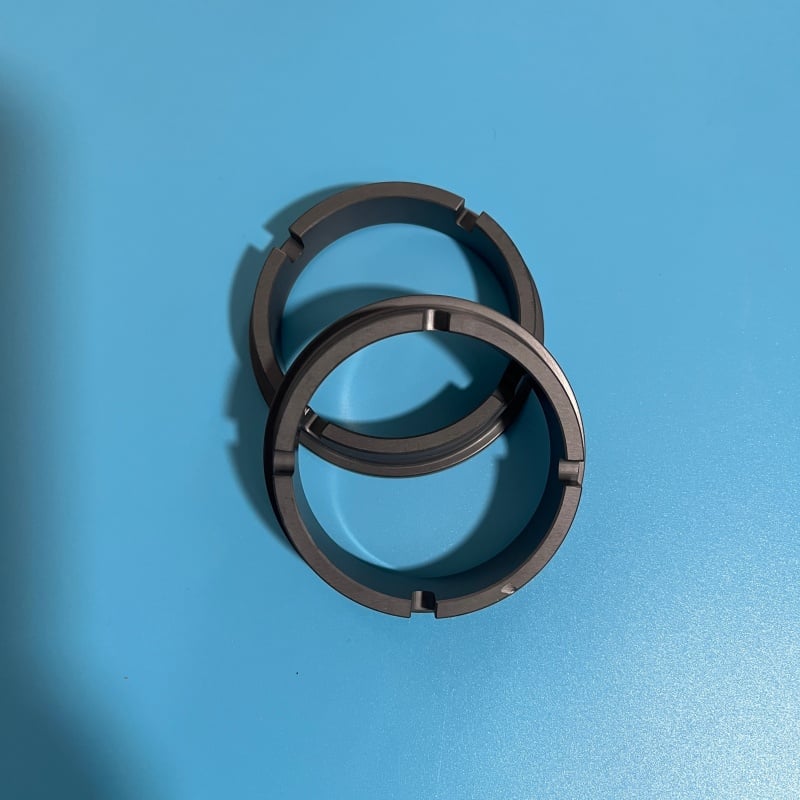 Structural ceramics should be selected with the load path, thermal cycle, and mounting method in view.
Alumina ceramic and mullite ceramic: different strengths, different checks
An alumina ceramic is commonly considered when hardness, wear resistance, stiffness, electrical insulation, and stable dimensional control are important. In the right grade and design, alumina ceramic components can serve abrasive contact points and compression-oriented parts well. However, the application still needs a realistic assessment of rapid thermal cycling, section thickness, and tensile loading; high hardness does not remove brittleness.
A mullite ceramic is often considered for hot-zone hardware and thermally demanding assemblies because mullite is associated with low thermal expansion, refractoriness, and good thermal stability. A mullite ceramic may therefore be a sensible direction where thermal cycling and temperature gradients dominate the requirement. It should not be selected by label alone: porosity, composition, firing route, dimensional tolerance, and the surrounding atmosphere affect the result.
The broader lesson is that structural ceramics should be compared by the failure mode they are expected to prevent. Alumina can be compelling for wear and rigid support; mullite can be compelling for certain high-temperature stability needs. Neither choice is automatically suitable without knowing the load direction, temperature profile, mating parts, and acceptance criteria.
A practical specification checklist for ceramic parts
Before requesting quotes for ceramic parts, organize the information that turns a broad request for structural ceramics into an engineering discussion:
- Provide a drawing, target dimensions, tolerances, and critical surface requirements.
- State static load, cyclic load, contact area, vibration, impact risk, and whether loads include bending or tension.
- Define the temperature range, ramp rates, dwell periods, and number of thermal cycles.
- Describe the atmosphere and process media, including abrasive particles, chemicals, moisture, or vacuum conditions.
- Identify mating materials and assembly forces, especially shrink fits, bolts, clips, and adhesive joints.
- Separate prototype validation from production acceptance, then agree on the tests needed for the application.
This checklist also keeps engineering ceramics conversations productive. It avoids promising a universal temperature or load limit when the meaningful limit depends on grade, shape, finish, and mounting conditions.
Design habits that help structural ceramics last
The most reliable results with structural ceramics usually come from designing for their strengths. Favor broad, even contact; generous radii; protected edges; and support that does not create a point load. Avoid forcing a ceramic part to correct a misaligned assembly. If a ceramic insert must be retained, examine assembly sequence and tolerance stack-up so the retention method does not preload it beyond its intended stress state.
It is also wise to treat material data as a screening tool, not a release approval. Test coupons can help compare candidates, but a finished part with holes, machining marks, and real fixtures can behave differently. For high-consequence applications, validate the actual ceramic parts under a representative load and thermal cycle.
Choose structural ceramics as a system decision
Structural ceramics serve heavy-load and high-temperature mechanical parts because they can combine hardness, stiffness, wear resistance, and heat stability in conditions that challenge conventional materials. Their limitations are just as design-relevant: limited tolerance for tensile stress, impact, stress raisers, and uncontrolled thermal gradients.
A sound selection process compares an alumina ceramic, a mullite ceramic, and other candidate structural ceramics against the component’s real operating conditions. Start with the load path and thermal cycle, then confirm geometry, assembly, material grade, and verification method. That disciplined approach helps turn a promising material family into a reliable mechanical component.

