 EN


Why piezoelectric ceramics can realize energy conversion in smart sensing devices
Smart sensing devices often have to do two jobs at once: detect a physical event and turn that event into an electrical signal that a circuit can use. Piezoelectric ceramics are useful in this setting because mechanical stress and electric charge are coupled inside the material. A small force, vibration, pressure change, or acoustic wave can create a measurable voltage; an applied voltage can also create controlled strain. That reversible behavior lets one component serve as a sensor, actuator, or energy-conversion element.
From an application-engineering perspective, selecting piezoelectric ceramics starts with the operating condition rather than a material name. The relevant questions are the excitation type, frequency range, geometry, mounting method, temperature, circuit impedance, and required signal stability. Those constraints determine whether the material is being used mainly for sensing, actuation, ultrasonic transmission, or limited energy harvesting.
The physical link between force and charge
The piezoelectric effect occurs when a material with a suitable crystal structure develops electrical polarization under mechanical stress. In a finished ceramic component, the microscopic domains are commonly aligned through a poling process so their response has a preferred direction. When the component is compressed, bent, or vibrated along that direction, charge appears on its electrodes. A sensing circuit can convert that charge into voltage, frequency information, or an event signal.
The reverse effect works in the other direction. An alternating electric field causes piezoelectric ceramics to change shape by a very small amount. At appropriate frequencies, the repeated strain can generate vibration or sound. This is why a piezoelectric transducer can both send and receive energy in a sensing system. The same coupling principle supports contact sensing, vibration monitoring, ultrasonic inspection, and acoustic ranging.
It is important not to equate a material property with finished-device performance. The useful output from piezoelectric ceramics depends on electrode layout, thickness, resonant mode, cable loading, amplifier input, enclosure stiffness, and the way the part contacts the measured object.
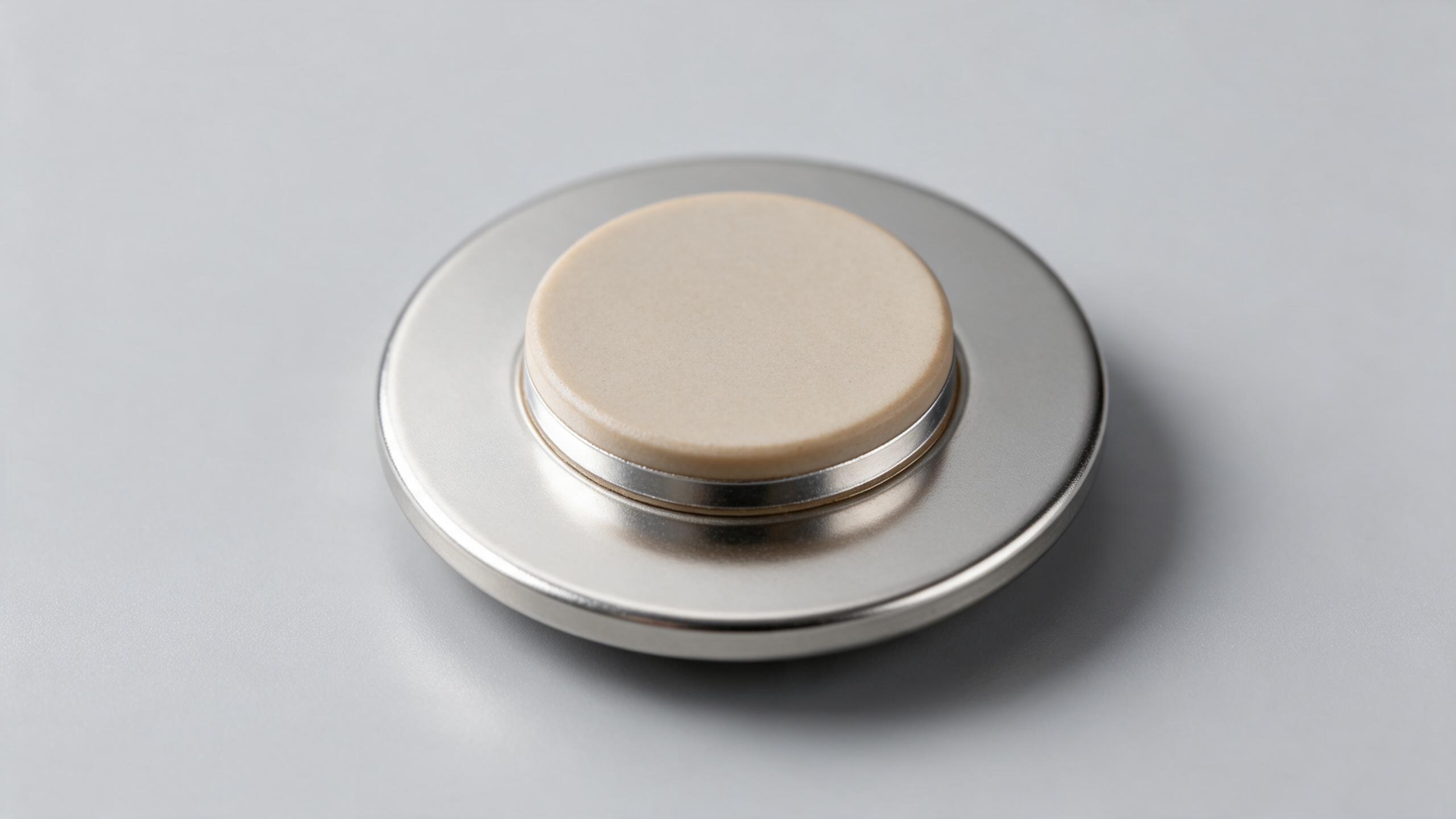
Why PZT ceramic is widely considered for sensing elements
A PZT ceramic is a lead zirconate titanate composition used in many established piezoelectric designs. It is often considered when a design needs a strong electromechanical response in a compact element. Different formulations can be tuned toward higher sensitivity, different mechanical behavior, or different loss characteristics, so “PZT ceramic” alone is not a complete specification.
For a design review, the more practical sequence is to define the target signal and working mode first. A thin disc used as a vibration pickup has different constraints from a ring used in an ultrasonic ceramic assembly. The designer should then identify the drive or sensing frequency, expected force direction, electrode configuration, mounting preload, and environmental limits. Those inputs help establish whether piezoelectric ceramics are appropriate and what geometry should be evaluated.
In smart sensing devices, a PZT ceramic may be used as the active layer that translates a local mechanical event into an electrical quantity. The surrounding electronics still matter. Charge amplifiers, filtering, shielding, and sampling logic shape the final measurement, while the mechanical package affects which vibration paths reach the element.
Energy conversion in a smart sensing architecture
The energy conversion performed by piezoelectric ceramics is direct but application-dependent. In sensing mode, mechanical energy enters the ceramic and a small electrical signal leaves through the electrodes. In actuation mode, electrical energy enters and controlled mechanical motion leaves. A smart device adds signal conditioning, processing, communication, or control around that conversion step.
Consider a machine-mounted vibration node. Its ceramic element can respond to changing strain or acceleration transmitted through the housing. The front-end circuit interprets the generated signal, while software compares trends or detects unusual events. The ceramic is not an autonomous diagnosis system; it is the conversion connection between the physical event and the electronics. That distinction helps teams set realistic requirements for piezoelectric ceramics.
For intermittent mechanical sources, engineers may also investigate whether piezoelectric ceramics can contribute energy to a storage or low-power sensing circuit. The result depends heavily on excitation consistency, mechanical coupling, conversion losses, power-management design, and duty cycle. This use case should be evaluated with representative tests rather than assumed from open-circuit voltage alone.
Where a piezoelectric transducer and ultrasonic ceramic fit
A piezoelectric transducer is the completed structure that couples electrical and mechanical energy for a defined task. It may contain one ceramic element or multiple elements, plus electrodes, backing, matching layers, leads, and a housing. In an ultrasonic device, the ultrasonic ceramic is usually selected and assembled so that its vibration mode supports the required frequency and energy transfer path.
This distinction matters during procurement and design communication. Asking for a piezoelectric transducer calls for system information such as operating frequency, dimensions, mounting connection, drive conditions, and intended medium. Asking for an ultrasonic ceramic may focus more directly on the ceramic shape, polarization direction, electrode pattern, and resonance requirement. Both can involve piezoelectric ceramics, but they are not interchangeable purchase descriptions.
Design inputs that affect real sensing results
The following checklist turns a broad material request into a technical discussion:
- Measured stimulus: Specify pressure, impact, bending, acceleration, acoustic energy, or another input, including its expected direction.
- Frequency behavior: State the useful band and whether resonance is intended or should be avoided.
- Geometry and electrodes: Diameter, thickness, ring dimensions, metallization area, and lead connection affect capacitance and field distribution.
- Mechanical integration: Bonding, clamping, preload, and adjacent materials can change how energy reaches piezoelectric ceramics.
- Electrical connection: Define cable length, input impedance, filtering, drive voltage where applicable, and the required output format.
- Environment and acceptance: Discuss temperature exposure, humidity, vibration, handling, sample validation, and any application-specific test method.
Those details also help separate a feasible ceramic part from an incomplete request. A material may show the desired effect in a data sheet yet perform differently after it is bonded into a dense sensor package. More accurately, the material is one part of a mechanical-electrical system.
How to choose the right development path
For early prototypes, begin with the sensing objective and map it to a conversion mode: direct charge generation, reverse vibration generation, or a transmit-receive function. Next, build a simple stack-up showing the ceramic, electrodes, fixture, measured medium, and electronics. This approach makes it easier to identify the assumptions behind a proposed PZT ceramic or ultrasonic ceramic.
For custom discussions, provide drawings, required frequency, usable dimensions, mounting details, and the conditions under which the signal will be accepted. Highborn Technology can organize technical communication around dimensions, frequency, and assembly conditions for piezoelectric transducer components. Final suitability should be confirmed against the actual device environment and validation plan.
Conclusion
Piezoelectric ceramics realize energy conversion because their electromechanical coupling links stress with charge and voltage with strain. In smart sensing devices, that makes piezoelectric ceramics a practical connection between a physical event and an electronic system. Whether the application uses a PZT ceramic for force sensing, a piezoelectric transducer for vibration conversion, or an ultrasonic ceramic for acoustic energy, the durable design decision comes from matching the ceramic, geometry, circuit, and mounting conditions to one defined task.

