 EN


Why silicon carbide ceramic is preferred for wear resistant liner applications
Wear liners are asked to do more than survive contact with abrasive solids. They must fit the equipment, distribute loads sensibly, tolerate temperature changes, and remain secure when a chute, cyclone, pipe, mill, or separator is in service. From an application-engineering viewpoint, silicon carbide ceramic is often considered when severe sliding abrasion is the dominant problem, but the material choice should still start with the operating conditions rather than a material name.
A liner can look suitable on a drawing and still underperform if the particle stream strikes an unsupported edge, the backing is uneven, or impact loading is higher than expected. For that reason, a silicon carbide ceramic liner discussion should include particle size, velocity, angle of attack, temperature, corrosion exposure, liner geometry, attachment method, and inspection access.
Why abrasive duty points engineers toward silicon carbide ceramic
Hard abrasive particles remove material by cutting, plowing, rolling, or repeated sliding contact. The appeal of silicon carbide ceramic in this setting is its high hardness and its established use in abrasive environments. A published NIST dataset for sintered alpha-SiC, for example, reports room-temperature Vickers hardness near 32 GPa. That is an illustrative material value, not a specification for every grade or finished liner, yet it helps explain why SiC is considered for demanding abrasive contact.
Hardness alone does not describe a complete wear system. Feed consistency, particle shape, moisture, flow direction, local turbulence, and the material on the opposing surface can all change the wear pattern. Still, where the mechanism is mainly sliding abrasion rather than large-impact breakage, silicon carbide ceramic can offer a practical balance of hardness, chemical stability, and thermal behavior for a liner design.
Wear resistance is a system property, not a catalog phrase
A technical wear study on SiC- and silicon-nitride-based ceramics identifies abrasion, thermal stress, fatigue, and contact interactions as relevant contributors to wear. This is useful context for liner planning: a hard surface is helpful, but the contact conditions decide whether that hardness is being used effectively. A silicon carbide plate installed over a flat, well-supported surface may see a different stress pattern from a shaped tile mounted near a high-velocity bend.
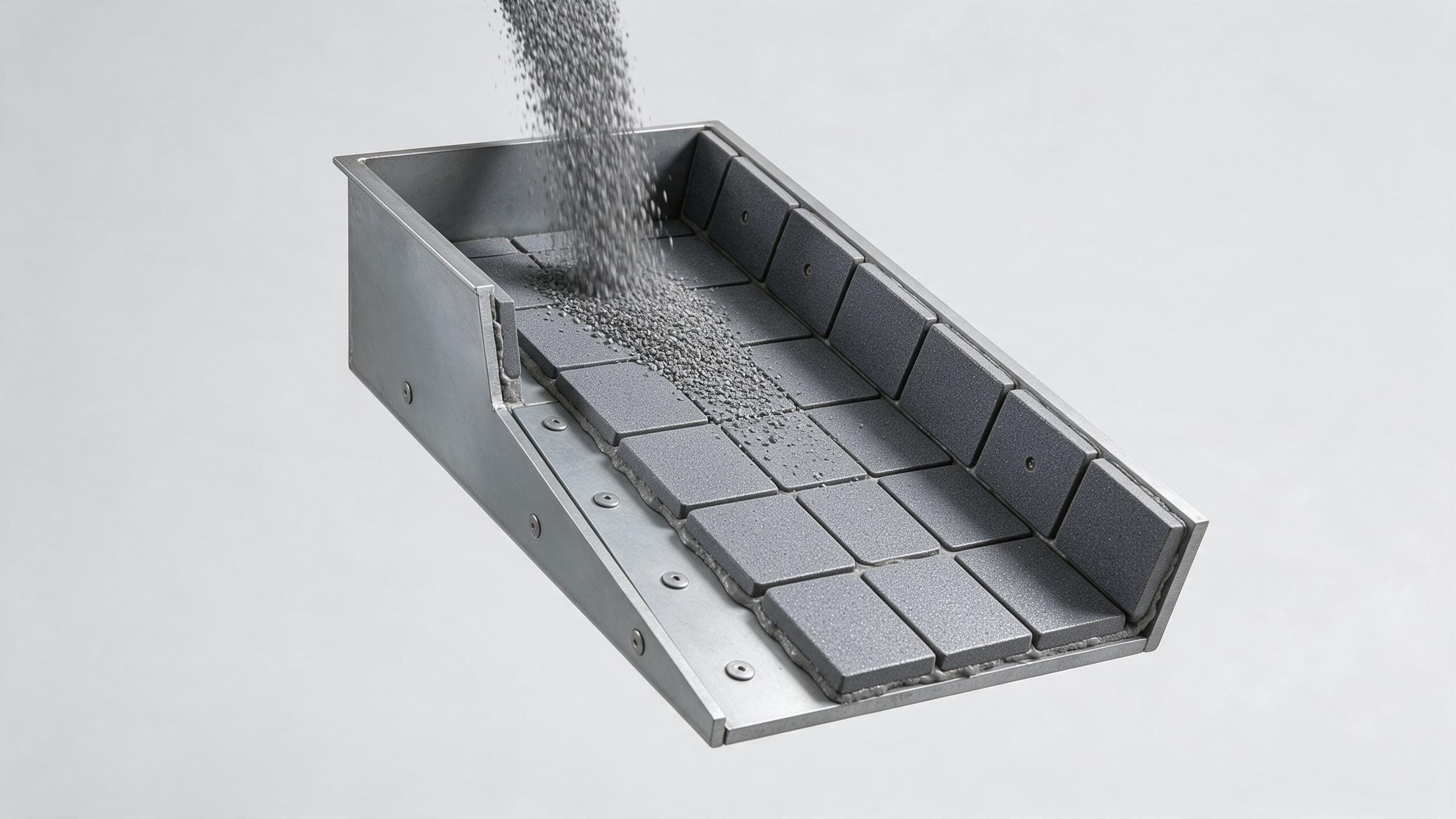
Ask where material is actually lost. A broad, shallow abrasion zone may favor one geometry, while a concentrated stream can demand different joints, tile sizes, or sacrificial layout. A silicon carbide plate may be appropriate for broad coverage, whereas smaller segments can make replacement and fit easier around complex shapes. In either case, the supplier needs the local dimensions and the location of the highest wear rather than only an overall equipment size.
Processing route and grade affect the decision
“SiC” does not identify one uniform material. Density, porosity, grain structure, bonding phase, and manufacturing route influence the behavior of a finished silicon carbide ceramic component. Published reference tables show that hardness and fracture-toughness values vary across sintered, hot-pressed, reaction-bonded, and other SiC routes. Therefore, material data should be requested for the actual grade under consideration, along with the relevant test method and test conditions.
This is especially important when a drawing calls for thin sections, holes, notches, tight radii, or interrupted support. A SiC ceramic part may be highly suitable for abrasion, yet it is still a ceramic component with limited tolerance for local tensile stress and abrupt impact. The design review should identify unsupported spans, bolt-seat loads, edge contact, and assembly methods that could introduce point loading.
Heat, chemistry, and thermal movement can strengthen the case
Many wear systems also introduce heat through process temperature, friction, or thermal cycling. Silicon carbide is valued for high thermal conductivity and relatively low thermal expansion compared with many structural materials. Those characteristics can support stable service when temperature gradients matter, but compatibility with the substrate and attachment system still needs review. The liner, adhesive or grout, backing, and steel shell do not expand in the same way.
For a heated abrasive stream, silicon carbide tubes can be considered where the component also needs a wear-facing flow path. The same caution applies: confirm the grade, wall thickness, support arrangement, media chemistry, and expected temperature cycle. The phrase silicon carbide tubes describes a shape, not a complete suitability statement.
Geometry and installation protect the material from avoidable damage
Good liner performance depends on how force enters the ceramic. Avoid forcing a silicon carbide plate onto a distorted substrate or relying on a small contact area to carry a large clamp load. Use joints and gaps that accommodate tolerances, and review whether the liner is meant to resist sliding abrasion, direct impact, or both. When impact cannot be reduced, a layered arrangement, a change in flow path, or a different material system may deserve evaluation.
Circular and sealing-adjacent arrangements need the same discipline. A SiC ring should be checked for concentricity, support, mating-surface condition, and loading path before the material is selected. In some assemblies, a SiC ring sees wear plus pressure or thermal gradients; those combined demands should be reviewed against grade-specific data rather than assumed from a general materials description.
Turn a liner request into an actionable specification
The most efficient RFQ separates what is known from what still needs confirmation. Start with the service environment, then define the component geometry and acceptance expectations. This approach helps both engineering and purchasing teams compare a silicon carbide ceramic option with alternatives on the conditions that matter.
- Describe the abrasive medium, approximate particle size, hardness, moisture, and chemistry.
- State flow velocity, impact angle, pressure, temperature range, and cycling conditions.
- Provide drawings or measured dimensions for the lining area, bends, holes, joints, and backing surface.
- Identify whether a silicon carbide plate, silicon carbide tubes, SiC ring, or another SiC ceramic part is being evaluated.
- Clarify sample, production quantity, inspection points, packaging, and replacement access.
How to make the preference defensible
Silicon carbide ceramic is often preferred for wear-resistant liner applications because its hardness, wear behavior, chemical resistance, and thermal characteristics can align well with severe abrasive duty. The preference is strongest when those properties match the actual mechanism of wear and when the liner has appropriate support and installation details. It is less useful to treat the material as a universal answer for every impact, geometry, or process condition.
For a productive technical review, share the wear location, process data, drawings, and desired inspection criteria. That information allows a proposed SiC ceramic part to be evaluated as part of the equipment system, not merely as a material label. A careful grade and geometry review is the sound basis for deciding whether silicon carbide ceramic belongs in the liner design.

