 EN


Why porous ceramic is suitable for stable essential oil aroma release
A passive diffuser has a deceptively simple job: take up a liquid fragrance and let it move into the air at a measured, useful pace. Porous ceramic is often suitable for that task because its connected voids can hold oil, its internal surfaces can distribute liquid, and its exposed surface can support gradual evaporation. From an application-engineering perspective, however, the material name alone does not settle the question. Pore structure, oil blend, component geometry, and the intended use environment all shape the release profile.
That distinction matters when developing a ceramic aroma diffuser or a small replacement component. A diffuser that takes up oil quickly but releases it unevenly may create a strong early note and little later presence. One that is too dense may absorb too little liquid. A useful design starts by treating porous ceramic as a controllable transport medium rather than as a decorative material.
How a porous ceramic supports passive fragrance release
A porous body contains internal spaces rather than being fully dense. When the pores are open and interconnected, essential oil can enter the structure through capillary action. The liquid spreads along pore walls and is retained within a network of small reservoirs. At the external surface, volatile fragrance compounds transfer from the liquid phase to the surrounding air.
This arrangement separates storage from evaporation. Instead of leaving the full oil volume exposed in an open container, a porous ceramic disc presents a distributed liquid contact area across the component. That can help moderate the initial release compared with a large exposed pool of oil. Research on porous coatings for essential-oil release has likewise described capillary action slowing the delivery of volatiles into the headspace relative to bulk oil. It is a useful mechanism reference, not a promise of a fixed release rate for every formulation or part.
In practical terms, porous ceramic can contribute three linked functions:
- Liquid uptake: accessible pores draw in a compatible oil blend.
- Internal distribution: a connected pore network helps move liquid beyond the first contact point.
- Surface-fed evaporation: oil reaching the outer surface can release aroma without a pump, heat source, or electrical system.
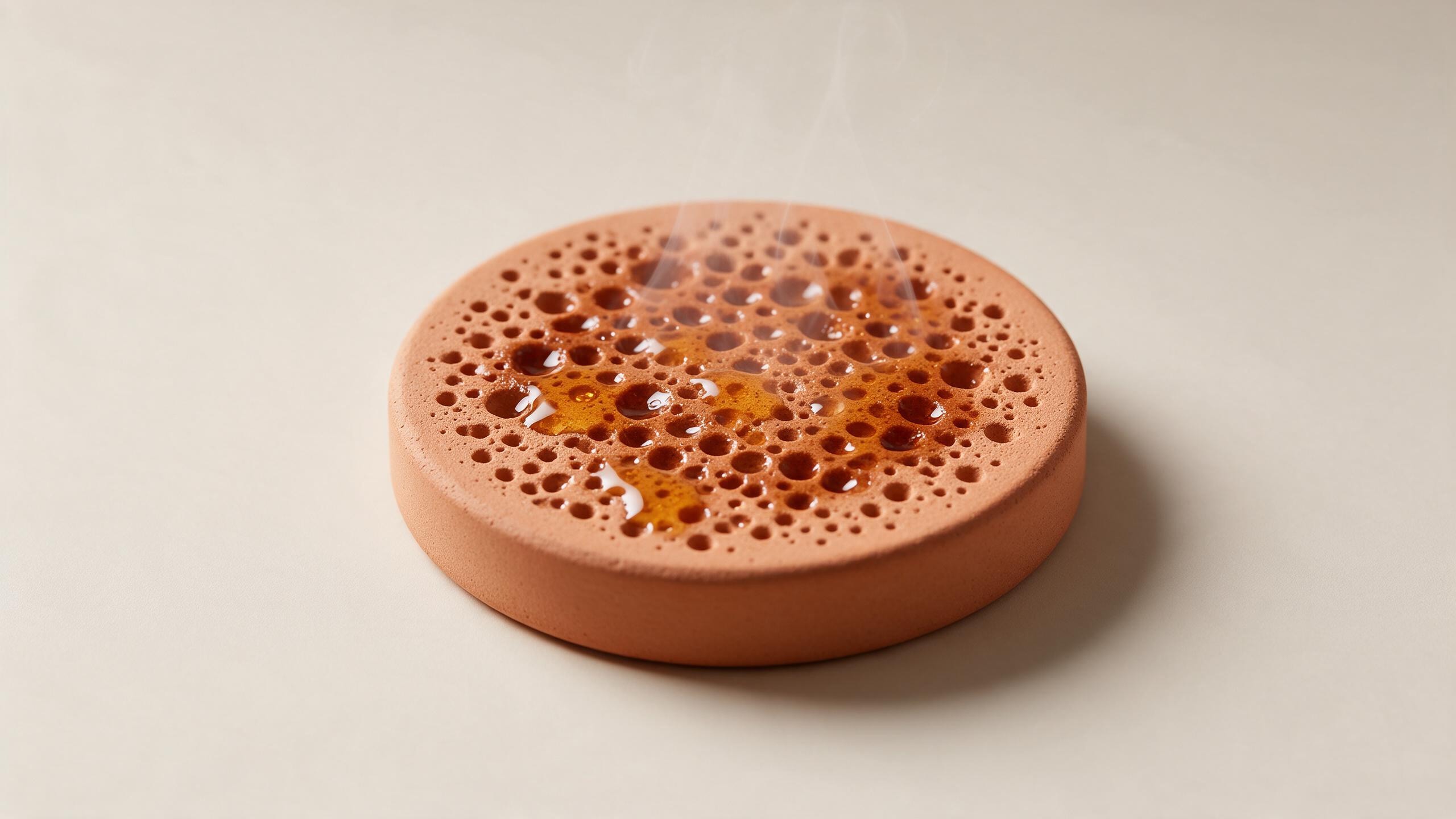
These functions are why a porous ceramic component may be considered for passive scent applications, including a ceramic aroma diffuser, an absorbent insert, or a small fragrance-holding element.
Pore size and pore connectivity affect the release curve
Porosity is not a single specification. Two components can both be described as porous yet behave differently because their pore size distribution, total open porosity, tortuosity, and thickness differ. Large, highly open channels may support faster loading and faster evaporation. Finer or more tortuous pathways may slow liquid movement and make the aroma release feel more gradual. Neither result is automatically preferable; the right direction depends on the expected refill interval, scent strength, component size, and room conditions.
For a porous ceramic disc, the useful question is not simply “Does it absorb oil?” A more informative set of questions is: How much oil is taken up under the planned filling method? Is wetting uniform across the disc? Does the part weep when handled? How does its mass change over time in the target oil blend? Those checks reveal whether the pore architecture and shape are working together.
Pore connectivity is especially important. Closed pores may reduce density but do little for liquid transport. Open, connected pores can form capillary paths from the loaded region to an evaporation surface. Still, more connectivity should not be assumed to mean more stable output. If liquid moves too freely, the initial release can be front-loaded. If pathways are too restrictive, the external surface may not remain supplied. The aim is a repeatable balance between retained liquid and surface replenishment.
Why formulation compatibility matters as much as the ceramic
A ceramic wick does not work independently of the liquid. Essential oils, fragrance compositions, diluents, and additives can differ in viscosity, surface tension, volatility, and interactions with the pore surface. A blend that loads evenly in one porous ceramic body may spread more slowly or leave more residue in another. Temperature and ventilation can also change the visible aroma output.
For that reason, product developers should test the actual formulation rather than infer results from water or a single reference oil. A small comparison can be revealing: condition identical samples, load them with the same mass of liquid, place them in controlled conditions, and record mass loss and surface appearance at planned intervals. The goal is not to create a universal number; it is to identify whether the selected porous ceramic and formula produce a repeatable pattern under relevant conditions.
This is also where a ceramic atomizer core and a passive fragrance element should be kept conceptually separate. An atomizer core belongs to a system that may use ultrasonic, thermal, or other active mechanisms. A passive ceramic element relies primarily on uptake, capillary transport, and evaporation. The materials may share some design questions, but the system requirements are not identical.
Geometry and finish influence real-world stability
Component shape determines how much liquid the part can store and how much surface it presents to air. A thicker element may have more internal volume, but it may also take longer to condition. A thin porous ceramic disc can respond quickly, yet it has less reserve. Surface texture, mounting orientation, contact with a holder, and whether one or both faces are exposed all influence evaporation.
It is easy to focus only on the ceramic material and overlook assembly details. More accurately, first confirm the disc diameter, thickness, mounting clearance, fill method, and whether the holder blocks part of the evaporation surface. Then evaluate the material choice. This approach reduces the chance that a sound ceramic specification is undermined by a poorly matched housing.
For further background on the relationship between pore design and fragrance behavior, see our guide to porous ceramic aroma diffusers and pore size.
A practical evaluation checklist
Before selecting a porous ceramic part for an essential-oil application, document the conditions that actually govern release:
- Specify the essential-oil or fragrance formulation, including any diluent liquid.
- Define the target component dimensions and the surfaces that will remain exposed.
- Measure uptake by mass, not only by visual wetting.
- Observe leakage, residue, discoloration, and handling behavior after loading.
- Track mass loss and sensory output over a planned interval at relevant temperature and airflow.
- Compare more than one pore structure or thickness if the target release profile is not met.
This checklist turns a general material discussion into an engineering conversation. It also creates a clearer path for discussing custom ceramic parts: provide the intended liquid, desired component size, loading method, exposure conditions, and any acceptance criteria. Those inputs are more useful than asking whether porous ceramic is “good” in the abstract.
Conclusion: suitability comes from controlled transport
Porous ceramic is suitable for stable essential-oil aroma release when its open pore network, geometry, and formulation compatibility are matched to the intended passive-diffusion task. Its value lies in controlled liquid uptake, internal distribution, and surface-fed evaporation—not in an unconditional performance claim. A ceramic aroma diffuser or ceramic wick should therefore be validated with the actual oil blend and housing conditions. By checking pore behavior, dimensions, and release over time together, developers can make a more reliable choice for their application.

