 EN


Why boron nitride is compatible with vacuum environment working conditions
When engineers ask whether boron nitride belongs in a vacuum assembly, the useful answer is usually “it can, if the grade and preparation match the duty.” That distinction matters. A material may retain attractive heat-management and electrical properties in a vacuum, yet a finished part can still be unsuitable if its binder system, absorbed moisture, machining residues, porosity, or mounting arrangement have not been considered.
From a material-selection perspective, boron nitride is often considered for hot-zone insulation, electrical isolation, spacers, guides, and a boron nitride fixture where heat must be transferred from one area without creating an electrical path. The decision should begin with the vacuum level, operating temperature, nearby materials, contamination budget, and the actual ceramic grade—not with a generic statement about BN.
Why boron nitride can suit vacuum service
Most machined BN parts are based on hexagonal boron nitride. This structure gives boron nitride a useful combination of electrical insulation, thermal stability in controlled atmospheres, thermal conductivity, and machinability. In a vacuum system, that combination can be valuable where a component must isolate an electrode or sensor while also tolerating a thermal gradient.
A boron nitride ceramic component can also be preferable to a conductive material when the design requires electrical separation. For a vacuum furnace or process chamber, this can simplify a fixture concept: the part can support or locate a component while the engineering team evaluates heat flow and electrical clearance together. It does not mean every BN grade is interchangeable, but it explains why the material appears in many high-temperature and electrically insulated assemblies.
Published supplier information illustrates the importance of atmosphere. One dense BN composite product range lists vacuum or inert-atmosphere temperature limits that are substantially higher than its oxidizing-atmosphere limits. That is not a universal rating for all boron nitride; it is a reminder that a vacuum environment removes one failure driver while leaving grade-specific limits, load, geometry, and process cleanliness to be checked.
Vacuum compatibility is a part-level question
Vacuum performance is not defined by chemistry alone. A BN ceramic billet may contain additives or binders that make hot pressing, density control, or machining practical. Those constituents can alter outgassing behavior, moisture sensitivity, and the temperature at which a part is acceptable. Surface condition and stored contamination also matter, especially when the chamber has a tight particle or residual-gas requirement.
For that reason, treat the phrase “vacuum compatible” as a qualification target rather than a material label. A hot pressed boron nitride grade with low residual binder may be evaluated differently from a more binder-rich, porous, or moisture-exposed grade. The appropriate comparison is the supplier’s data sheet and qualification evidence for the specific grade, not a property chart for BN in general.
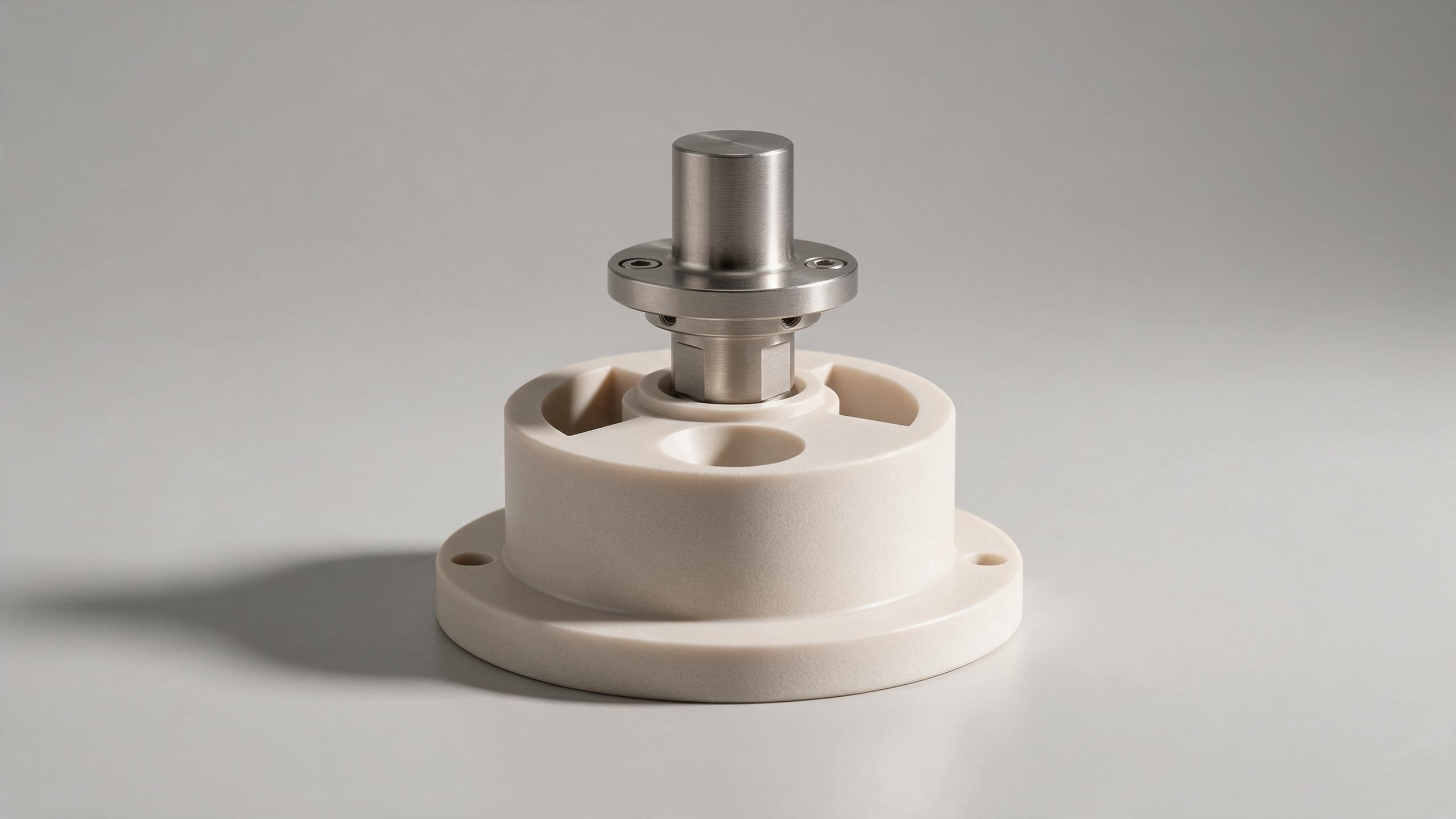
Five conditions to review before selecting a boron nitride fixture
1. Vacuum level and contamination sensitivity
Define whether the application is rough vacuum, high vacuum, or an environment with much stricter residual-gas and particle constraints. The tighter the contamination budget, the more important it becomes to document the boron nitride ceramic formulation, its cleaning history, handling controls, and any bakeout procedure. A material that is practical for a general vacuum furnace may need additional validation for a sensitive deposition, analytical, or semiconductor process.
2. Grade, binder, density, and porosity
Ask for the grade name, composition summary, processing route, density range, and binder information. These details help an engineering team decide whether a BN ceramic part is appropriate for the target pressure and temperature. They also help distinguish a general machining grade from a hot pressed boron nitride option intended for more demanding cleanliness or thermal conditions.
3. Temperature, heat path, and thermal cycling
Vacuum removes convective cooling, so conduction and radiation dominate the thermal balance. The part must therefore be reviewed as part of the complete assembly: heater proximity, contact area, shielding, fastening, thermal expansion of adjacent materials, and cycling rate can all change the local temperature. A boron nitride fixture should be evaluated under its expected load and mounting condition rather than as a free-standing coupon.
4. Electrical requirements
When electrical isolation is a design objective, verify voltage, creepage distance, surface condition, and the effect of deposited films or process residue. Boron nitride may support an insulating design, but a chamber environment can change surfaces over time. This is one reason a part drawing should identify the areas that must remain clean and electrically isolated.
5. Fabrication and cleaning route
Machining can make boron nitride attractive for complex seats, rings, and supports, but the drawing should state critical tolerances, thin sections, acute edges, and contact faces. Then specify the cleaning method, packaging, and handling expectations before the component enters the chamber. A well-chosen material can still introduce avoidable risk if machining dust, oils, fingerprints, or unsuitable cleaning residues travel with it.
A practical qualification workflow
Consider an anonymous example: a team needs an insulating locator near a heated element in a vacuum chamber. Instead of simply requesting “a BN part,” the team can make the choice traceable with a short sequence:
- Document chamber pressure, operating temperature, thermal cycle, electrical duty, and nearby process materials.
- Identify whether the part is a structural support, an electrical insulator, a heat-transfer element, or all three.
- Compare candidate boron nitride grades using grade-specific composition, temperature, density, and cleanliness information.
- Review the drawing for stress concentrations, clamp loads, differential expansion, and service-side surfaces.
- Agree on cleaning, packaging, acceptance checks, and—where the process is sensitive—sample or assembly-level validation.
This workflow keeps the claim proportional to the evidence. It does not assume that every boron nitride ceramic part is ready for every vacuum task. It identifies what must be confirmed before purchase or installation.
When boron nitride needs extra scrutiny
Extra review is sensible when the application requires ultra-low outgassing, high-temperature cycling, a very clean process volume, a tightly controlled electrical surface, or a component that carries mechanical load. In these cases, request the specific grade documentation and discuss whether testing should be performed on the finished part or representative assembly. Pay attention to binder content, porosity, exposed area, cleaning, storage humidity, and process deposits.
It is also worth separating material suitability from fabrication suitability. A hot pressed boron nitride billet may be a sound starting point, while a thin, sharply notched, poorly supported geometry can still create a mechanical risk. Likewise, a boron nitride fixture may work well in one thermal layout and require redesign when contact conditions or cycle rates change.
What to include in an RFQ
For a useful discussion of boron nitride, provide a drawing or key dimensions, grade preference if one exists, quantity, vacuum level, operating and peak temperature, thermal cycle, electrical requirements, mating materials, and cleanliness expectations. State whether the part will be exposed to process gases, coatings, process materials, or direct radiation. This gives the supplier enough context to discuss material, geometry, and inspection limits without overstating what a generic BN label can establish.
Conclusion
Boron nitride is compatible with many vacuum working conditions because selected grades can combine electrical insulation, thermal functionality, chemical stability, and machinability. The dependable conclusion is conditional: assess the specific boron nitride ceramic grade, binder system, part geometry, cleaning route, vacuum level, and temperature profile together. With those checks in place, a BN ceramic component or boron nitride fixture can be evaluated on engineering evidence rather than assumptions.

