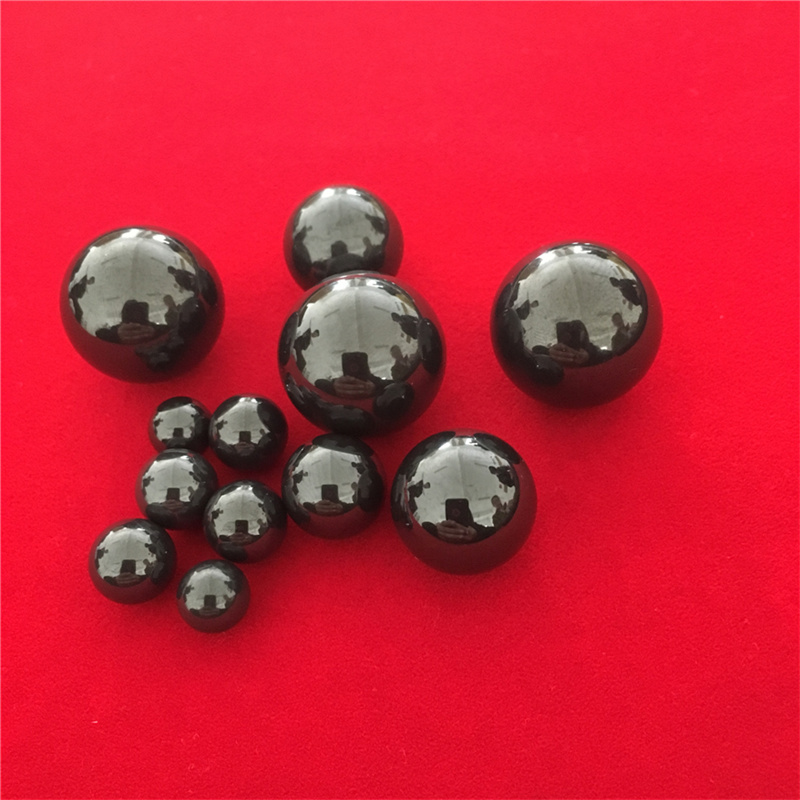
Silicon nitride really stands out when dealing with high stress situations because it has some pretty impressive mechanical characteristics. Take fracture toughness for instance it measures around 6 to 8 MPa root m, which is roughly three times better than what we see in alumina ceramics according to ScienceDirect from last year. What makes this material so tough? Well, it all comes down to that beta phase crystal structure inside. The long grains basically lock together like puzzle pieces, making it much harder for tiny cracks to spread through the material when subjected to repeated loads.
The material’s flexural strength reaches 1,000 MPa, surpassing zirconia (650 MPa) and silicon carbide (550 MPa). Unlike these alternatives, silicon nitride retains 85% of its room-temperature strength at 800°C, as demonstrated in thermal stress simulations.
This exceptional toughness is driven by three key factors:
Advanced sintering techniques produce a fine-grained matrix (1–3 µm) reinforced with larger β-phase crystals. This “self-reinforced” structure improves load distribution, enabling silicon nitride bearings to endure 20% higher Hertzian contact stresses than steel counterparts in turbine applications.
Silicon nitride bearings exhibit outstanding resistance to rolling contact fatigue (RCF), maintaining integrity under cyclic stresses exceeding 4 GPa. A 2024 study published in Surface and Coatings Technology revealed that silicon nitride’s grain boundary chemistry reduces subsurface crack initiation by 40% compared to steel bearings, even in high-load turbine environments. This behavior stems from covalent atomic bonds that efficiently dissipate energy during stress cycles.
Collaborative trials with aerospace and industrial partners showed a 60% increase in bearing service life using silicon nitride hybrid designs. These bearings endured over 500,000 load cycles in jet engine simulations without measurable wear, outperforming steel equivalents by a 3:1 margin. Field data confirmed reduced maintenance frequency, especially under fluctuating radial loads.
The homogeneous microstructure of silicon nitride minimizes stress concentration points, resulting in a 75% reduction in spalling failures compared to zirconia-based ceramics. Failure shifts from sudden fracture to gradual wear, enabling predictive maintenance. Surface profilometry tests showed 85% less material loss after 1,000 hours in abrasive conditions.
With a Vickers hardness of approximately 15 GPa—nearly double that of hardened steel—silicon nitride resists adhesive and abrasive wear effectively. In dry-running tests at 400°C, wear rates remained below 0.02 mm³/Nm, making it ideal for oil-free operations. The balance between hardness and toughness ensures reliable performance in contaminated environments where steel bearings typically suffer pitting.
The lower density of silicon nitride at around 3.2 grams per cubic centimeter cuts down on centrifugal forces by as much as 60 percent when compared with steel which weighs in at 7.8 g/cm³. This means components can run smoothly even when spinning at over 1.5 million DN units (that's diameter multiplied by revolutions per minute). The benefit really shines through in things like airplane turbine shafts and those tiny but vital spindles found in medical devices. Steel bearings tend to fail sooner because they just can't handle all that inertial stress over time. Studies from material scientists show these reduced stresses actually extend maintenance periods by somewhere between 12 and 18 percent for industrial turbochargers. Makes sense why so many manufacturers are switching materials nowadays.
| Material | Density (g/cm³) | Centrifugal Stress at 50k rpm | Heat Generation |
|---|---|---|---|
| Silicon Nitride | 3.2 | 220 MPa | 35°C Increase |
| Steel | 7.8 | 580 MPa | 82°C Increase |
The 3.4:1 density ratio enables lighter bearing assemblies without compromising load capacity—a decisive factor in Formula 1 hybrid powertrains, where teams achieve 11% faster acceleration through mass reduction.
Silicon nitride bearings can spin about 25 to 40 percent faster than their steel counterparts in gas turbines because they have lower inertial forces. Wind turbine operators are seeing around 6 to 9 percent less energy loss in main shafts too, based on numbers from the International Renewable Energy Agency back in 2023. The manufacturing world has taken notice as well. Companies making precision tools such as Tsugami and Okuma found that when they switched to ceramic bearings in their spindle drives, cycle times dropped by roughly 15% across high speed CNC machining centers. These improvements are starting to reshape what's possible in industrial applications.
DN Value: Industry standard metric where DN = Bearing bore (mm) × rotational speed (rpm)
Silicon nitride holds up really well when temperatures climb past 1000 degrees Celsius, way better than regular steel which starts to bend and warp around just 400 degrees. What makes this material so tough? The answer lies in those super strong chemical bonds between atoms plus a tightly packed internal structure. These properties let it perform reliably even inside high temperature environments like factory furnaces or jet engine parts where other materials would fail. Research from the Ain Shams Engineering Journal last year showed something interesting too. After sitting for 500 straight hours at scorching 1000 degrees, these ceramic materials still kept more than 90% of their original bending strength. That kind of durability proves they can handle serious heat stress without breaking down over time.
These thermal properties make silicon nitride essential for jet engine components operating continuously above 800°C. In high-speed machining, the material reduces heat-induced spindle distortion by 40–60% compared to steel, supporting tighter tolerances in precision metalworking.
As a non-metallic material, silicon nitride resists galvanic corrosion in saltwater, acidic, and alkaline environments. It operates reliably in chemical pumps and marine equipment without lubrication, reducing maintenance costs by up to 70% in offshore wind turbines and desalination systems.
Silicon nitride’s thermal expansion coefficient (3.2 × 10⁶/°C) closely aligns with stainless steel (17 × 10⁶/°C), minimizing interfacial stress during rapid temperature changes. This compatibility prevents loosening in automotive turbochargers subjected to frequent thermal cycling.
When it comes to materials science, silicon nitride beats regular steel on several important fronts and fixes many problems that traditional ceramics had. The material is much lighter too - only about 3.2 grams per cubic centimeter compared to steel's hefty 7.8 grams. This makes ceramic bearings really good at handling high speed machinery since they cut down those pesky centrifugal forces by around two thirds. What's even better? These ceramic components keep working fine all the way up to temperatures near 1,000 degrees Celsius. That's way past what steel can handle before it starts to fail at around 300 degrees. And when it comes to how tough they are against cracks forming, modern silicon nitride actually matches some top quality steel alloys in terms of resistance. According to recent research from tribology experts published last year, machines using these advanced ceramics last almost three times longer during constant operation cycles.
Although silicon nitride bearings carry a 30–50% higher initial cost, their 3–5x longer lifespan in harsh conditions results in 40% lower lifetime maintenance expenses. A 2024 manufacturing analysis found semiconductor facilities reduced annual bearing replacement downtime by 120 hours after switching to hybrid ceramic designs, achieving full return on investment within 18 months.
New frontiers include hydrogen fuel cell compressors and satellite reaction wheels, where electrical insulation and vacuum compatibility are vital. Recent precision engineering forecasts project 25% annual growth in these niche markets through 2030.
EV manufacturers are incorporating silicon nitride bearings into 800V traction motor shafts, leveraging their non-magnetic nature to minimize electromagnetic interference. Wind turbine producers report 12% efficiency gains in direct-drive generators using lubrication-free ceramic bearings resistant to saltwater corrosion.
Advanced gas pressure sintering now achieves 99.5% theoretical density in production-grade components, cutting post-processing needs by 35%. These advances resolve historical consistency issues and support scalable manufacturing once limited to steel bearings.


 EN
EN