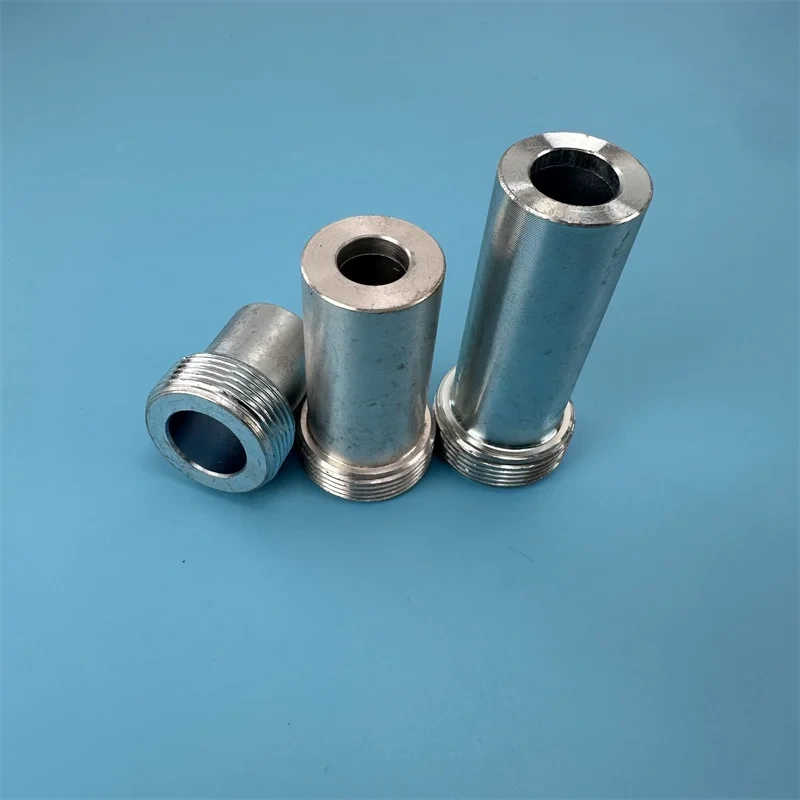
B4C or boron carbide blasting nozzles last way longer in tough wear conditions than most alternatives. Shipyard maintenance reports indicate these nozzles need replacing about 40% less often than tungsten carbide versions when working with silica abrasives according to Ponemon's findings from 2023. The longer lifespan means less time spent swapping out worn parts, which matters a lot for facilities running nonstop operations. After all, every hour a plant shuts down costs around $5,600 on average as noted by the Industrial Blasting Journal back in 2023. That kind of money adds up fast.
Material testing highlights B4C’s superior erosion resistance:
| Material | Relative Wear Rate | Service Life (Hours) | Cost per Operating Hour |
|---|---|---|---|
| Boron Carbide (B4C) | 1.0 (Baseline) | 600-800 | $2.10 |
| Tungsten Carbide | 2.8x | 220-300 | $4.75 |
| Silicon Carbide | 3.5x | 180-250 | $5.20 |
Independent analysis confirms B4C maintains <8% bore diameter expansion after 500 hours of aluminum oxide blasting, outperforming alternatives by 300–400% (Journal of Materials Engineering 2024).
Lifecycle assessments across mining and aerospace sectors reveal B4C's economic advantages. A 2024 study of abrasive blasting systems found:
This performance stems from B4C’s hardness (9.5 Mohs) and elastic modulus (380 GPa), enabling wear rates below 0.01 mm/hour even at 150 psi.
Boron carbide sits right behind diamond and cubic boron nitride when it comes to hardness, clocking in at around 9.6 on the Mohs scale. Its Vickers hardness number goes over 30 GPa, which puts it ahead of silicon carbide that measures about 27 GPa and tungsten carbide at roughly 22 GPa. What makes boron carbide so tough? Well, it has this special rhombohedral crystal structure. Inside there, those boron atoms link together with really strong covalent bonds, creating a tight atomic lattice that just doesn't want anything penetrating through it.
B4C withstands stresses above 50 N/mm², crucial for blasting applications. A 2021 tribological study revealed its coefficient of friction remains below 0.35 at sliding speeds up to 6 m/s. Key properties include:
These characteristics enable effective load distribution during abrasive particle contact, surpassing conventional ceramics.
B4C resists intergranular fracture under impact velocities up to 300 m/s. Microscopy shows less than 5% microcrack propagation after 1,000 hours of continuous blasting with 80-grit aluminum oxide. This stability is due to:
Controlled erosion tests show B4C nozzles lose 83% less material than tungsten carbide when processing HRC 60 steel grit. The wear process follows three stages:
This predictable pattern allows accurate forecasting of service life, with most users achieving 3,000–4,000 operational hours before tolerances exceed ±0.15 mm.
In marine environments using 50–200 µm steel grit, B4C nozzles maintain internal bore consistency (±0.05 mm) for 800–1,200 hours—three times longer than silicon carbide models. This reliability supports critical shipyard workflows such as hull preparation and anti-fouling treatments, directly reducing downtime.
Mining operations processing 5–10 tons/hour of silica abrasives report 67% lower erosion rates with B4C nozzles at 100 psi compared to tungsten carbide. In aerospace, B4C reduces turbine nozzle throat erosion from 0.3 mm/hour (alumina ceramics) to just 0.07 mm/hour, extending component life to over 450 cycles between replacements.
Standardized testing (ASTM G76-22) demonstrates B4C’s superiority:
| Material | Erosion Rate (g/kg abrasive) | Operating Temp Limit | Impact Angle Optimization |
|---|---|---|---|
| B4C | 0.12 | 450°C | 75–90° |
| Tungsten Carbide | 0.31 | 300°C | 30–45° |
| Silicon Carbide | 0.43 | 1380°C | 15–30° |
Field data shows B4C delivers 42% lower lifecycle costs than other ceramics when handling Mohs 7+ abrasives, reinforcing its adoption in heavy industries.
More heavy industry sectors are turning to B4C nozzles because they save money over time. Market research from Astute Analytica suggests the industrial spraying nozzle sector will hit around $3.6 billion by 2033 as companies look for materials that last 3 to 5 times longer than traditional options. When working with steel grit or alumina abrasives, businesses report cutting their yearly replacement expenses by nearly two thirds when switching from tungsten carbide to B4C according to Parker Industrial findings from last year. This shift makes sense given the numbers, which explains why most shipyards have made B4C their go-to choice for maintaining those massive hulls. Some operators even mention how these nozzles handle the harsh marine environment better than anything else they've tried.
The latest developments in pressure assisted sintering techniques have pushed boron carbide (B4C) nozzle density close to 99.8% of what's theoretically possible, which represents around a 15% improvement compared to older manufacturing approaches. What makes this really valuable is that these improvements let manufacturers embed sensors right into the nozzles so they can monitor wear as it happens, all while keeping the material's ability to resist erosion intact. Modern B4C nozzles typically show wear rates below 0.1 mm per hour when exposed to 80 grit garnet at 150 psi conditions. This kind of performance simply can't be matched by traditional materials like silicon carbide or ceramic lined options currently available on the market.
Although B4C nozzles cost 2–3x more upfront than tungsten carbide, their 3–5x longer lifespan results in 40% lower total ownership costs over three years in high-volume operations (NICE Abrasive 2024). This makes them economically viable for facilities conducting more than 20 hours per week of abrasive blasting.
B4C’s hardness (3,800–4,000 HV) makes it ideal for sharp abrasives like garnet and aluminum oxide. However, avoid use with angular steel grit finer than 80 mesh, as high-impact conditions increase fracture risk due to B4C’s inherent brittleness.
| Maintenance Action | Frequency | Impact on Lifespan |
|---|---|---|
| Air filter inspection | Daily | Prevents 72% of premature wear from contaminated airflow |
| Nozzle alignment check | Weekly | Reduces asymmetric erosion by 60% |
| Pressure optimization | Per shift | Lowers wear rates by 18–22% at 80–100 psi vs. 120+ psi |
Daily inspections identifying bore changes ≥0.5 mm can extend service life by 30% (Everblast 2024). Rotating nozzles every 150–200 hours ensures even wear distribution across multiple units.


 EN
EN