 EN


How soil water potential meter measures soil moisture status accurately
A soil water potential meter does not simply report how much water is in the ground. It indicates how tightly the soil holds water and, therefore, how hard a plant must work to take it up. That distinction is useful when two soils contain a similar amount of water but make it available very differently. From an equipment-user perspective, dependable readings come from correct placement, a saturated sensing path, enough time to equilibrate, and a record of field conditions—not from treating one number as a universal irrigation instruction.
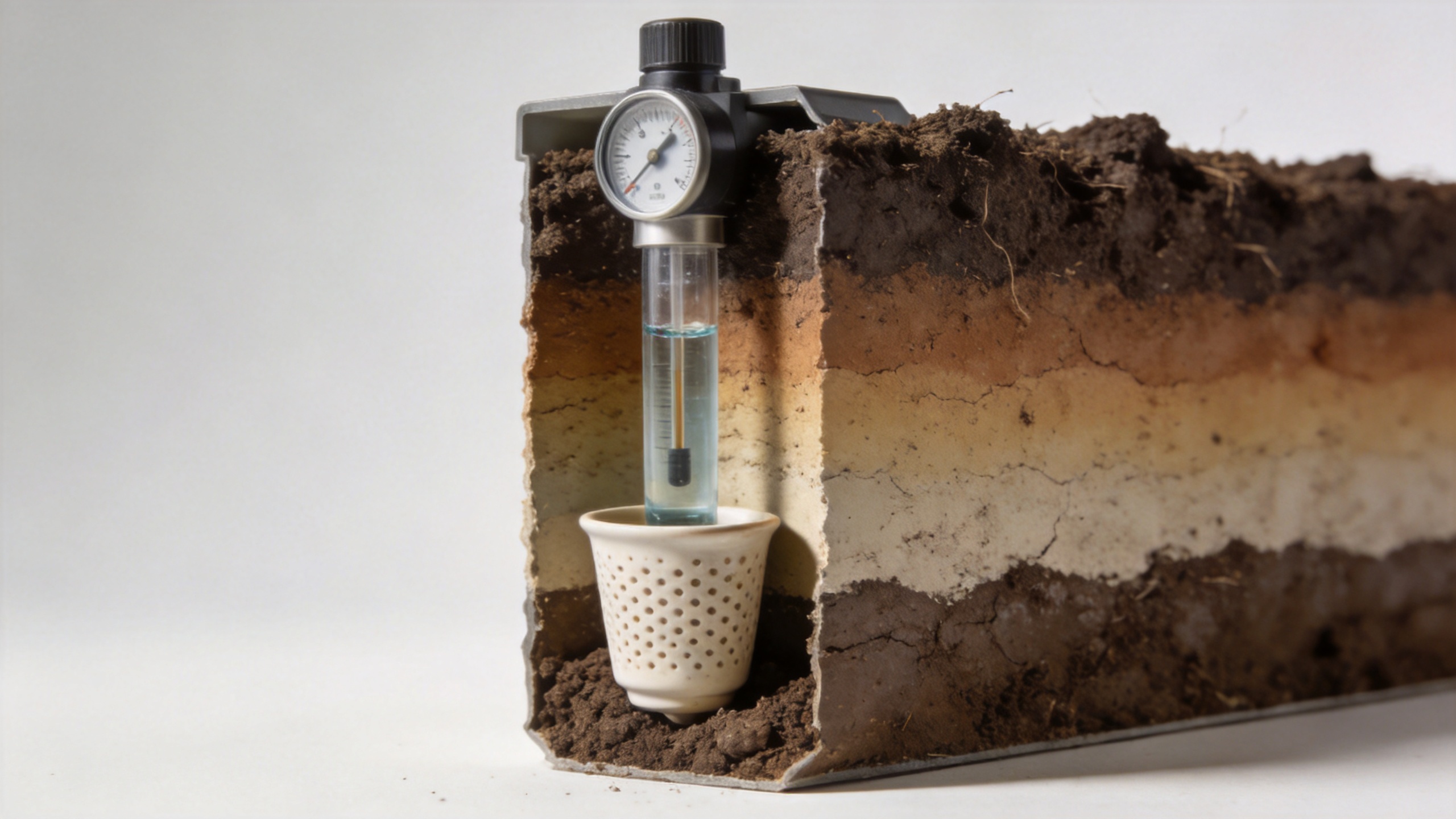
Many installations use a soil tensiometer, sometimes called a soil irrometer, as the sensing assembly. The basic design is straightforward: a water-filled body connects a gauge or electronic transducer to a porous ceramic contact surface in the soil. Yet the method works only when that contact surface, the water column, the instrument, and the surrounding soil are all working as one hydraulic system.
What a soil water potential meter actually measures
A soil water potential meter measures soil-water potential, often discussed as matric potential or soil water tension in irrigation practice. It describes the energy state of water in the soil relative to a reference condition. As soil dries, water adheres more strongly to particles and becomes harder to extract. A soil water potential meter translates that change in suction into a reading that can support crop and irrigation decisions.
This is different from a volumetric water-content sensor. Water-content instruments estimate the proportion of soil volume occupied by water. A soil water potential meter instead focuses on availability: whether water can move toward roots and how strongly the soil retains it. Neither measurement replaces the other. For example, a fine-textured soil may retain substantial water while its tension reading still warns that extraction is becoming more difficult. The practical question is not which method is universally superior, but which measurement answers the field decision in front of you.
The measurement principle: ceramic contact and pressure balance
In a conventional soil tensiometer, a water-filled tube ends in a porous ceramic cup. The cup is installed at the depth that represents the active root zone. When the surrounding soil becomes drier than the water inside the cup, water moves outward through the pores. That outward movement creates a partial vacuum in the sealed instrument body. A gauge or transducer detects the pressure change, and the soil water potential meter displays it in the unit used by that instrument.
When soil is rewetted, the pressure difference relaxes as water moves back toward the cup. The reading is therefore an equilibrium-based response, not an instantaneous declaration of crop condition. A porous ceramic tube or porous ceramic pipe is not just a housing detail: pore continuity, wetting, and firm contact with undisturbed soil determine whether the water path can transmit soil tension faithfully.
Conventional tensiometers are commonly associated with wetter to moderately dry conditions. University guidance describes direct tensiometer readings in a range of roughly 0 to 80 centibars and notes that soil texture affects suitability. That is a useful operating example rather than a fixed rule for every meter, crop, or installation. Check the actual instrument documentation, soil type, and irrigation program before assigning thresholds.
Why correct installation determines accuracy
A soil water potential meter can only represent the soil touching its ceramic contact surface. Start by choosing a depth that corresponds to the part of the root zone you need to manage. A shallow sensor may respond quickly to a small irrigation event, while a deeper sensor can show whether water reached lower roots. In layered ground, more than one depth may be needed because a single soil water potential meter cannot describe every horizon.
- Prepare the access hole carefully. Make a hole that matches the cup geometry as closely as practical. An oversized void around a porous ceramic tube creates air gaps and delays pressure transfer.
- Wet and fill the sensing system as specified. The ceramic material and internal water path should be free of trapped air. Air bubbles can compress and make a soil water potential meter respond slowly or drift from field conditions.
- Seat the cup against representative soil. Avoid loose backfill, stones, root voids, or a smeared sidewall. The goal is hydraulic contact, not merely physical support.
- Protect the instrument head. A damaged seal, leaking cap, or disturbed tube changes the closed system on which a soil water potential meter depends.
- Label depth, location, and date. A useful reading is tied to an identifiable zone, crop stage, and irrigation event.
A common mistake is to focus only on the meter display while overlooking the soil around the cup. A reading may look stable even when the cup is separated from the soil by a small gap. If a soil water potential meter behaves differently from nearby instruments after installation, confirm contact and filling before drawing a crop-management conclusion.
Equilibration: why timing matters after installation or irrigation
A new or refilled soil water potential meter needs time for water movement through the ceramic wall and nearby soil to reach balance. The required interval varies with soil texture, cup condition, moisture change, and installation quality. Reading immediately after pushing in a porous ceramic pipe can reflect handling and local disturbance more than the broader root zone.
The same logic applies after rain or irrigation. A soil water potential meter may change rapidly in coarse soil and more gradually in fine soil. Rather than judging an isolated value, compare the trend with irrigation timing, weather, crop development, and readings at other depths. This turns the instrument from a single alarm into a decision aid. If an abrupt response occurs at the shallow point but not lower down, the event may have wetted only the upper layer.
How to validate a reading before using it
Use a short field check whenever a soil water potential meter gives an unexpected result:
- Inspect the instrument for cracks, a loose cap, low water level, or a damaged gauge connection.
- Check whether the porous ceramic tube remains firmly seated and whether recent cultivation, rodent activity, or root growth may have disturbed it.
- Compare the trend with a second position or depth rather than assuming one instrument represents the whole field.
- Record recent irrigation, rainfall, and any change in the sensor location’s shade, mulch, or compaction.
- Confirm that the displayed unit matches the decision chart being used; do not transfer trigger values across units without conversion and local agronomic review.
These checks are especially important for a soil irrometer used in variable field conditions. A valid measurement is a combination of instrument condition, location, soil contact, and a sensible comparison period. It is prudent to establish site-specific response patterns before using a soil water potential meter as the sole basis for an irrigation change.
Choosing components and communicating requirements
When specifying a soil water potential meter or replacement sensing assembly, provide more than a product name. State the intended depth, soil texture, crop or landscape use, expected measurement unit, mounting constraints, and whether the design uses a porous ceramic pipe, a short cup, or another ceramic geometry. For a soil tensiometer, it is also useful to confirm service access for filling and inspection, as maintenance needs can affect long-term data quality.
Highborn Technology can help structure a technical conversation around ceramic contact surface dimensions and the environmental details that affect component selection. Material and geometry should be confirmed against the actual medium, installation method, and operating conditions. That approach keeps a component discussion tied to the measurement system rather than making unsupported claims about field performance.
Key takeaway
A soil water potential meter measures the effort associated with extracting water from soil, using a pressure relationship established across a water-filled system and a porous ceramic contact surface. Accurate interpretation depends on correct installation, good cup-to-soil contact, air-free filling, adequate equilibration, and trend-based review. Used with field observations and local irrigation guidance, a soil water potential meter can provide a more actionable view of soil moisture status than water quantity alone.

