 EN


Why Mullite Ceramic Is Preferred for High Temperature Supporting Structures
In a firing line, heat-treatment fixture, or kiln-furniture assembly, a support does more than survive a high setpoint. It carries a load while temperature changes, resists distortion, and remains compatible with the atmosphere and the parts around it. That is why mullite ceramic is often considered for beams, posts, setter slabs, tubes, and other supporting structures. A mullite ceramic component combines a refractory oxide chemistry with relatively low thermal expansion and useful high-temperature stability. Those qualities matter, but they are not a substitute for checking the actual load, geometry, and firing cycle.
From a materials-selection perspective, the useful question is not whether mullite ceramic is universally superior. It is whether its balance of expansion behavior, hot strength, thermal-shock tolerance, and manufacturability fits a specific support. This article explains that balance and shows what should be confirmed before selecting a mullite ceramic structure.
Why supporting structures face a different high-temperature problem
A lining can sometimes tolerate a local crack or a small dimensional change. A loaded support has less room for that. It must hold ware, trays, coils, or process hardware at a defined position. When the support heats faster than the load, or when one face cools sooner than another, thermal gradients create stress. Repeated cycles can make a small mismatch in expansion or mounting clearance significant.
For that reason, selecting a mullite ceramic support starts with a system view: maximum and normal operating temperature, heating and cooling rate, load direction, contact area, atmosphere, and the way the component is restrained. A support that is appropriate in intermittent service may need a different section, grade, or mounting arrangement in continuous duty. Here, thermal stability means more than a published temperature number; it means behavior during the real temperature change and installation condition.
Low expansion helps manage thermal stress
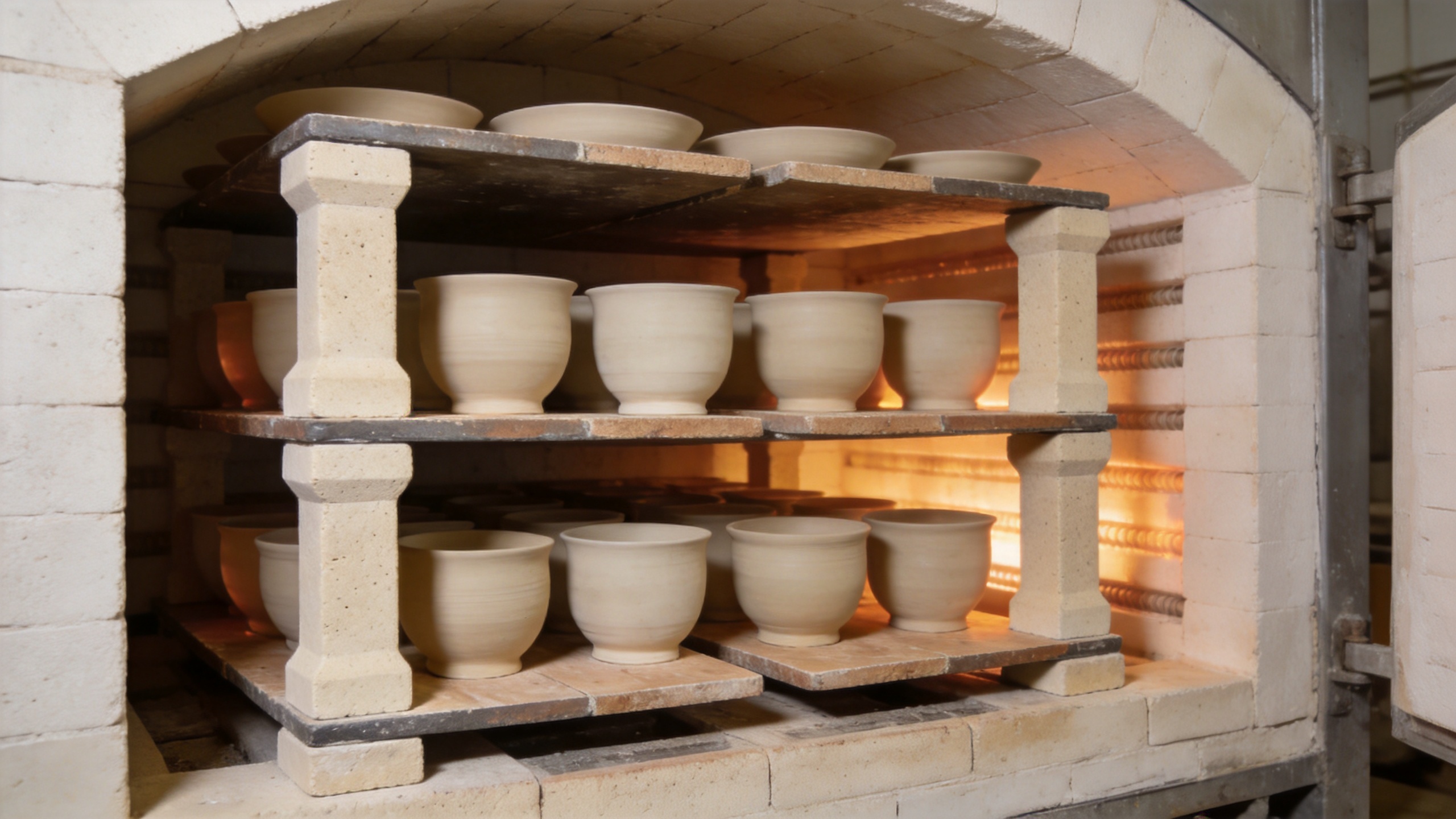
One reason mullite ceramic is widely used in refractory ceramics is its comparatively low thermal expansion. Lower dimensional change during heating can reduce the stress created by temperature gradients and by interfaces with adjacent parts. In kiln furniture, that can help a mullite ceramic post or setter remain more dimensionally consistent through repeated firing cycles.
The benefit is practical rather than absolute. Thermal stress also depends on section thickness, temperature uniformity, edge details, surface condition, and how freely the component can expand. A thick mullite ceramic slab that is rigidly clamped can still see damaging stress. Designers should therefore consider expansion allowance, support spacing, and load distribution together rather than relying on the material name alone.
Thermal-shock tolerance supports cyclic service
Supporting structures often experience heating and cooling rather than steady exposure. A mullite ceramic grade can be attractive where cycling is important because low expansion is one contributor to thermal-shock tolerance. Its microstructure, porosity, fired density, and component shape also influence the result. That is why a material data sheet should be read alongside the proposed cross-section and firing profile.
Cordierite mullite is frequently considered when rapid thermal cycling is a dominant concern. The cordierite phase is associated with low expansion, while mullite contributes refractory behavior and structural stability. Yet cordierite mullite is not an automatic replacement for a denser mullite ceramic support. If the structure carries a sustained load at elevated temperature, the required hot strength and creep behavior may point toward a different formulation or geometry. The comparison should be based on the duty cycle, not a broad material ranking.
Load bearing at temperature requires creep awareness
A support can remain intact and still become unsuitable if it sags gradually. This time-dependent deformation is commonly described as creep. For a mullite ceramic beam, post, or plate, the relevant conditions include temperature, compressive stress, time at temperature, and the distribution of glassy or secondary phases in the material. Published testing of commercial mullite refractories commonly evaluates creep under specified stress and temperature conditions, which is a useful reminder that creep performance must be tied to the service case.
For structural ceramics, geometry is part of the material decision. A longer span increases bending demand; point contacts can concentrate stress; an uneven load can turn a compressive member into a bending member. Before choosing mullite ceramic, confirm the unsupported length, load per support, contact pattern, allowable deflection, and whether the load changes during the thermal cycle. These checks are particularly important for large setter slabs and load-bearing kiln furniture.
Chemical and process compatibility still matter
High temperature alone does not define the environment. Ash, alkali vapors, fluxes, metal oxides, and process gases can change the service conditions for refractory ceramics. A mullite ceramic support may be appropriate in one atmosphere but require validation in another. The material should also be assessed against the product being fired so that contact reactions, sticking, contamination, and differential expansion are considered early.
A ceramic sagger illustrates the point. A ceramic sagger may protect product from direct exposure while also acting as a support within a stack. Its material choice must consider the charge, the atmosphere, the loading method, and the expected cycle. In that setting, a mullite ceramic body is evaluated not only for heat resistance, but also for shape retention, contact behavior, and whether the chosen wall thickness can handle the handling and stacking forces.
How mullite fits within a practical material comparison
Mullite ceramic is often chosen when an application needs a balanced refractory material rather than a solution optimized for one isolated property. Compared with a lower-expansion cordierite mullite option, a mullite ceramic formulation may be favored where elevated-temperature structural stability and sustained support duty carry more weight. Compared with other structural ceramics, it may offer a useful combination of refractory performance and fabrication flexibility for many shapes.
That comparison needs boundaries. Higher temperature capability on paper does not establish service life, and a higher density does not by itself prove that a support will resist thermal shock. The right choice depends on the operating window and on evidence from the proposed grade. A representative test, a review of prior firing conditions, or an engineering check may be appropriate when the support is safety-critical, unusually large, or subject to severe cycling.
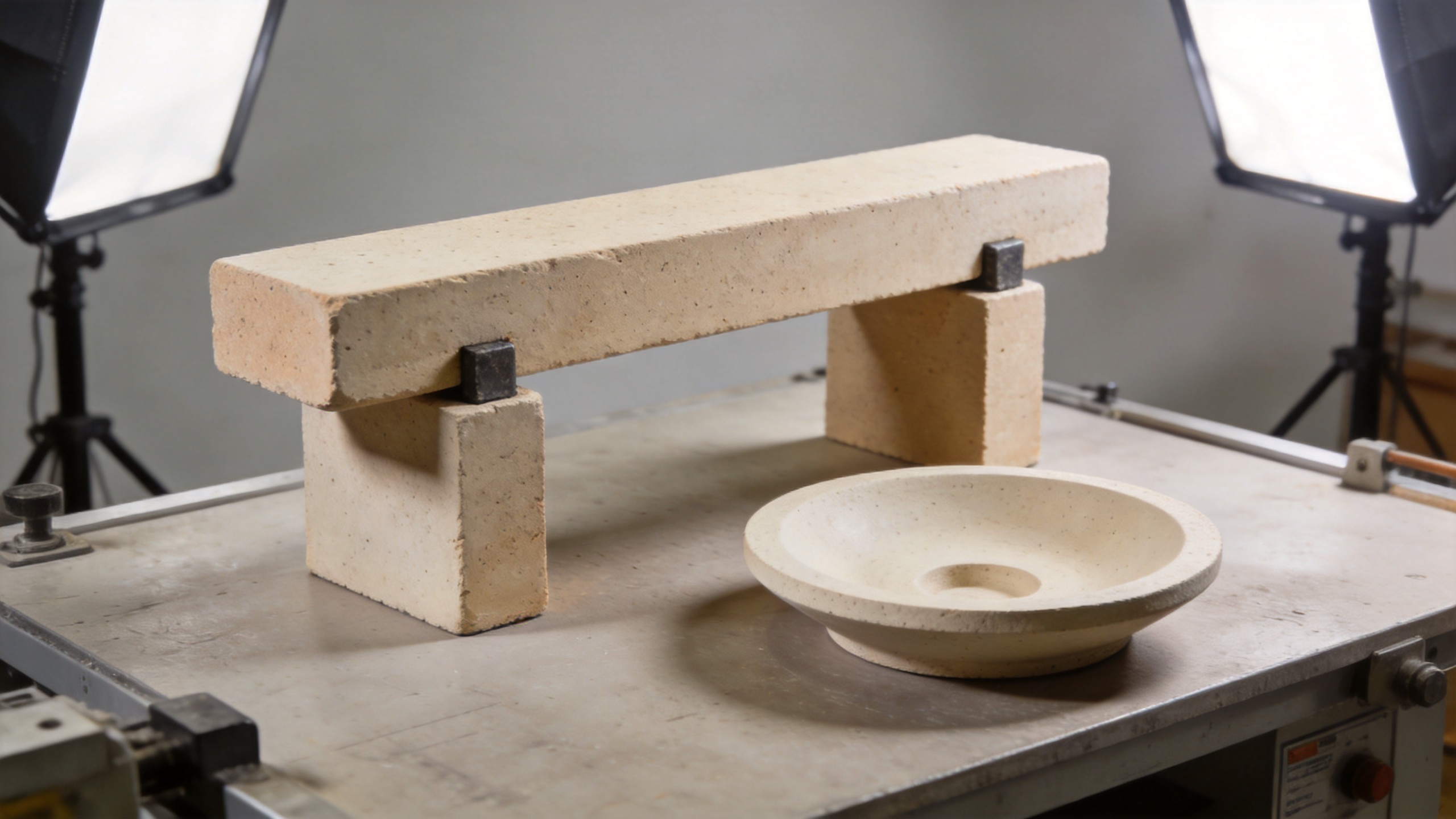
A selection checklist for mullite ceramic supports
- Define the normal operating temperature, peak temperature, dwell time, and heating and cooling rate.
- Record the supported load, load path, span, contact points, and allowable deflection.
- Identify the atmosphere and any vapors, fluxes, particulates, or contact materials that may affect the surface.
- Decide whether thermal cycling or sustained load is the primary limitation before comparing mullite ceramic and cordierite mullite options.
- Confirm dimensions, tolerances, mounting clearance, and handling features for the finished mullite ceramic component.
- Request relevant material and application data for the proposed grade; do not treat generic refractory ceramics data as proof for every component.
Conclusion
Mullite ceramic is preferred for many high-temperature supporting structures because its low expansion, refractory stability, and potential for dependable structural service align with the demands of loaded thermal processes. The preference is strongest when those properties are matched to the actual cycle, support geometry, atmosphere, and load. For a mullite ceramic post, slab, beam, or ceramic sagger, the most useful next step is to turn the application into a clear set of temperature, load, dimension, and installation requirements. That approach makes it easier to determine whether mullite ceramic, cordierite mullite, or another structural ceramic is the more suitable choice.

