In the semiconductor and precision manufacturing fields, wafers or thin-sheet workpieces need to be securely held in place before subsequent processing can be carried out. Yet chucks made of the same ceramic material are often divided into two categories: vacuum chucks and electrostatic chucks. Since both are called ceramic chucks, why must they be split into two types? The work they do and the results they achieve are actually quite different.
Same Material Origin, Same Purpose
Both are made of ceramic materials, and the core goal of both is to firmly secure the workpiece in the processing position. Ceramic discs, ceramic blocks, ceramic plates, and other ceramic components in various forms play key roles in these systems, and common materials such as aluminum oxide, silicon nitride, and silicon carbide are often used in the manufacture of the chuck body. But beneath this common ground, the two follow different paths in terms of structural complexity, impact on the workpiece, and functional expandability.
This shared origin means that when facing harsh environments such as high temperatures, corrosion, or wear, both can demonstrate stability superior to ordinary metals or polymer materials; and their shared purpose means that whichever one is chosen, the ultimate goal is the same—"holding things securely." But the manner of "holding" and the chain reactions that follow "holding" are precisely what distinguishes the two. For this reason, they exhibit completely different orientations in structural design, degree of protection for the wafer, and functional boundaries—which is also why, in actual production, engineers need to make choices based on specific processes.
Clear Differences in Structural Complexity
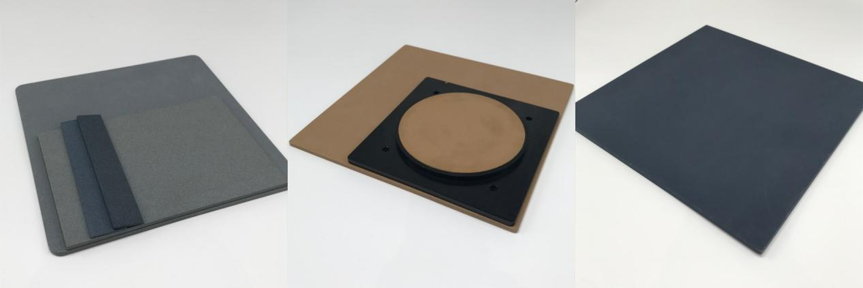
Vacuum chucks have a relatively simple structure: the core is a porous ceramic plate matched with a base, and after sealing the perimeter, it can operate. The interior of the porous ceramic plate is filled with microscopic pores, and the overall structure is not complex. Electrostatic chucks are far more refined, with extremely high requirements for surface flatness, smoothness, and micron-level concave-convex structures. The precision of the concave-convex structures must reach the micron level, and there are high technical thresholds in material proportioning, sintering processes, surface treatment, and other stages.
Completely Different Impacts on Wafers
Vacuum chucks rely on pressure differential to adsorb the workpiece onto the surface. When the workpiece is sucked in, air pressure causes it to deform; after processing is completed, the workpiece rebounds, and the cut surface is prone to wavy patterns, with flatness decreasing, which in turn affects processing precision. Electrostatic chucks use non-contact adsorption, which greatly reduces the risk of workpiece damage and contamination, ensuring that the wafer has good flatness and thereby achieving better processing precision. Their adsorption force is uniform, the wafer does not warp or deform, and the adsorption force remains continuous and stable.
Functional Expandability: High vs. Low
Vacuum chucks have relatively limited functions; their main task is to secure the workpiece and meet the basic need for stable fixation. Electrostatic chucks, beyond fixation, possess more expandability: helium backside cooling can be employed with good temperature uniformity effects, enabling temperature control; during processing, they can also provide DC bias to the wafer and control the wafer surface temperature. Ceramic tubes, ceramic rods, and other ceramic components in various forms also often appear in the supporting structures of such systems.
Different Application Scenarios
In actual production, vacuum chucks more often play the role of handling "rough and heavy work"—for example, when a workpiece needs to be firmly pressed onto the table for shape trimming, thickness reduction, or surface cleaning, they can provide stable and reliable gripping force. At the same time, because of the soft contact of the porous ceramic itself, they are less likely to scratch the workpiece and also reduce the retention of dust and debris. Electrostatic chucks are better suited to "fine work"—in microscopic processing environments that are extremely sensitive to cleanliness and do not allow mechanical contact pressure, they use electrostatic force to make the workpiece fit more snugly, producing no contact wear and no warping caused by uneven local stress. They are particularly suitable for high-precision surface treatment and patterning operations carried out in closed chambers or special atmospheres.
Summary
Although ceramic vacuum chucks and electrostatic chucks are both made of ceramic materials, both aim to secure workpieces, and both possess stability against high temperatures, corrosion, and wear, they differ significantly in structural complexity, impact on wafers, functional expandability, and application scenarios: vacuum chucks have simple structures and rely on pressure differential for adsorption—their gripping force is stable but they easily deform workpieces, their functions are limited, and they are suitable for "rough and heavy work" such as shape trimming and thickness reduction; electrostatic chucks have refined structures and use non-contact adsorption—workpieces remain flat without deformation, cleanliness is high, and they can be expanded with functions such as temperature control, backside cooling for heat conduction, and DC bias, making them suitable for high-precision processing that is sensitive to cleanliness. One "grips firmly," the other "protects precisely"—with different orientations and each having irreplaceable scenarios, selection must be made according to the process in actual production. This is precisely the fundamental reason why the two technical routes have coexisted for so long.


 EN