 EN


What Benefits Come with MnZn Soft Ferrite for Switching Power Supplies?
For a switching power supply, the magnetic core is not merely a mechanical form that carries a winding. It sets limits on magnetizing current, stored energy, heat, and usable switching frequency. MnZn soft ferrite is widely considered for transformer and inductor designs because it combines useful permeability with high electrical resistivity and power-ferrite grades designed for low loss over defined operating windows. The useful word here is defined: a magnetic core benefit depends on frequency, flux density, temperature, DC bias, air gap, waveform, and geometry.
From a material-selection perspective, it is more accurate to ask what a particular MnZn grade can do in a particular converter than to ask whether one ferrite core is universally better than another. Once those conditions are clear, MnZn soft ferrite can offer several practical advantages in offline and DC-DC power magnetics.
Why MnZn soft ferrite fits power-conversion work
MnZn ferrite is a soft magnetic ceramic based on manganese, zinc, and iron oxides. In a switching supply, its high electrical resistivity helps limit the conventional eddy-current component of loss that would become troublesome in a conductive metal core at elevated frequency. That does not make loss disappear: hysteresis and dynamic loss still matter. It does mean a properly selected Mn Zn Power Ferrite can be a workable starting material for many high-frequency transformer and inductor applications.
Material data sheets normally present loss as a function of frequency, AC flux density, and temperature rather than as one permanent number. That format reflects the real design problem. Raising switching frequency, increasing flux swing, or departing from the grade's favorable temperature region can change core heating substantially. A design team should therefore compare like-for-like curves before choosing a magnetic core.
Key benefits of a MnZn soft ferrite magnetic core
1. Useful permeability for transformer magnetizing inductance
A suitable MnZn soft ferrite grade can provide relatively high permeability. In an ungapped transformer core, that can help achieve needed magnetizing inductance with a practical turn count and geometry. Fewer turns may reduce copper length, while an appropriate inductance helps the converter meet its intended current ripple and reset behavior. This benefit is especially relevant to transformer-oriented components, where energy storage is not the primary role of the core.
Permeability is not a stand-alone purchase specification. It changes with material grade, temperature, signal level, mechanical stress, and any intentional air gap. For this reason, a Power Ferrite Core should be reviewed with its effective core parameters and winding arrangement, not selected from initial permeability alone.
2. Low-loss options in the intended switching window
Many MnZn power-ferrite families are formulated around particular frequency and temperature ranges. When the operating point aligns with the material's data-sheet test window, lower core loss can reduce internal temperature rise and make thermal design easier. That may support a smaller magnetic assembly or provide more temperature margin, depending on the rest of the supply.
There is an important boundary: a low-loss result measured at one flux density and temperature is not a promise at another. Ask for loss curves under a waveform and temperature close to the design target. For resonant, flyback, forward, bridge, or LLC designs, the applied waveform and peak flux conditions should be part of the comparison.
3. Electrical resistivity that supports higher-frequency magnetics
Ferrite's ceramic electrical behavior is a practical advantage in switching applications. Compared with a conductive core material, a ferrite core can avoid large circulating eddy-current paths within the bulk material. This makes MnZn soft ferrite a familiar option for power transformers, common-mode and differential-mode magnetic components, and some gapped inductors operating well above line frequency.
Still, frequency alone does not determine the answer. At higher frequencies, designers must check the grade's loss curves, winding AC resistance, leakage inductance, insulation system, and parasitic capacitance together. A core material that works well at tens or hundreds of kilohertz may not be the right selection at a much higher frequency without a fresh loss and thermal review.
4. Flexible core geometries for packaging and winding choices
MnZn materials are available in many familiar core shapes, including E, EE, ETD, PQ, RM, toroidal, and low-profile geometries. The material benefit becomes more useful when the geometry supports the required window area, creepage distance, heat path, and winding layout. An E-type ferrite core may simplify bobbin winding and gap placement, while a flat-profile form can help control profile in a compact assembly.
Geometry changes the magnetic circuit. Effective cross-sectional area, magnetic path length, window utilization, and gap location all influence the result. A material comparison should therefore include the actual core set, not only a generic MnZn data sheet.
5. A practical path for separating transformer and inductor requirements
The same MnZn soft ferrite family may appear in both transformers and inductors, but the design priorities differ. A transformer usually emphasizes magnetizing inductance, flux balance, isolation construction, and loss at the applied AC excitation. A stored-energy inductor often uses an intentional air gap; there, the gap and DC bias can dominate effective permeability and energy-storage behavior.
That distinction prevents a common selection error: assuming that the highest-permeability magnetic core is automatically ideal for every switching component. For a gapped inductor, the relevant checks often include inductance under DC current, saturation margin, fringing-field effects, winding loss near the gap, and allowable temperature rise. In other words, look at material, gap, turns, and current together.
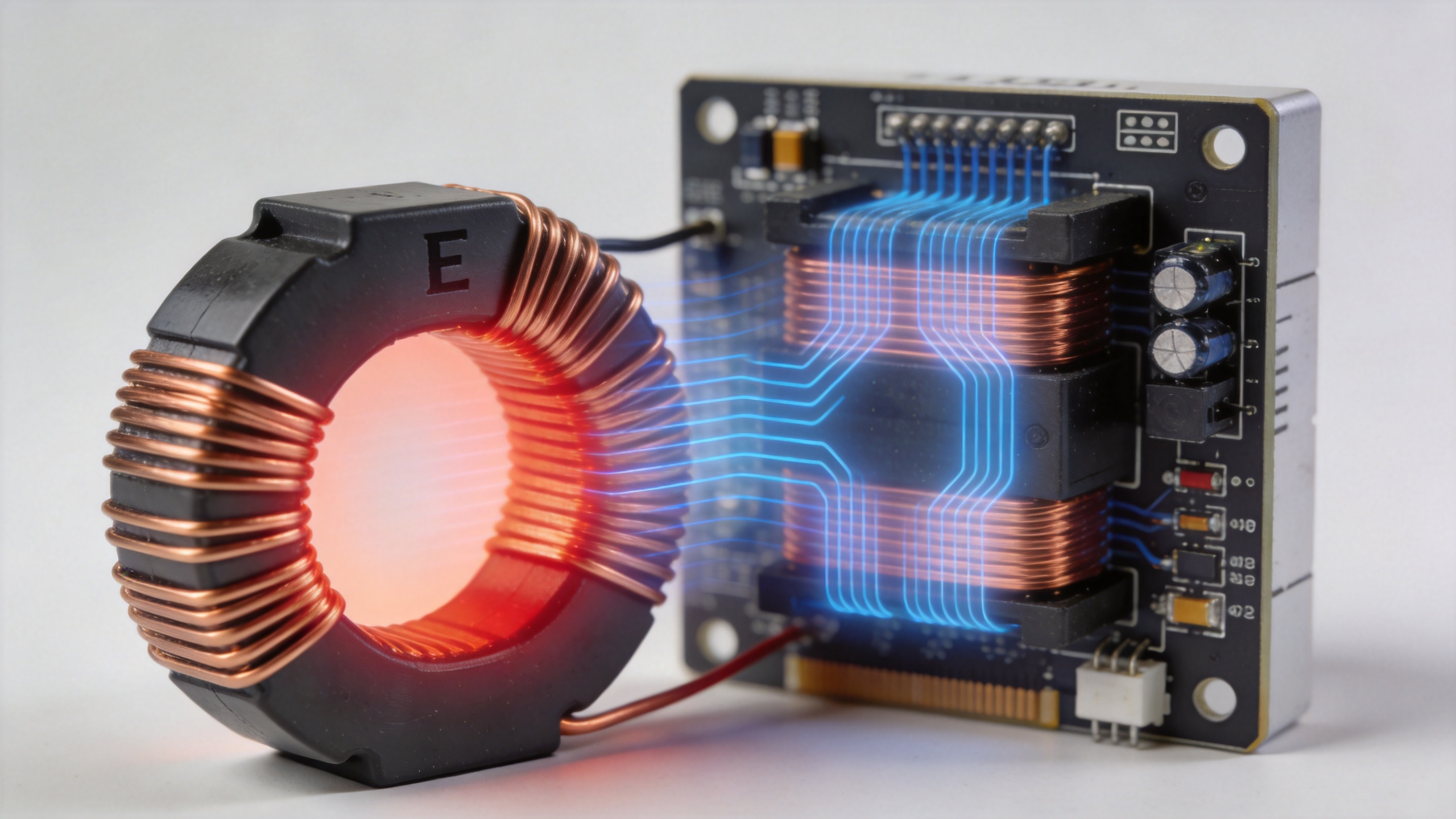
A short selection checklist before specifying a ferrite core
- Converter topology and waveform: identify whether the component is a transformer, choke, resonant inductor, or another magnetic function.
- Frequency range: use the full operating range, not only the nominal switching frequency.
- Flux-density target: calculate the expected AC flux swing and retain margin for input-voltage and load conditions.
- Temperature range: compare loss and permeability information at realistic core temperatures, not only at room temperature.
- DC bias and air gap: include these early for inductors and coupled inductors.
- Core geometry and winding space: verify the actual ferrite core supports insulation, copper area, heat removal, and manufacturing needs.
- Verification plan: confirm material grade, tolerances, test conditions, and acceptance criteria with the intended supplier before release.
When the benefits need qualification
MnZn soft ferrite is not a substitute for a complete magnetic design. A material may have strong permeability or favorable loss behavior, yet still be unsuitable if the core saturates under the chosen volt-seconds, if DC bias causes inductance to fall too far, or if winding loss becomes the thermal bottleneck. Likewise, two grades described as MnZn can have very different loss-versus-temperature behavior.
A useful decision sequence is simple: define the electrical stress, choose a candidate geometry, compare grade-specific loss and permeability data at the expected conditions, then validate the built component. This replaces a broad material claim with measurements that are relevant to the supply being designed.
Conclusion
The main benefit of mnzn soft ferrite in switching power supplies is that suitable grades combine usable permeability, high electrical resistivity, and low-loss performance within stated operating conditions. Those qualities can support efficient transformer and inductor designs, but only when the material grade, ferrite core shape, frequency, flux density, temperature, air gap, and winding design are evaluated as one system. For an informed RFQ or design review, prepare the topology, input range, switching range, target inductance, DC current, thermal limits, core geometry, and applicable test conditions before comparing a magnetic core.

