 EN


Why ceramic atomizer core delivers stable atomization output
A ceramic atomizer core is often discussed as if the material alone determines output. In practice, stable atomization comes from a controlled relationship between the porous body, the liquid, the heater contact boundary, and the operating conditions. From an application-engineering perspective, the useful question is not simply whether the component is present. It is whether its pore network can replenish liquid at a rate that remains compatible with heat input and use cycles.
Stable output begins with a repeatable liquid path
The working surface of a ceramic atomizer core contains interconnected voids rather than one open channel. When the liquid wets that network, capillary forces draw liquid from the supply side toward the heated zone. This is why porous ceramic can act as both a liquid transport medium and a structural support. If the connected paths are too restricted for the liquid viscosity, replenishment can lag behind heating. If they are too open, local flooding or uneven wetting may become more likely. Neither condition is an automatic material defect; both depend on the whole application.
The porous body therefore needs more than a stated porosity value. Buyers should ask how pore size distribution, pore connectivity, thickness, and the intended liquid interact. Two parts can use a similar ceramic substrate yet deliver different results if the sintering cycle or forming method changes the internal network. The relevant target is a controlled liquid path that can recover between pulses, not the highest possible porosity.
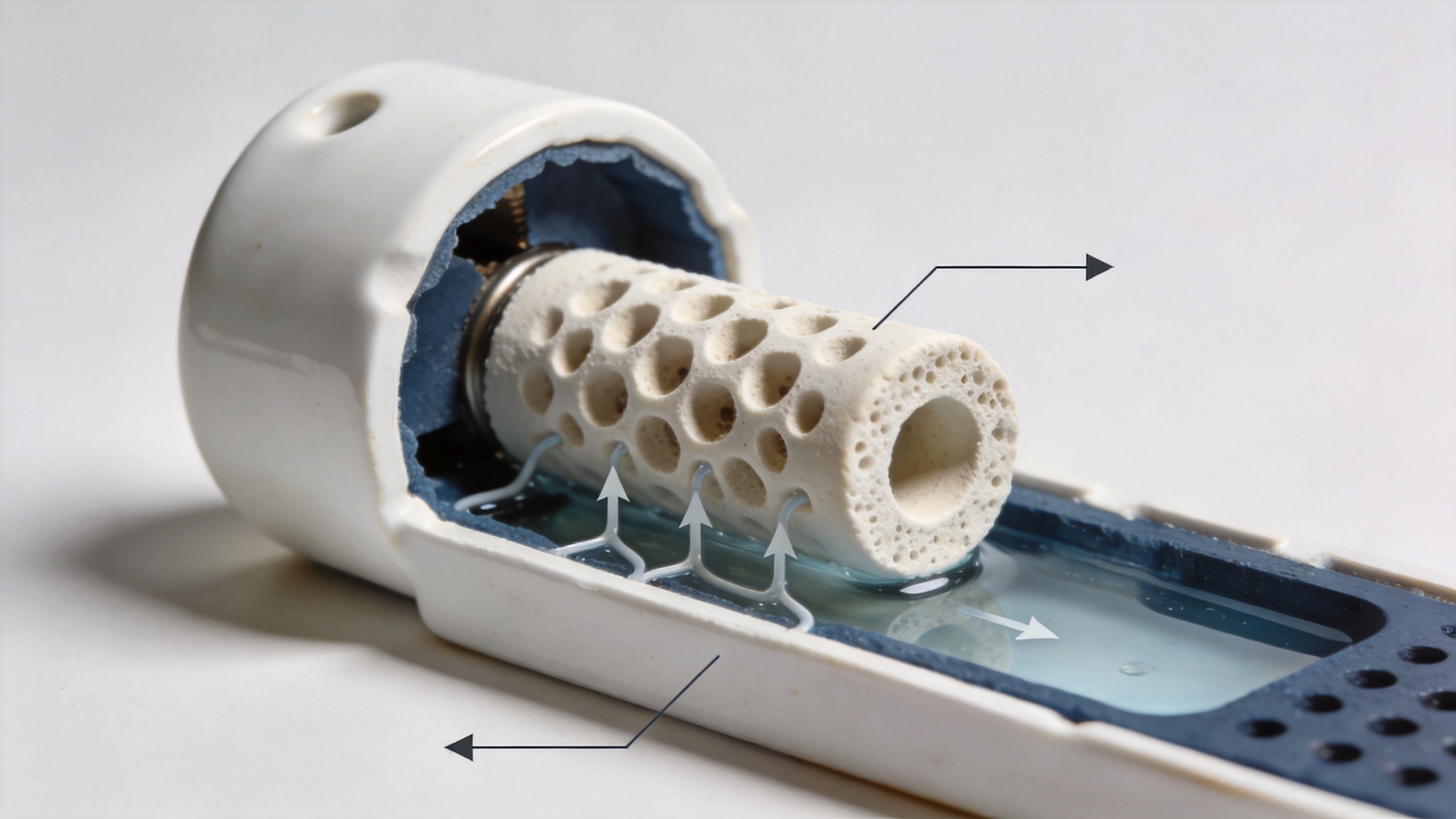
How pore structure affects a ceramic atomizer core
Three structural features have a direct bearing on consistency:
- Connected porosity: The ceramic atomizer core needs paths that connect the reservoir-facing area to the heating area. Isolated pores add void space but may contribute little to replenishment.
- Pore-size distribution: A narrow, application-appropriate distribution helps limit large differences in local flow. A porous ceramic structure with mixed extremes can create uneven wetting under the same duty cycle.
- Thickness and geometry: The route length through the core affects resistance to liquid movement. A design change that looks small on a drawing can alter how quickly the heated surface is supplied.
These factors should be evaluated with the actual liquid, temperature range, orientation, and pulse profile. The same ceramic part may behave differently when viscosity changes with temperature or when a formulation has different wetting behavior. That is why a pore specification should be treated as a starting point for validation, not a standalone output promise.
Heat transfer and contact quality matter as much as porosity
Liquid delivery only solves one side of the problem. The core also needs reasonably even thermal coupling at the active area. Gaps, uneven contact pressure, inconsistent coating, or a changing electrical connection can produce local temperature differences. Those differences may show up as output variation even when the porous ceramic itself is within its drawing requirements.
It helps to separate two questions during troubleshooting. First, does the core supply liquid consistently? Second, does the assembly apply heat consistently across the intended surface? Looking at only one question can lead to the wrong corrective action. For example, increasing porosity may not address a heater-contact issue, and a power adjustment may not compensate for a core that cannot replenish liquid under the intended cycle.
Why manufacturing control supports repeatability
A ceramic atomizer core is shaped before it reaches its final porous state. Powder characteristics, binder system, forming pressure, drying, and sintering all influence the final structure. During sintering, a ceramic body densifies as void space changes, so a nominal powder recipe is not enough to predict the finished pore network. Lot-to-lot consistency depends on controlling the process route and checking the resulting part.
For a ceramic substrate used in atomization, useful control items commonly include density or porosity verification, dimensional checks, visual cleanliness, crack screening, and a functional wetting or flow test agreed for the application. The test method needs its own conditions: liquid type, soak time, orientation, temperature, electrical setting, and acceptance observation. Without those details, a pass/fail result may not describe real operating behavior.
Build validation around the intended use cycle
A useful validation plan starts by defining what stable output means for the finished assembly. It may be a repeatable visual observation, a controlled mass-loss measurement, an electrical response window, or another agreed engineering criterion. The method should identify the liquid batch, fill volume, preconditioning time, orientation, ambient temperature, power setting, pulse duration, rest interval, and number of cycles. Recording these conditions allows development and procurement teams to compare samples on the same basis.
Sampling should also separate material variation from assembly variation. One practical approach is to evaluate several parts from a ceramic lot in the same fixture, then evaluate more than one assembly build using the same part condition. If a difference appears only after assembly, review seating force, conductor placement, and thermal contact before changing the porous-body specification. If the difference follows the ceramic lot across controlled assemblies, inspect the forming and firing records alongside pore and dimension checks.
Acceptance criteria should remain proportional to the application. A laboratory observation can establish a development baseline, but it does not replace testing under the customer’s actual liquid and use pattern. Conversely, an application test without traceable component records may make future corrective work harder. Combining component checks with a documented functional test gives both sides of the supply chain a clearer basis for approving a porous ceramic part.
Common reasons output becomes less stable
When the component shows inconsistent behavior, the root cause can sit in several places. The list below is a practical diagnostic sequence rather than a claim that every issue has one cause.
- Liquid compatibility changed: Compare viscosity, surface tension, and temperature against the validated condition.
- Core geometry changed: Review thickness, exposed area, and contact boundaries, not only the material name.
- Porous ceramic variation appeared: Check lot records and functional tests for differences in wetting or transport.
- Assembly contact shifted: Inspect seating, compression, conductor position, and heat-transfer contact areas.
- Residue or cleaning practice altered the surface: Confirm that the cleaning method and drying time suit the material and the application.
This sequence is useful because it does not assume that a porous ceramic core is the only variable. A sound review compares the component, liquid, electrical setup, and assembly together.
What to specify when sourcing a ceramic atomizer core
For an RFQ, describe the part by its job in the assembly. Include a drawing with critical dimensions and tolerances, the ceramic substrate or approved material range, desired pore or flow characteristics, the liquid family, operating temperature, heating arrangement, duty cycle, and required inspection method. If samples are planned, agree on the test liquid and observation criteria before comparing lots.
Lianyungang Highborn Technology can organize custom ceramic-part discussions around drawings, dimensions, operating conditions, and acceptance priorities. That information makes it easier to assess whether a proposed porous ceramic route is suitable for the application and what should be checked during sampling. It is also more useful than treating a material name as a complete specification.
Conclusion
A ceramic atomizer core supports stable atomization when its connected pores supply liquid at a controlled rate and the assembled heater applies energy evenly to that supplied liquid. The practical outcome depends on pore architecture, sintering control, geometry, wetting behavior, thermal contact, and the real duty cycle. For procurement and development teams, the next step is to convert those conditions into drawings, sample tests, and acceptance criteria rather than relying on a generic ceramic atomizer core description.

