 EN


What is the working logic of a soil tensiometer with ceramic components
A soil tensiometer is a soil-water tension instrument. It does not report how much water is present as a percentage. Instead, it indicates how strongly the surrounding soil is holding water. That distinction matters when irrigation decisions depend on how difficult it is for roots to draw water from the soil rather than on a single moisture-content number.
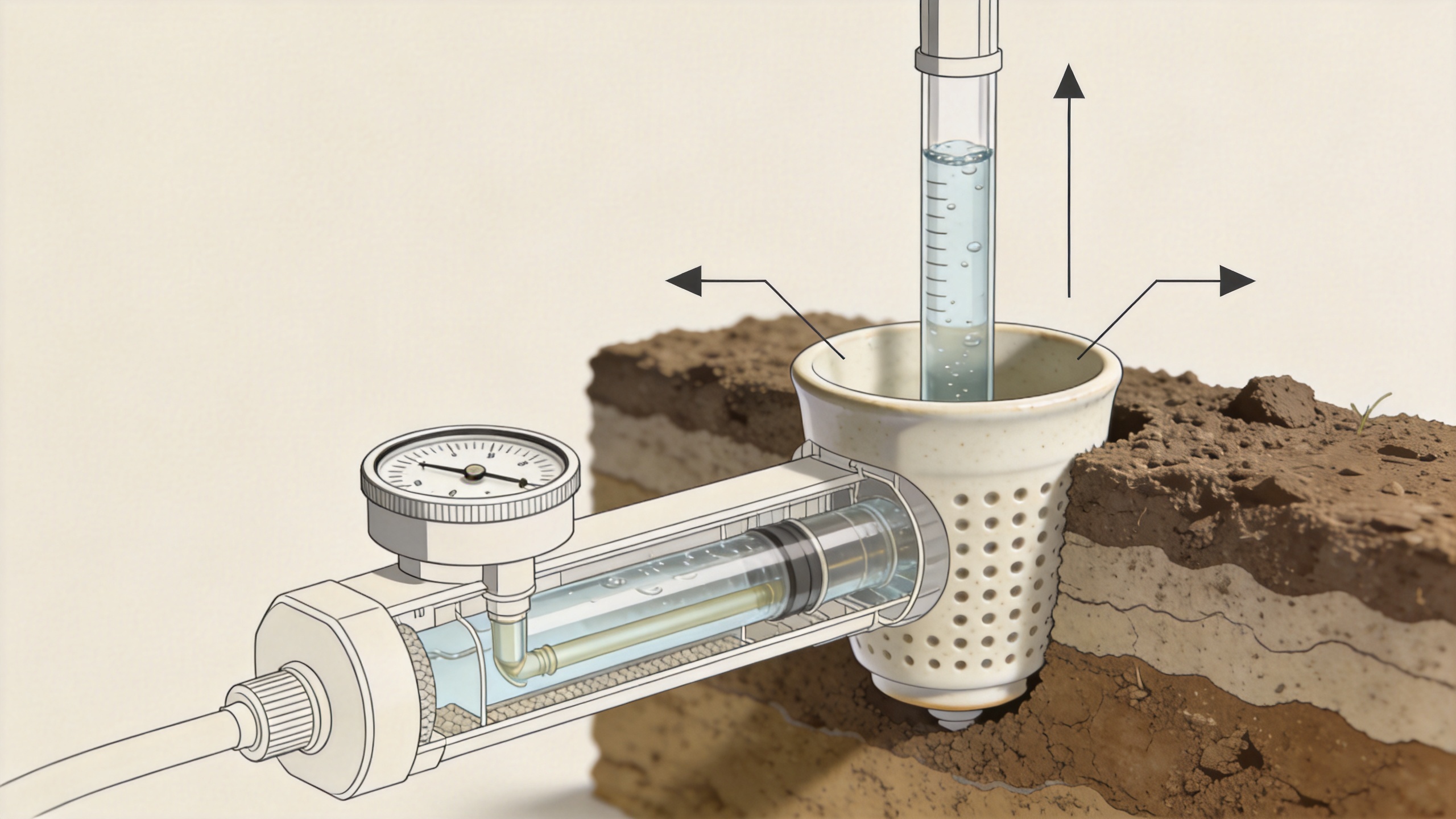
The working logic is straightforward: a sealed, water-filled tube ends in a porous ceramic cup. Once the cup is in close contact with the soil, water can move across the cup wall until the water inside the instrument and the water in the soil approach hydraulic equilibrium. A gauge, dial, or pressure transducer observes the negative pressure that develops inside the tube. In that sense, a soil tensiometer is a practical way to translate the soil’s pull on water into a reading that can support irrigation timing.
The parts that make the measurement possible
Most designs combine a water reservoir or tube, a sealed cap, a pressure-reading component, and a porous ceramic probe at the lower end. The ceramic is not simply a protective tip. Its interconnected pores form the hydraulic connection between the instrument’s water column and the soil pore water. Water can pass through those pores, while the ceramic body keeps the water column physically contained.
The choice of a porous ceramic component is therefore central to a soil tensiometer. The cup must be saturated, intact, and seated firmly against undisturbed soil. A gap around the cup, a crack, or trapped air in the instrument interrupts the pressure relationship the gauge is supposed to represent. A porous ceramic probe also needs pore characteristics suited to the expected operating range; its job is to pass water in response to a pressure difference, not to measure a crop directly.
How the soil tensiometer responds as soil dries
After installation and filling, the water inside a soil tensiometer is initially near atmospheric pressure when the adjacent soil is wet enough. As roots take up water and evaporation removes water from the soil, the soil water is held more tightly by the soil matrix. Water then tends to move out of the instrument through the ceramic cup toward the drier soil.
Because the tube is sealed, that small water loss creates a partial vacuum inside it. The gauge senses this negative pressure. A higher tension reading means the instrument’s water column must be held under more suction to remain in equilibrium with nearby soil water. A soil water potential meter may use different sensing technology, but the key interpretation is similar: the reading describes the energy state of water, not a universal volume of water in the profile.
This is why a soil tensiometer often tracks the question growers actually need to ask: “Is water becoming harder for roots to extract at this depth?” The answer must still be interpreted for crop, root depth, soil texture, and management target. The same reading is not automatically the same irrigation trigger in sand, loam, clay, containers, or a research plot.
What happens after irrigation or rainfall
When water enters the soil, the pressure difference can reverse. Water moves from the wetter soil back through the ceramic cup toward the lower-pressure water inside the tube. The internal vacuum declines, and the reading moves toward the wet end of the instrument’s scale. This wetting response is the other half of the working logic of a soil tensiometer.
Response time is not only an instrument issue. Soil-to-cup contact, cup size and permeability, soil texture, installation quality, and how rapidly the wetted zone reaches the sensor depth all influence how quickly the reading changes. A soil irrometer or any comparable tensiometer should therefore be viewed as a measurement point within a soil profile, not as a substitute for observing irrigation coverage and root-zone conditions.
Why ceramic condition and installation affect the result
For a soil tensiometer to work, the cup and surrounding soil need continuous hydraulic contact. During installation, the hole should fit the instrument closely and the cup should sit at the planned monitoring depth. Loose backfill or a dry void beside the cup can cause a delayed or misleading response because the cup is no longer exchanging water with representative soil.
Air is another practical concern. Air bubbles in the water column can compress and distort the pressure response. As the soil becomes very dry, air can also enter through the cup in many designs, causing the device to lose its water-filled continuity. At that point, refilling, de-airing, and checking the cup are maintenance tasks, not optional cosmetic work. A porous ceramic cup should be inspected for damage and kept free from residues that restrict water movement.
- Fill the instrument with clean water according to its operating instructions.
- Remove visible air where the design allows and confirm seals are secure.
- Install the porous ceramic probe at a depth tied to the active root zone.
- Read trends over time rather than reacting to one isolated number.
- Compare readings at more than one depth when the root zone and irrigation pattern justify it.
Reading values in context
A soil tensiometer is useful because it measures matric tension in the relatively wet-to-moderately-dry range where irrigation decisions are often made. It is less suitable once soil tension becomes so high that the water column loses continuity or the ceramic cup no longer maintains reliable exchange. The practical limit depends on the instrument construction and the site, so a dial scale should not be treated as a stand-alone crop prescription.
For that reason, a soil water potential meter program benefits from simple field notes: sensor depth, irrigation date and duration, rainfall, crop stage, observed wetting pattern, and any maintenance performed. These notes make it easier to separate a real root-zone trend from a sensor issue. They also help an engineering or procurement team define the material, dimensions, sealing arrangement, and operating conditions required for a ceramic component.
A concise way to remember the mechanism
The ceramic cup couples a sealed water column to the soil. Drying soil draws water through the cup and raises the vacuum; wetting soil lets the vacuum relax. The soil tensiometer reports that pressure change as soil-water tension. When the ceramic connection, water fill, and installation are sound, the instrument provides a direct, interpretable signal for irrigation monitoring. When any of those conditions is weak, the reading needs troubleshooting before it is used to guide a watering decision.
Questions to resolve for a ceramic component
When discussing a ceramic cup or replacement assembly, define the intended soil conditions rather than relying on a material name alone. Useful questions include the required outer diameter and length, pore structure or air-entry requirement, tube and seal connection, exposure to fertilizer or saline water, expected cleaning method, and the depth at which the soil tensiometer will operate. That information turns a general request for a ceramic part into a reviewable technical requirement.

