 EN


What Industrial Uses Can Piezoelectric Ceramics Support?
Piezoelectric ceramics support industrial work wherever a system must sense force, create tightly controlled motion, or launch and receive ultrasonic energy. For an application engineer, the useful starting point is not a catalog shape but the conversion task: does the system need mechanical input converted into an electrical signal, or an electrical drive converted into movement? That distinction helps narrow the role of piezoelectric ceramics before geometry, electrodes, and mounting are specified.
Most industrial piezoelectric ceramics are polarized functional materials. Under mechanical stress, a piezoelectric ceramic can develop electrical charge; under an applied electric field, it can deform. These direct and inverse effects allow a small active element to work as a sensor, an actuator, or a piezoelectric transducer. The material itself is only one part of the device: electrodes, backing, housing, bonding, drive electronics, and the operating environment all influence the finished result.
Where Piezoelectric Ceramics Create Industrial Value
1. Sensing force, vibration, impact, and acoustic events
Piezoelectric ceramics are commonly used in dynamic sensing. A force pulse, vibration, pressure fluctuation, or acoustic wave can load the active element and produce a signal for monitoring equipment. This makes piezoelectric ceramics relevant to vibration monitoring, impact detection, process feedback, acoustic pickups, and ultrasonic sensing assemblies. They are especially useful when the measured event changes quickly; however, sensor performance still depends on the mechanical stack, cable routing, shielding, calibration method, and the frequency range that the system must cover.
For a piezoelectric transducer used as a sensor, ask how the load reaches the ceramic. A force applied through a compliant adhesive, a loose clamp, or an uneven contact face may produce a different response from the same force applied through a rigid, controlled contact arrangement. The requirement should therefore state the load direction, expected frequency content, preload, temperature, humidity, and the signal-conditioning approach.
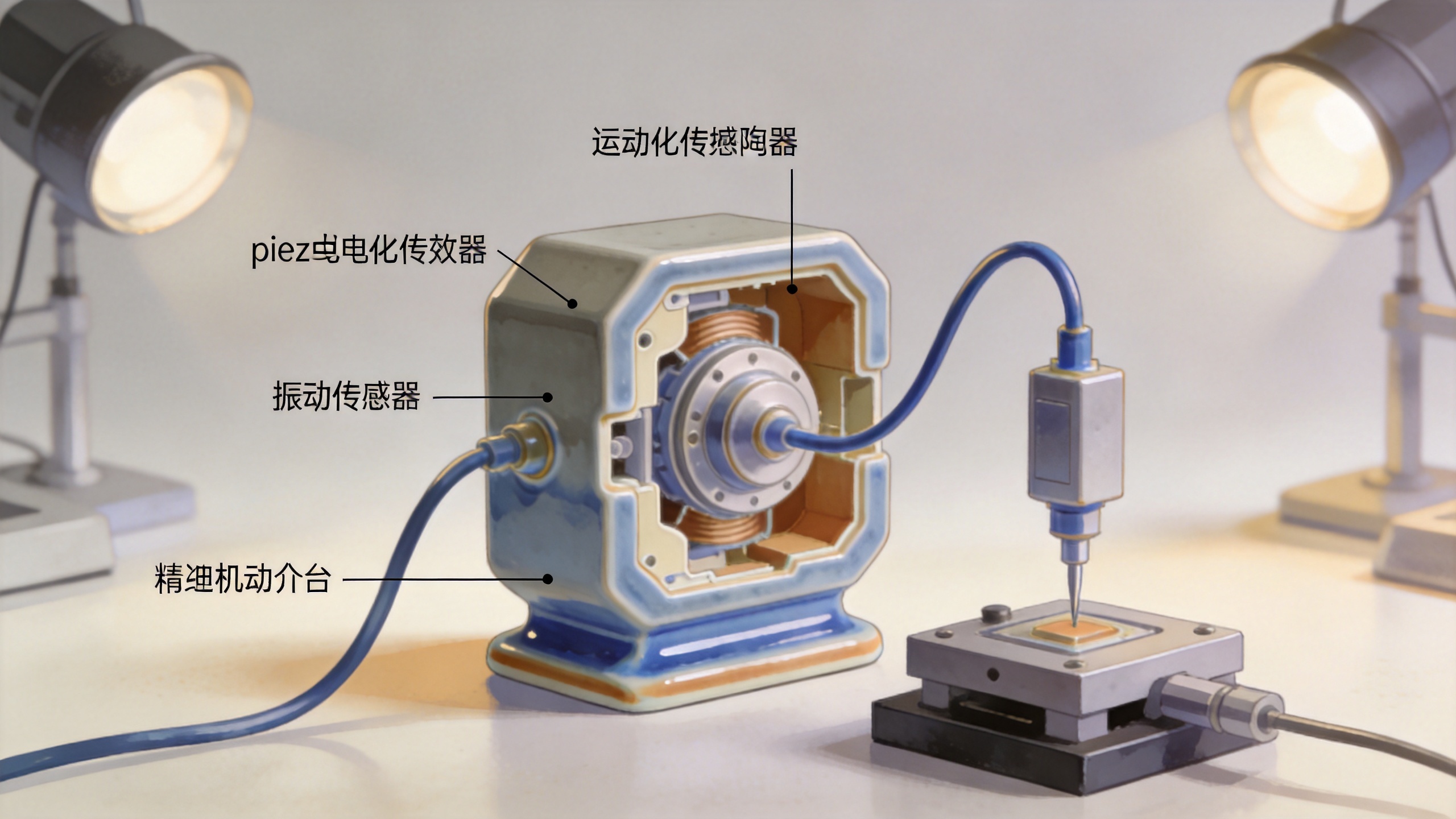
2. Precision positioning and fast motion
When voltage is applied, piezoelectric ceramics can create very small, fast dimensional changes. Industrial designs use that behavior for fine positioning, micro-adjustment, valve control, optical alignment, fast tool compensation, and active vibration control. In these applications, piezoelectric ceramics are often selected for response characteristics rather than for long travel. A practical design may pair a piezo actuator with a flexure, lever, or other mechanical amplifier, accepting trade-offs among travel, blocking force, stiffness, resonant behavior, and control complexity.
Specification work should separate commanded displacement from usable system motion. A piezoelectric ceramic may be constrained by the assembly, and the drive waveform, duty cycle, preload, and temperature can change the working condition. For precision equipment, define the target resolution, stroke at load, settling behavior, allowable heat rise, and whether closed-loop feedback is required before choosing the active element.
3. Ultrasonic cleaning, welding, cutting, and inspection
Ultrasonic systems are another major industrial use of piezoelectric ceramics. A driven piezoelectric transducer can convert electrical excitation into mechanical vibration that couples into a horn, tank, tool, or test piece. Depending on the system architecture, this supports ultrasonic cleaning, joining, cutting, atomization, flow measurement, non-destructive inspection, and distance measurement. The ceramic does not determine the outcome alone: resonance matching, acoustic impedance, backing, coupling media, tool geometry, and drive control are all part of the engineering problem.
For ultrasonic equipment, it is more useful to define the operating frequency band and mechanical connection arrangement than to request a “high-power piezo” without context. The RFQ should identify the desired mode, input voltage, continuous or pulsed operation, mounting method, surrounding medium, and any target dimensions. That information lets a supplier assess whether a particular piezoelectric ceramic formulation and shape are appropriate for the assembly.
4. Ignition and controlled pulse generation
Piezoelectric ceramics can also be used where a short mechanical event is converted into a high-voltage pulse for ignition. Industrial ignition modules and related equipment may use this principle when a mechanical impact mechanism is part of the design. Here, the design review should cover repeat-use conditions, mechanical loading path, insulation distances, electrode design, and the surrounding environment. The active ceramic is a functional element, not a substitute for the electrical and mechanical safety work required for the complete module.
How Piezoelectric Ceramics Relate to Ceramic Electronics
It is important not to treat every ceramic electronic part as a piezoelectric ceramic. A ceramic substrate can provide electrical insulation, dimensional stability, and thermal management for circuits without being the active piezoelectric element. Likewise, a thick film resistor or a thick film circuit board may be printed on a ceramic substrate to support drive, sensing, or control electronics. These components can sit in the same industrial assembly as piezoelectric ceramics, but their functions are different.
For example, a piezoelectric transducer assembly may contain an active ceramic element, electrode connections, a ceramic substrate carrying a thick film resistor, and a thick film circuit board for signal or drive functions. Treating the parts as a system helps engineering teams allocate requirements correctly: the piezoelectric ceramics need electromechanical and polarization requirements, while the supporting circuit needs electrical, thermal, layout, and reliability requirements.
A Practical Selection Checklist
Before requesting piezoelectric ceramics, organize the following details. Clear inputs reduce the risk of choosing a material based only on a familiar part name.
- Function: sensing, actuation, ultrasonic transmission, ultrasonic reception, or pulse generation.
- Mechanical design: shape, dimensions, tolerances, load direction, preload, mounting, and allowable stress.
- Electrical conditions: drive voltage, waveform, frequency, current limits, electrodes, insulation, and connection method.
- Environment: temperature range, humidity, chemicals, vibration, thermal cycling, and enclosure conditions.
- Validation: sample-versus-production requirements, acceptance criteria, test method, and the system-level performance to verify.
Turning an Application into a Useful RFQ
Piezoelectric ceramics can support a broad set of industrial functions, from sensing vibration to moving a precision stage and driving ultrasonic equipment. Their value comes from integrating the material with a realistic mechanical and electrical design. For custom ceramic parts or piezoelectric transducer assemblies, provide the frequency target, drawing or key dimensions, loading direction, mounting concept, electrical connection arrangement, operating environment, and acceptance criteria. That gives the engineering discussion a concrete basis and makes it easier to evaluate a piezoelectric ceramic within the actual equipment rather than in isolation.

