 EN


Why Quartz Coil Performs Well Under High Temperature Working Conditions
In industrial discussions, a quartz coil usually means a formed section of high-purity quartz tubing used to move, isolate, heat, cool, or observe a process stream. It is not the consumer replacement part that often dominates an exact-keyword search. For process equipment and laboratory systems, the useful question is more specific: why can a quartz coil remain a practical choice when temperatures change quickly or stay elevated?
From an application-engineering perspective, the answer starts with material behavior, then moves to coil geometry and installation. A well-specified quartz coil can perform well because fused silica expands very little as it heats. That characteristic can reduce thermally induced strain. It does not, however, turn every coil into a suitable part for every furnace, fluid, or thermal cycle.
Low thermal expansion reduces one important source of stress
Most industrial quartz components are made from quartz glass, commonly described as fused silica or fused quartz. Unlike crystalline quartz, fused silica has an amorphous structure. Technical property references commonly place its linear thermal expansion near 0.5–0.6 × 10⁻⁶/K across moderate temperature ranges. In practical terms, a quartz coil changes length relatively little for a given temperature change.
That matters because a coil experiences more than a uniform rise in temperature. The inlet may be cooler than the outlet; the outer turns may see a different environment than the inner turns; and clamps or fittings can hold local sections in place. When one part of a tube tries to expand more than another, stress develops. Lower expansion does not remove every stress source, but it gives the design a more forgiving starting point than materials with much larger thermal movement.
This is why fused silica is often considered where temperature ramps, radiant heating, or intermittent exposure are part of the duty cycle. More accurately, though, the benefit depends on the temperature gradient and restraint. A coil heated evenly and supported with allowance for movement has a different risk profile from one heated at one end while both ends are rigidly fixed.
Why the coil shape can help—and where it needs care
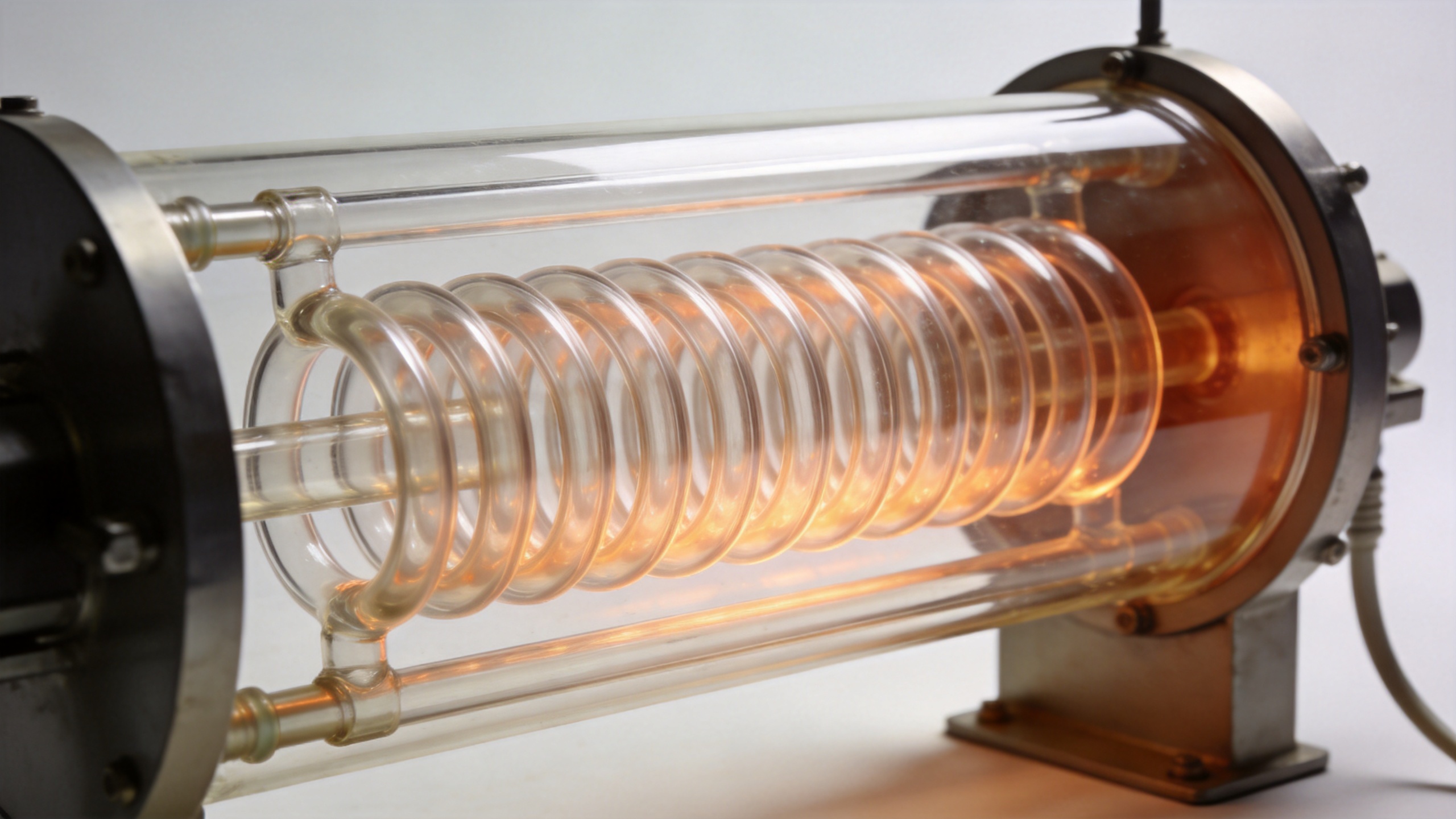
A spiral shape gives a quartz coil a long flow path in a compact footprint. It can also provide some geometric compliance: the turns may accommodate small dimensional changes more naturally than a straight, fully constrained quartz tube. This is useful in heat exchange, gas handling, sampling, and other layouts where space or residence time matters.
Yet coil geometry is not automatically benign. Tight bend radii, uneven wall thickness, poor support spacing, or contact between adjacent turns can concentrate stress. One common oversight is to confirm the outer dimensions of a coil without also checking the heating pattern, support material, and clearance between turns. At elevated temperature, these details can matter as much as the nominal diameter.
- Coil pitch: Maintain clearance so adjacent turns do not rub or create local hot spots.
- Bend radius: Use a radius appropriate to the tube size and forming process; tight bends deserve closer review.
- Support method: Avoid rigid point loading and allow movement where the assembly expands.
- End connections: Check the expansion behavior of metal fittings, seals, and neighboring parts rather than evaluating the quartz coil alone.
Thermal shock resistance is useful, but it is not a blanket approval
Fused silica is widely valued for thermal-shock resistance because its low expansion limits the strain caused by rapid temperature differences. This explains why a quartz coil can be a strong candidate when start-stop operation, hot-to-cool transitions, or localized heat are expected. It is still important not to reduce the decision to a single property.
Wall thickness, coil diameter, surface condition, defects, contamination, and the rate at which the process medium changes temperature all affect the result. A thin-wall coil may respond differently from a heavy-wall coil. A clean, smoothly supported coil may behave differently from one with scratches, deposits, or a rigid fitting at the hottest point. If the process is safety-critical, a representative thermal-cycle test remains more informative than a generic material claim.
High-temperature capability has an assembly boundary
Published fused-quartz data often list a softening point around 1,680 °C. That is a material reference, not a recommended continuous operating temperature for an assembled quartz coil. Long-term service limits can be set by the material grade, internal pressure, coil geometry, atmosphere, joints, seals, supports, and allowable deformation.
For example, a quartz coil in an oxidizing atmosphere may face a different set of considerations than one exposed to reducing gases, alkali-containing vapors, or deposits that change local heat absorption. A quartz container or coil that performs well in a clean thermal zone may need a different assessment when particles, splashing, pressure pulses, or aggressive chemicals are introduced. Material compatibility should therefore be confirmed against the actual medium and temperature history.
Fused silica supports a clean technical design conversation
The term fused silica is useful because it moves the conversation beyond a vague “heat resistant” label and toward verifiable design inputs. For a custom quartz coil, start by collecting the maximum and normal temperature, ramp rate, dwell time, internal medium, pressure or flow condition, outside heating method, and available support locations. Then add the required tube OD, ID, wall thickness, coil diameter, pitch, end geometry, and connection details.
These inputs help separate a material question from an assembly question. A quartz coil may be a reasonable option when low expansion, purity, chemical compatibility, and the required geometry align. If the process includes unusually severe gradients, mechanical loads, or uncertain contamination, engineering review should focus on those conditions before a final specification is issued.
A practical review checklist before specifying a quartz coil
- Define the normal and maximum temperatures, including ramp and cool-down rates.
- Map where heat enters the coil and where the coldest process stream enters.
- Identify the process medium and possible deposits, vapors, or cleaning agents.
- Confirm tube dimensions, coil pitch, bend radius, and clearance between turns.
- Review how supports, seals, and fittings accommodate differential expansion.
- Set acceptance points for geometry, surface condition, and any application-specific testing.
Conclusion
A quartz coil performs well under high-temperature working conditions mainly because quartz glass has very low thermal expansion, which can reduce stress from heating and cooling. The coil form can also package a long path while allowing a thoughtful layout for movement. Still, material performance only has meaning when the temperature profile, atmosphere, dimensions, supports, and connections are known. For a custom discussion, provide the drawing, medium, temperature range, thermal-cycle details, and connection requirements so the coil can be assessed against the real working conditions.

