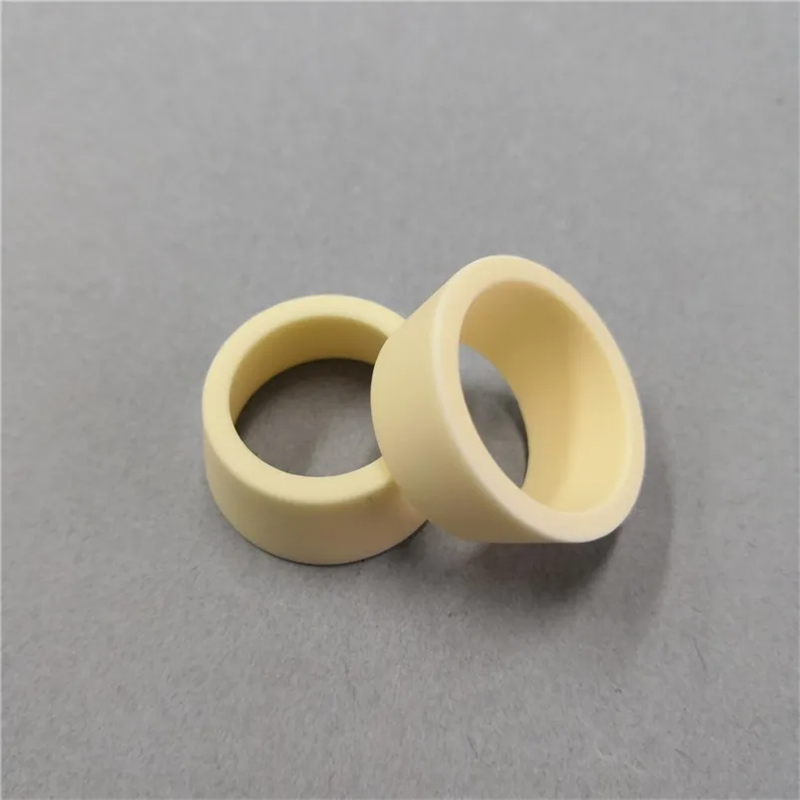
Laser ceramic nozzles serve two main purposes in industrial applications. First, they help deliver the laser beam accurately where it needs to go. Second, these nozzles manage the flow of assist gases like oxygen or nitrogen during cutting operations. The concentric shape of ceramic nozzles helps keep the laser beam tightly focused on the workpiece while simultaneously blowing away molten material from the cutting area. Compared to traditional metal alternatives, ceramic materials stand up much better against heat damage and oxidation when exposed to extreme temperatures commonly encountered in laser cutting processes. This means the laser stays aligned properly over time instead of drifting off course. Ceramic nozzles also reduce the amount of slag that builds up around cuts and protect sensitive optical components located upstream in the machine. According to recent field tests conducted by several manufacturing firms, companies that invested in improved nozzle designs saw noticeable improvements in both their cutting accuracy and production speeds across multiple material types.
The shape and size of nozzles have a big impact on how quickly materials cut and how much energy gets used during the process. When we look at smaller openings between 0.8 to 1.2 millimeters, these create faster gas movement which works great for making quick, neat cuts through thinner sheets. On the other hand, bigger holes around 2 to 3 mm manage both pressure levels and air volume better when dealing with thick metal plates. Some studies indicate good nozzle design can cut down gas turbulence by about thirty percent, which means less electricity needed while still getting pretty accurate results down to 0.1 mm precision. Ceramic nozzles tend to perform better because their inside surfaces are smoother, so there's less resistance as gases pass through. This helps maintain consistent operation even when lasers reach power levels above 6 kilowatts, plus it makes these components last longer before needing replacement.
Ceramic nozzles enhance assist gas effectiveness through three key properties:
Computational fluid dynamics (CFD) simulations show ceramic nozzles deliver 15% higher gas density at the cutting front than steel variants, resulting in cleaner edges and improved performance in high-speed applications.
Four advanced ceramics dominate in high-power laser nozzles:
| Material | Thermal Conductivity (W/mK) | Max Operating Temp (°C) | Key Advantage |
|---|---|---|---|
| Zirconia | 2-3 | 2,300 | Low thermal expansion |
| Alumina | 30 | 1,750 | Electrical insulation |
| Silicon Nitride | 15-30 | 1,400 | Thermal shock resistance |
| Silicon Carbide | 120 | 1,650 | Extreme heat dissipation |
Silicon carbide is preferred in systems exceeding 15kW due to its superior thermal conductivity—three times that of alumina—enabling efficient heat dispersion during continuous operation.
Ceramics retain dimensional stability above 2,000°C—300% better than copper nozzles—thanks to strong covalent bonds that prevent plastic deformation. In stress tests simulating 500 thermal cycles (25°C – 1,200°C), zirconia nozzles warped only 0.02mm compared to 1.7mm in steel, demonstrating exceptional resistance to thermal shock.
Ceramic nozzles have some serious durability advantages because of their high Vickers hardness ratings. Alumina comes in at around 1,600 HV while silicon carbide hits about 2,500 HV, which explains why these materials hold up so well against abrasion. Real world testing shows ceramic versions typically survive between 5,000 to 15,000 operating hours compared to just 1,000 to 3,000 hours for standard metal nozzles. This means companies can save roughly 87% on replacement expenses within three years alone, plus there's a noticeable drop in production downtime by about 62%. Another big plus is how resistant ceramics are to oxidation. This becomes really important during oxygen assisted cutting processes where most metal components start breaking down after only a short time exposure.
Although ceramic nozzles cost 3–5 times more upfront, their lifespan is up to 400% longer, yielding 28–35% savings per cutting hour. A 2025 study across 47 manufacturing facilities found return on investment typically achieved within 8–14 months. Technical ceramics have become indispensable in high-demand sectors requiring both precision and thermal endurance.
In systems operating above 4kW, residual laser energy and molten material transfer heat to the nozzle, potentially raising temperatures beyond 1,200°C. Uncontrolled, this leads to warping, wear, and unstable gas flow. Overheating can shorten nozzle life by up to 70% in continuous-duty operations, highlighting the need for effective thermal management.
The ceramic nozzles naturally lose heat because of their built-in ability to conduct thermal energy, which varies quite a bit based on what they're made of, somewhere between 3 to around 120 W per meter Kelvin. Take zirconia for instance, it spreads heat unevenly across different directions, basically moving the hot spots away from where the actual work happens at the nozzle tip, all without needing any kind of forced cooling system. What this means in practice is that the laser stays focused properly even after running for long periods, and manufacturers don't have to rely so much on those bulky external cooling devices that take up space and add costs to production lines.
A 2023 trial comparing silicon nitride (Si₃N₄) to copper nozzles in 6kW fiber lasers showed significant improvements:
These gains enabled a 19% increase in daily productive cutting hours, confirming silicon nitride’s effectiveness in managing heat in high-power setups.
The choice of ceramic material really comes down to what kind of laser power density we're dealing with here, measured in watts per square millimeter. For lower power applications under 3 kilowatts, regular alumina with its thermal conductivity around 35 W/mK works just fine. But when things ramp up to between 6 and 10 kW, we need something better at conducting heat away from the system. That means going with options like silicon carbide which has about 120 W/mK conductivity or silicon nitride at roughly 85 W/mK. Getting this match right makes all the difference. It stops the whole setup from overheating and keeps those positioning errors under control, staying within that critical 0.01mm tolerance zone even when running flat out at full capacity for extended periods.
The shape of nozzles plays a major role in how gases flow and affects the quality of cuts made. Convergent nozzle designs tend to produce smoother edges compared to standard cylindrical ones, sometimes improving results by around 40%. Recent research using X-ray imaging in 2024 showed something interesting about throat angles. When these angles fall between 60 and 75 degrees, there's significantly less turbulence in gas streams traveling at speeds between 15 to 20 meters per second. This leads to much better consistency in kerf width, typically within plus or minus 0.1 mm for 5 mm thick aluminum alloys. Getting the coaxial alignment right matters too. If components are aligned within just 0.05 mm tolerance, it stops pressure imbalances that otherwise create those annoying edge defects measuring 30 to 50 micrometers.
Getting the coaxial alignment just right makes sure the assist gas can blast away molten metal at speeds above 12 meters per second without damaging those delicate optical parts. When things get misaligned even slightly, say more than 0.2 millimeters off track, we see a dramatic jump in dross formation around 70% higher in 10mm mild steel sheets. For best results, keeping the standoff distance matching the size of the orifice creates a nice tight jet stream. This approach cuts down on heat affected areas by roughly 25% when working with copper alloys, which is pretty significant for many industrial applications where material integrity matters most.
Modern CFD simulations achieve 93% accuracy in modeling gas-particle interactions at 0.01mm resolution. These tools have refined nozzle divergence angles to 8–12°, reducing nitrogen consumption by 18–22% in 6kW systems processing 1–3mm stainless steel sheets.
New prototypes feature voice-coil actuated apertures that adjust dynamically from 1.5mm to 4.0mm, allowing one nozzle to handle materials from 0.5mm to 25mm. Field tests show these adaptive nozzles reduce piercing time by 45% and cut assist gas waste by 30% in mixed-thickness production runs.
Back-reflection occurs when laser beams reflect off highly reflective metals like copper or aluminum, redirecting up to 15% of beam energy toward sensitive optics. This poses serious risks to focus lenses, sensors, and the laser source, especially in systems above 6 kW.
Ceramic nozzles help mitigate back reflection through three mechanisms:
A 2023 study across 12 automotive manufacturers found silicon carbide nozzles reduced unscheduled maintenance by 40% compared to brass. One facility using 8 kW lasers for aluminum chassis parts reported a 63% drop in focus lens replacements after switching to ceramic nozzles, saving $18,000 annually in optics costs.
Advanced nozzles now combine alumina cores with nanostructured anti-reflective (AR) coatings. This dual-layer approach achieves 99.2% beam transmission and reduces back reflection to less than 0.5%, outperforming uncoated ceramics by 34% in prolonged cutting trials. The AR coating also resists slag buildup, maintaining protection over 300+ operational hours.
Ceramic nozzles provide superior heat resistance, maintain better beam alignment, and reduce slag build-up, thereby enhancing cutting accuracy and speed. They also last longer and require fewer replacements compared to metal nozzles.
The design, including size and shape, of a laser nozzle affects the speed and efficiency of cutting, influencing how much energy is needed and the quality of the cut. Optimized designs can significantly reduce gas turbulence and improve precision.
Ceramics offer better thermal resistance, maintain dimensional stability at higher temperatures, and resist wear and oxidation, making them more durable and effective in high-power laser operations compared to metal alternatives.
Assist gases like oxygen and nitrogen are used to blow away molten material and reduce slag, enhancing cut quality. Ceramic nozzles ensure effective coaxial alignment, maintain thermal stability, and resist clogging, enhancing the effectiveness of assist gases.


 EN
EN