Power device packaging technology is facing continuous pressure for upgrades from application scenarios. This is particularly true in contexts such as new energy vehicle traction inverters and smart grid power modules, where the severity of thermal cycling conditions is constantly increasing. Consequently, the reliability of Direct Bonded Copper (DBC) ceramic substrates has become a key bottleneck limiting the overall system lifespan. While alumina substrates have long been the mainstream choice due to their cost and insulation advantages, their inherent brittleness leads to insufficient resistance to crack propagation, exposing limitations under frequent thermal shock. To break through this performance ceiling, the zirconia-toughened alumina (ZTA) system offers a viable solution. By leveraging the martensitic phase transformation of zirconia particles dispersed within the alumina matrix under stress, a compressive stress shielding zone is formed at the crack tip, significantly enhancing resistance to crack initiation and propagation. With this toughening mechanism, ZTA substrates maintain the excellent thermal conductivity of alumina while achieving a substantial improvement in fracture resistance, securing an important position in high-reliability power module packaging.
However, translating this toughening potential into actual product reliability first requires overcoming the specific processing challenges inherent in preparing this two-phase composite system. Unlike single-phase ceramics, the final performance of ZTA materials depends not only on the sintering behavior of the alumina matrix but also on the spatial distribution state of the zirconia dispersed phase and its phase evolution path during the thermal history. On one hand, the significant differences in density and surface chemistry between the two components make the mixed slurry highly prone to agglomeration or segregation. This microstructural non-uniformity directly degrades the material's strength and reliability. On the other hand, the toughening effect of zirconia relies on the metastable retention of the tetragonal phase at room temperature. Slight deviations in thermodynamic conditions during sintering and cooling can induce unwanted spontaneous transformation, leading to the failure of the toughening mechanism or even internal damage. Therefore, systematic process design and optimization around powder dispersion, densification during forming, and the sintering regime constitute the core tasks for manufacturing high-performance ZTA substrates.
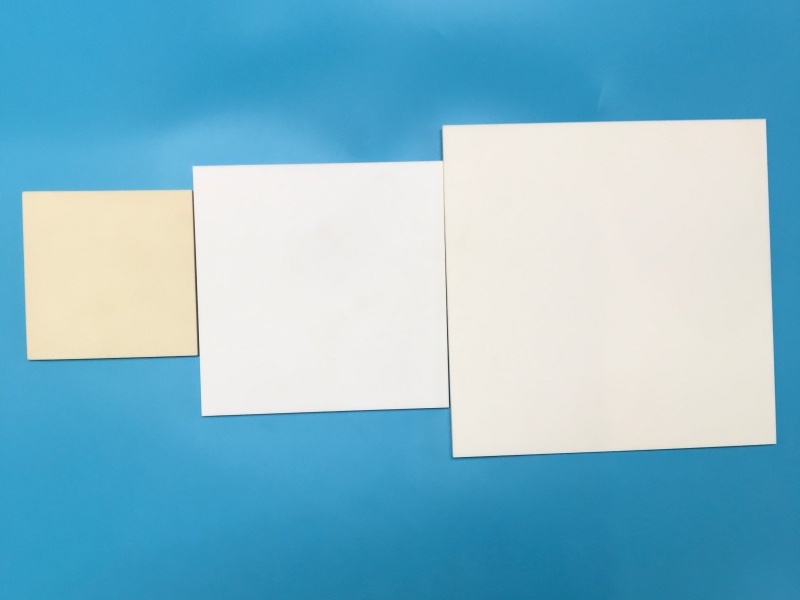
Two Core Challenges in ZTA Fabrication: Phase Control and Microstructural Homogeneity
Challenge 1: Phase Transformation Stability Control
Zirconia particles are the key functional component enabling the strengthening and toughening of ZTA composite alumina substrates. Their toughening value relies on a stress-induced crystal structure transformation mechanism. When cracks initiate and propagate in the alumina matrix, stress causes surrounding zirconia particles to undergo a crystal structure change. The associated volume expansion counteracts the cracking stress, hindering further crack extension and optimizing the damage resistance of components like alumina spacers and plates. For this toughening mechanism to function stably, the zirconia particles must maintain a metastable crystal structure at room temperature, transforming only under external load. If temperature control during the sintering and cooling of ZTA substrates is off, the zirconia particles may undergo spontaneous transformation without external force. This uncontrolled volume change generates numerous microcracks within the alumina matrix, completely eliminating the toughening effect and, in severe cases, directly causing cracking and damage to the alumina substrate or ceramic spacer.
Challenge 2: Microstructural Homogeneity Control
The mechanical properties, thermal resistance, and corrosion resistance of ZTA ceramic substrates, spacers, and rods are highly determined by the microscopic distribution uniformity of the two constituent materials. When zirconia particles are uniformly dispersed at the grain boundaries of the alumina matrix, they can constrain excessive grain growth of alumina, enhancing the structural strength of various alumina-formed components. This ensures stable toughening across the entire area of plates or rods, preventing performance discrepancies caused by particle aggregation. Due to the significant density difference between alumina and zirconia, conventional mechanical mixing often leads to sedimentation and aggregation of zirconia particles, creating localized zirconium-rich zones. This disrupts the uniform microscopic arrangement of various ZTA alumina profiles, ultimately degrading the overall quality of products like alumina substrates and spacers.
Optimizing the Fabrication Process
1. Powder Preparation
The microstructure of alumina-zirconia composite ceramic substrates is determined by powder quality. Qualifying powders must meet five requirements: uniform dispersion of the two phases without agglomeration; fine particle size with a narrow size distribution; predominantly tetragonal zirconia; absence of hard agglomerates for uniform forming filling; and appropriate moisture content to avoid die sticking or insufficient particle bonding.
Various liquid-phase methods are common approaches for uniform mixing, including suspension dispersion, sol-gel, and coprecipitation. Suspension dispersion relies on dispersants and pH adjustment to prepare slurries, requiring multiple steps and complex processing. Sol-gel and coprecipitation can achieve molecular-level mixing but demand strict control over temperature, pH, and reaction time; parameter deviations can easily cause abnormal reactions, grain deformation, or phase changes.
The non-aqueous precipitation coating process utilizes an organic solvent system where metal precursors and precipitants undergo complexation-precipitation, forming a complete coating layer on the surface of alumina particles. Upon sintering, this core-shell powder results in zirconia being concentrated at alumina grain boundaries, inhibiting grain growth and eliminating powder agglomeration.
After mixing, spray drying granulation is needed to obtain spherical powder with good flowability, ensuring uniform die filling. The type and amount of binder must be precisely controlled.
2. Compression moulding
Transforming loose ceramic powder into a green body with sufficient initial strength and a trend toward internal uniformity is the fundamental goal of the forming process. For ceramic substrate products, the industry primarily employs two main routes: die pressing (uniaxial or biaxial) using a mold, and tape casting using a thin layer of slurry spread onto a carrier.
Die pressing is typically suitable for products with relatively simple shapes but high requirements for dimensional precision and mechanical properties. The most challenging aspect is avoiding density gradients within the green body. Isostatic pressing, using liquid as the pressure transmission medium, offers an effective solution—since pressure is applied uniformly from all directions, powder particles experience balanced forces, resulting in a green body with high packing density, fine pore characteristics, and good spatial uniformity. For alumina-based ceramics, this uniform pressure application significantly suppresses delamination defects in large-sized bodies.
Tape casting demonstrates unique advantages in manufacturing large-sized, thin ceramic substrates. The process generally involves: a ceramic slurry with appropriate rheological behavior being spread into a thin layer by a moving carrier, followed by leveling, solvent evaporation and solidification, cutting to size, stacking multiple layers, and applying uniform pressure at a constant temperature to produce the green sheets. This process offers flexibility in thickness control, accommodating a wide range from thin to medium thicknesses, making it especially suitable for large thin plates required in high-density packaging. Throughout the process, slurry rheology significantly impacts layer quality and must be maintained within an appropriate range. Additionally, the thin layer is sensitive to environmental conditions during solvent removal. If surface drying proceeds too quickly, a closed film may form prematurely, hindering continued solvent escape from the interior, leading to surface wrinkling or internal defects. For zirconia-toughened systems, precise control of the drying regime is particularly crucial due to their higher specific surface area and surface activity, which increase the risk of microcrack propagation. The alumina-zirconia composite system also imposes stricter demands on slurry stability, narrowing the process window for tape casting.
3. Sintering
The sintering stage is decisive for finalizing the microstructure of ZTA ceramics and fully releasing their performance capabilities. This process requires balancing three core objectives: achieving full densification, effectively suppressing excessive grain growth, and maintaining the metastable tetragonal zirconia (t-ZrO₂) phase at room temperature.
Regarding the selection of sintering aids, their role extends beyond merely lowering the sintering temperature and limiting grain coarsening. For the ZTA system, certain additives also substantially interfere with the phase transformation behavior of zirconia. For example, yttria (Y₂O₃) can dissolve into the zirconia lattice, introducing oxygen vacancies that enhance the structural stability of the tetragonal phase during cooling. Simultaneously, it catalyzes interparticle matter transport, synergistically promoting densification and improving final mechanical properties. However, relying on a single aid often fails to meet all requirements. Industrial practice tends toward using multi-component additive systems, the specific composition and addition levels of which must be optimized based on the base formulation characteristics and process conditions to find the best compromise between phase transformation temperature control and toughening efficiency.
Concerning the temperature profile, conventional sintering usually follows a stepped heating strategy, reaching a target holding temperature for a certain duration before cooling. Shrinkage and pore elimination predominantly occur within a narrow temperature window during the later stage of sintering. Unfortunately, this interval also coincides with the most active grain boundary migration, which can easily trigger rapid grain growth. Such excessive growth not only reduces the final density but also weakens the pinning effect of zirconia particles on boundary movement, inducing destabilization of the metastable tetragonal phase into the monoclinic phase. To overcome this dilemma, recent advances include novel techniques like two-step sintering, hot pressing (applying mechanical pressure), and spark plasma sintering (based on plasma activation effects). These methods enable densification under relatively lower thermal conditions, effectively controlling grain size while preserving the functional reserve of the tetragonal phase. Furthermore, the heating and cooling rates should not be overlooked. Excessive thermal shock can easily induce cracking or residual stress within the body, compromising structural integrity and service reliability.
Conclusion
The substantial performance enhancement of ZTA ceramic substrates fundamentally depends on the precise dual control of the material's internal microstructure: achieving a high degree of "uniformity" and precisely managing the "phase transformation behavior." Throughout the entire fabrication chain—from the effective management of powder characteristics in the initial stage, to achieving a uniformly dense green body during forming, to successfully retaining the metastable phase in the final sintering step—each operation profoundly impacts the spatial distribution of the zirconia component and its phase transformation response capability. Only by systematically identifying and synergistically optimizing the key influencing factors in each of these process steps can ZTA ceramics fully mobilize their toughening potential while maintaining excellent thermal conductivity. This enables them to meet the stringent demands for long-term stable operation and service durability in high-voltage, high-power application scenarios, thereby laying a more robust materials foundation for the engineering advancement of next-generation power electronics modules.


 EN
EN