Production Process of Quartz Flanges:
- Raw Material Selection: High-purity natural quartz crystals or synthetic silica sand are chosen as the starting material. The silica content typically exceeds 99.9% to ensure superior properties.
- Melting: The raw material is heated to an extremely high temperature (above 1700°C) in a vacuum or inert atmosphere furnace (often an electric resistance or induction furnace) to melt it into a viscous, bubble-free molten quartz.
- Forming: The molten quartz is then shaped into flanges using one of several methods:
- Molding: Pouring into precision graphite or ceramic molds.
- Centrifugal Casting: Spinning the mold to form hollow cylindrical shapes which are later machined.
- Hot Pressing/Finishing: Forging the heated quartz blank under pressure for densification and near-net-shape forming.
- Annealing: The formed flanges undergo a controlled, slow cooling process in an annealing furnace. This relieves internal thermal stress, preventing cracking and ensuring structural stability.
- Precision Machining: The annealed blanks are meticulously machined using diamond-coated tools. This includes grinding, cutting, drilling, and lapping to achieve the final dimensions, surface finish (often optical grade), flatness, and precise sealing surfaces (e.g., Ra < 0.4 μm).
- Cleaning & Quality Inspection: Rigorous cleaning (e.g., ultrasonic, acid cleaning) removes contaminants. Each flange is inspected for dimensions, visual defects (bubbles, inclusions), and optical properties. Advanced methods like laser interferometry check flatness and parallelism.
Advantages of Quartz Flanges:
- Exceptional Thermal Stability: Extremely low coefficient of thermal expansion (~5.5 x 10⁻⁷/K) makes them highly resistant to thermal shock. They can withstand rapid heating and cooling from 1000°C to room temperature without cracking.
- High-Temperature Resistance: Can operate continuously at temperatures up to 1100°C and briefly up to 1300°C, maintaining structural integrity where metals would soften or creep.
- Superior Chemical Purity & Inertness: Made from high-purity SiO₂, they are non-porous and highly resistant to corrosion by most acids, halogens, and aggressive chemicals (except hydrofluoric acid and hot phosphoric acid). This prevents contamination in sensitive processes.
- Excellent Optical Properties: High transparency across a broad spectrum from UV to near-infrared. This allows for visual process monitoring, UV transmission, and use in laser applications.
- Outstanding Electrical Insulation: High dielectric strength and low electrical conductivity even at elevated temperatures,making them ideal for semiconductor and vacuum applications.
-
High Mechanical Strength & Rigidity: While brittle, fused quartz has high compressive strength and maintains its shape under load at high temperatures, unlike many polymers.
- Ultra-High Vacuum Compatibility: Extremely low gas permeability and outgassing rates. When properly baked, they contribute to achieving and maintaining ultra-high vacuum (UHV) environments.
- Long Service Life & Dimensional Stability: Resists weathering, does not degrade or age under typical conditions, and maintains precise dimensions over time due to its stability.
-
Primary Applications: Semiconductor fabrication (etching, diffusion, CVD/LPCVD chambers), fiber optics, precision optics, laser systems, laboratory and analytical equipment, high-temperature sight glasses, and specialized lighting (high-intensity discharge lamps).
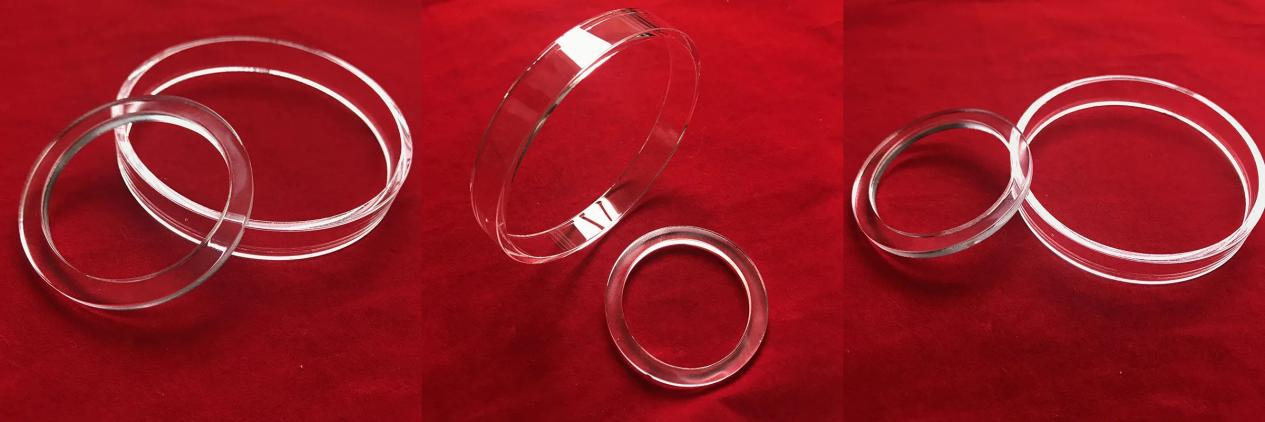
Primary Application Fields and Uses of Quartz Flanges
Quartz flanges are critical components in demanding industries due to their unique combination of properties. Their main applications and specific uses are as follows:
- Semiconductor & Microelectronics Manufacturing
- Use: As viewing ports, chamber liners, gas inlets, and diagnostic ports in wafer processing equipment.
- Key Equipment: Plasma Etchers, Chemical Vapor Deposition (CVD) and Low-Pressure CVD (LPCVD) reactors, diffusion furnaces, and ion implanters.
- Reason: Their purity prevents silicon wafer contamination, and their transparency allows for in-situ process monitoring.
- Optical & Photonics Industries
- Use: As end windows, laser tube housings, and mounting components.
- Key Applications: High-power laser systems, UV and IR optical systems, spectrophotometer cells, and astronomical telescope mirrors (for low thermal expansion substrates).
- Reason: Exceptional UV to IR transmission and minimal thermal distortion under high-intensity light.
- High-Purity/Low-Pressure Chemical Processing
- Use: As reactor liners, sight glasses for corrosive fluids, and connecting components in pilot plants.
- Key Processes: Handling ultrapure acids, halogen gases, and high-temperature specialty chemicals.
- Reason: Superior chemical inertness ensures product purity and resists attack from all acids except hydrofluoric and hot phosphoric.
- Use: As the envelope (outer bulb) for high-intensity discharge lamps.
- Key Products: Mercury vapor lamps, xenon arc lamps, and UV sterilization lamps.
- Reason: Withstands extremely high operating temperatures (>1000°C) and transmits UV light efficiently.
- Scientific Research & Analytical Instrumentation
- Use: As windows for vacuum chambers, sample holders in furnaces, and components in mass spectrometers.
- Key Environments: Ultra-High Vacuum (UHV) systems, electron microscopes, and space simulation chambers.
- Reason: Extremely low outgassing and high dimensional stability under vacuum and thermal cycling.
- Specialized Industrial Processes
- Use: As protective sight ports in high-temperature furnaces (e.g., crystal growth furnaces like Czochralski pullers) and flow components in fiber optic preform manufacturing.
-
Reason: Maintains clarity and integrity in continuous high-temperature operation, allowing visual control of the process.
Technical Specifications
Property Content |
Property Index |
Density |
2.2×10³kg/cm³ |
Strength |
580KHN100 |
Tensile Strength |
4.9×10⁷Pa(N/㎡) |
Compression Strength |
>1.1×10⁹Pa |
Coefficient of Thermal Expansion |
5.5×10⁻⁷cm/cm℃ |
Thermal Conductivity |
1.4W/m℃ |
Specific Heat |
670J/kg℃ |
Softening Point |
1680℃ |
Annealing Point |
1215℃ |



 EN
EN