The atoms of silicon nitride ceramics are bonded together by strong covalent bonds, which is an inherent property that makes this inorganic non-metallic ceramic very difficult to achieve dense sintering. During processing, not only must it withstand a high-temperature environment of over 1800℃, but it also needs to maintain sintering pressure for a long time. The extreme processing environment is prone to causing internal pores and cracking problems in the green body, directly weakening the material's mechanical performance and overall functional reliability. To solve this preparation problem, the industry has developed various different sintering processes.
1.Pressureless sintering
In the process of preparing silicon nitride through atmospheric pressure sintering, there is a core contradiction: the densification process of the material competes with the high-temperature decomposition reaction of silicon nitride. This problem becomes more pronounced in the formulation system that includes magnesium-based additives. To improve the densification effect of the green body under atmospheric conditions, the industry will use yttrium oxide combined with magnesium oxide, or yttrium oxide, aluminum oxide, and aluminum nitride in combination as auxiliary sintering components to prepare silicon nitride. After extensive verification, the two formulations of yttrium oxide + aluminum oxide and yttrium oxide + magnesium oxide have become the mainstream choices in the market. This process has not yet been widely applied in specialized composite fields. However, as long as it is combined with appropriate processing techniques and non-destructive testing to eliminate internal defects, the silicon nitride components produced by atmospheric pressure sintering can be used for high-reliability equipment accessories.

2.Reaction Sintering (RBSN)
The production of porous reaction-sintered silicon nitride starts with the preparation of ceramic blanks from finely ground silicon powder after compression treatment. The blanks are placed in a nitrogen or ammonia atmosphere and continuously heated at a temperature range of 1000 - 1450°C. During this process, the silicon powder undergoes a nitridation reaction, resulting in a mixed crystal phase composed of α-Si3N4 and β-Si3N4. This nitridation process causes a volume expansion of approximately 22%, but the voids left between the particles of the blank can counteract this expansion effect. During the sintering process, the size of the blank hardly undergoes shrinkage deformation. Due to this feature of maintaining a constant size, this process is highly suitable for manufacturing special-shaped ceramic blocks, special-shaped bushings, and the base of intervertebral spacers. After sintering, no further machining with diamond tools is required, and it has significant cost advantages. Even if the porosity of the finished product remains at 20% - 30%, these components still maintain excellent mechanical properties, with a bending strength of up to 350 MPa.
3.Hot Pressing Sintering (HP)
The hot-pressing sintering process cannot densify the silicon nitride preform without adding any additives. Therefore, magnesium-based materials such as magnesium oxide and magnesium nitride are mixed into the powder system as sintering aids. The optimal addition amount of the additives is preferably controlled within the range of 3.3-5.0 wt.%. During the processing, a mechanical pressure of 23 MPa is applied to the preform, and the sintering temperature is set at 1800±50℃, with a holding time of 4 to 18 minutes. This process can produce dense ceramic parts with a relative density higher than 99.9%, and the finished product's bending strength can reach 690±20 MPa. With its extremely high density, the hot-pressing sintering process can be used to manufacture products with strict mechanical performance requirements, such as silicon nitride bearings, silicon nitride ceramic rods, and silicon nitride wear-resistant balls. This solution has also been implemented in industrialization.
4.Gas Pressure Sintering (GPS)
The core function of the pressure sintering process is to solve the industry problem of the easy decomposition of silicon nitride during high-temperature sintering. This process achieves this by introducing high-pressure nitrogen gas into the sintering chamber, creating a high-pressure protective atmosphere, which effectively reverses and inhibits the high-temperature decomposition reaction of silicon nitride, ensuring the structural integrity and stable performance of the preform during the high-temperature densification process. With excellent densification effect and material stability, the pressure sintering process can produce large-scale high-temperature-resistant silicon nitride crucibles and long-tube silicon nitride ceramic tubes, as well as other high-precision and high-temperature-resistant structural components. The silicon nitride products prepared by this process have overall performance highly similar to those produced by mainstream sintering processes, and have excellent comprehensive performance, presenting broad industrial application prospects.
5.Sintering reaction combined with silicon nitride (SRBSN)
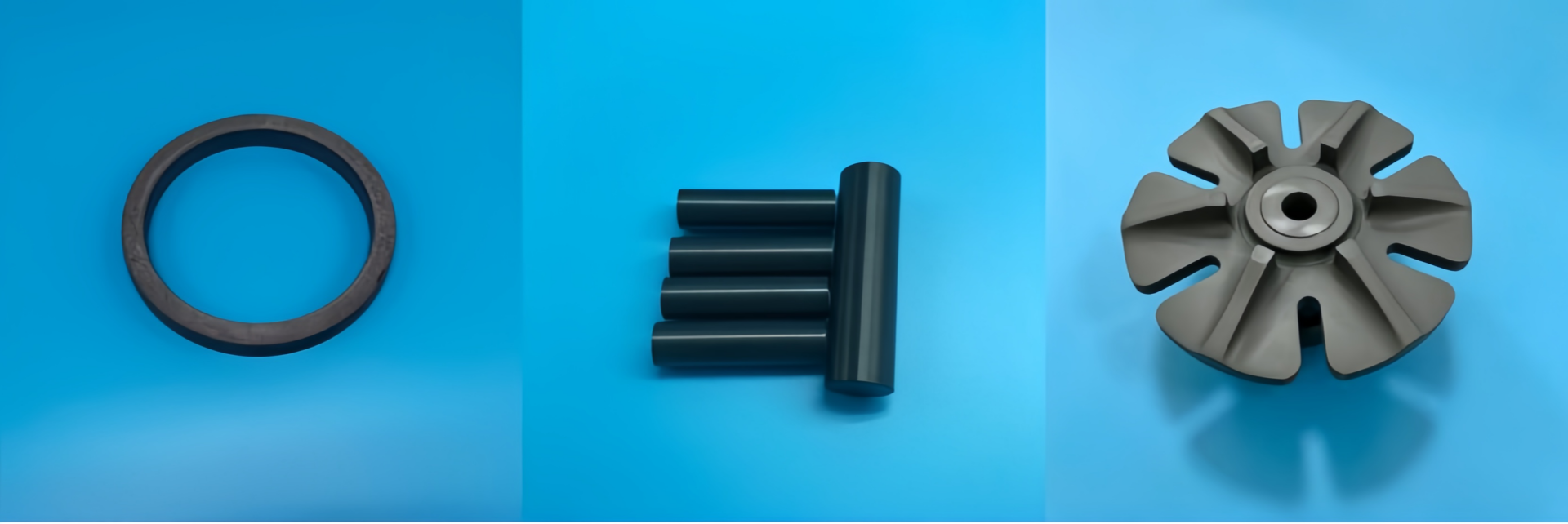
To improve the sintering behavior of the green bodies, alumina, silica and calcium oxide, which are auxiliary sintering components, are added to the silicon powder raw material. The entire preparation process is divided into two heating stages. Firstly, in an atmosphere containing hydrogen or argon and nitrogen, a long-term nitridation reaction is carried out at 1400℃, with the process duration lasting 150 to 300 hours. After the nitridation is completed, it is transferred to a high-pressure sintering environment, where it is held at a temperature range o f 1700 to 1950℃ for 1 to 2 hours. The nitrogen gas pressure in the environment is adjusted to be within the range of 0.21 to 2.1 MPa. Through this process, the density of the green bodies can exceed 86% of the theoretical density. If the nitrogen gas pressure inside the sintering chamber is further increased to over 10 MPa, the density of the green bodies can rise to 98% of the theoretical value, and the bending strength of the components can also reach 750 MPa. With good forming accuracy and controllable processing costs, this process can be used to produce heavy-duty silicon nitride ceramic rings and large-sized silicon nitride ceramic plates. After densification modification, the physical and mechanical properties of these components have already been able to match the performance of high-performance silicon nitride sintered parts on the market.
6.Discharge Plasma Sintering (SPS)
The discharge plasma sintering process relies on the direct action of pulsed current on the powder compact, and uses resistance heating to rapidly increase the temperature of the compact. It can achieve dense solidification without the need for long-term high-temperature holding. This short-term high-temperature processing mode can inhibit the continuous growth of crystal grains, avoid abnormal phase transformation, retain the fine micro-crystalline structure of the material, and enable components to obtain more excellent mechanical properties. This process is suitable for processing ultra-thin silicon nitride ceramic sheets and miniature silicon nitride positioning pins, which are precision small parts. Compared with conventional sintering schemes, the entire process takes less time, the processing rhythm is faster, and it can significantly shorten the overall processing cycle of silicon nitride components.


 EN
EN